
Anatomy of a Political Cartoon
A brief analysis of how creative ideas happen
I was a Madison Avenue creative director for three decades. I’ve created thousands of ideas for ads and commercials. I’ve written books and op-ed columns. And have a long history of doodling disrespectful cartoons.
People sometimes ask:
“Where do you get all your ideas?”
I tell them it gets easier with practice. I even wrote a book about my six-step process for idea-making (Simon & Schuster). So, I definitely don’t need any outside help coming up with ideas.
Until (as recently happened) I do.
But first, an important digression
The creative directors of ad agencies are talented men and women who (almost always) work their way up through the ranks of the copy department or the art department. And we’re very social. We know other creative directors at other ad agencies. We get together at convivial lunches, impromptu gabfests at editing houses, and regularly catch up with our fellow CDs at awards ceremonies and industry conventions.
And we trade stories.
You might mention your latest location shoot. (“Have you shot in Fiji yet? It’s waaay cool! Stick a palm tree in your next storyboard — and pitch it to your Pepsi client.”)
You might brag about your latest gold trophy. (“Yeah, winning that Grand Prix Lion at Cannes was a kick. I was staying at the Hotel Majestic and my happy client sent Cristal and beluga up to the room.”)
Or you might tell your latest celebrity story. Maybe mention your Lincoln shoot when you and the brand’s spokesperson, Matthew McConaughey, ducked out for a crazy evening of boilermakers. (“Matt — I call him Matt — even gave me his private email.”)
And sometimes you tell your worst advertising war story. The campaign that flopped. The location shoot that got hammered with four straight days of rain. The celeb who was doing drugs in his trailer. But the most-demeaning stories are variations of this harrowing theme: “The-CEO’s-wife-has-an-idea.”
It spins out something like this
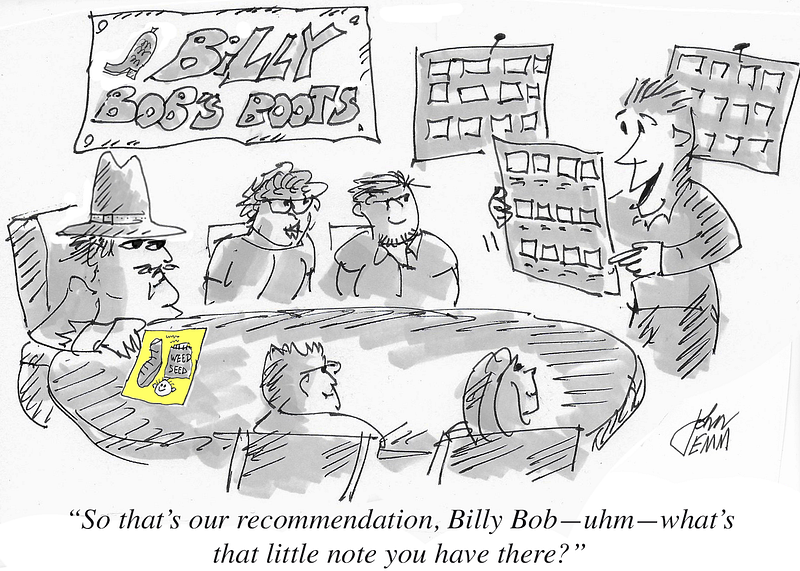
Imagine that Billy Bob’s Boots is a new client at your agency. It’s a growing company that makes cowboy boots, workplace boots, and hiking boots. The CEO (Billy Bob) founded the company and still calls all the shots. His innovative boot designs use high-quality materials. With savvy niche pricing, he’s built his little venture into an industry-leading brand.
The client is important to your agency. Your assignment is to introduce their newest product. Create a splashy commercial for their line of rugged boots for off-trail biking. The brand name of the line: Billy Bob’s Bush Busters.
You put a couple of creative teams on this and give them a week. You also get involved yourself and do some personal research. The process will usually yield a dozen or so rough TV concepts. As creative director you select the best three ideas. The art department develops three finished storyboards.
Now you fly to Dallas to present this work in a big conference room at the Billy Bob corporate offices. Attending are Billy Bob (himself!), a marketing VP, an ad manager, and two young product managers.
You stand up at your end of the table and recap the assignment. Then you talk about how the agency—and you, in particular—looked for solutions to the creative challenge.
“I drove to Maine two weeks ago. I was wearing a pair of Bush Busters — your Exxtreme 1000 model — and put them through a mean-ass bicycle torture test. Man, I sure do love that boot!”
(CLIENTS GLOW WHEN THEY LEARN THE AGENCY CREATIVE GUY HAS ACTUALLY USED THEIR PRODUCT—AND HE TRULY LIKES IT.)
Then you pull out the first of your three storyboards.
“This first commercial uses a slo-mo camera mounted at pedal level. The viewers will feel like they’re riding on the toe of the boot. They’ll see your boot working hard — at ground level — as it rips through hardscrabble country.” You explain all the visuals and then read the copy. The wrap-up line is: BILLY BOB’S BUSH BUSTERS—GET THE LOWDOWN.
Now you pull out a second storyboard. “This spot uses computer animation and features two cartoon characters,” you say. “There’s a thorny briar bush who’s complaining to a scrawny poison ivy vine. The briar bush is really pissed off. We hear it say: ‘Those damn Billy Bob Bush Busters messed me up right down to the roots!’ You read poison ivy’s response. “Hey, briar dude — tell me about it!” Then you deliver the wrap-up: BILLY BOB’S BUSH BUSTERS—NOT RECOMMENDED BY WEEDS.
“Those two spots are pretty good,” you say. “But check out this next one.”
Your third storyboard shows a real chimp riding an off-trail bike through a hellscape of barbs, briars, sticky vines, and swampy pits. The chimp is grinning and hooting maniacally as he plows through wilderness obstructions like a hot knife through butter. You read the copy and intone the wrap-up: BILLY BOB’S BUSH BUSTERS—FOR CHIMPS, NOT FOR CHUMPS.
You explain that the agency did focus-group testing with off-trail bikers. “The first two spots got a lot of likes,” you say, “but the chimp spot blew the doors off. It scored best—by far—in brand awareness. And the ‘intent-to-buy’ numbers were off the charts.”
The pitch—asking for the order
“So that spot is our recommendation. What do you think, Billy Bob?”
Billy Bob clears his throat.
“Wal, now, I’m jes not fond of chimps—them things are damn smelly beasts. But at breakfast this mornin,’ Mrs. Billy Bob had an idea.” (He is unfolding a scribbled piece of note paper.)
“Lemme show you this here commercial.”
(YOUR THOUGHT: Oh shit—here we go.)
Mike Tyson just took a swing at your gut. But you’re still on your feet. This is going to require the unique skills of seeming acceptance, combined with subtle rebuttal, while adding a sprig of gentle persuasion. You start by opening the door.
“Sure, Billy Bob—we’ll take a great idea from anywhere. I’d love to hear it.” (This is a lie. Agencies have a fierce pride about originating ALL ideas for their produced creative work. Clients make the products. Agencies make the ads. End of story.)
So you let Billy Bob ramble on about his wife’s idea to include a packet of weed seeds with every pair of boots.
“Y’see?” says Billy Bob. “A buyer gets to grow his own weeds—the kind with them really sticky burrs. Then he can put on his Bush Busters and go rippin’ through the weeds on his bike.”
If the CEO is not a total narcissist, he’ll spot the glum faces and avoiding eyes around the table. Hmmm. My own team think the idea sucks.
You may not have to say a thing.
“Wal, maybe that’s a crappy idea. Show me your chimp storyboard again.”
During my ad career, I did have a couple of clients who tried to push their own (or their wife’s) idea—but, happily, none succeeded. Nevertheless, there are probably ten thousand creative directors who can’t make that statement. And they cringe when telling their stories.
In the early 1990s I had a client who never did this. Alan Silberstein was EVP Retail and Marketing at Midlantic Bank, a scrappy New Jersey-based regional bank. He was probably the brightest client I’ve ever worked with—a metallurgical engineer with an MBA from Harvard. And he was a dream client. The brief was always clear and strategic. His response to creative recommendations was decisive and crisp. “That’s great — let’s do it.”
My agency had a profitable run with Midlantic. And our ad campaigns helped build the bank’s business. Maybe we did too good a job? In 1995, the giant PNC bank acquired Midlantic for $3 billion. And where did that leave us? PNC had a big ad agency doing all their advertising—and we were a small shop handling the smallest bank in their portfolio. That story ends only one way. We reluctantly bid adieu to Silberstein.
Happily, he and I have stayed in touch over the years. We exchange calls and emails often. Before the Covid pandemic we met for lunch once a month. The only topic on the menu: Innovation — in all its forms.
Last week he sent me an email with the subject line: cartoon idea
Hi John,
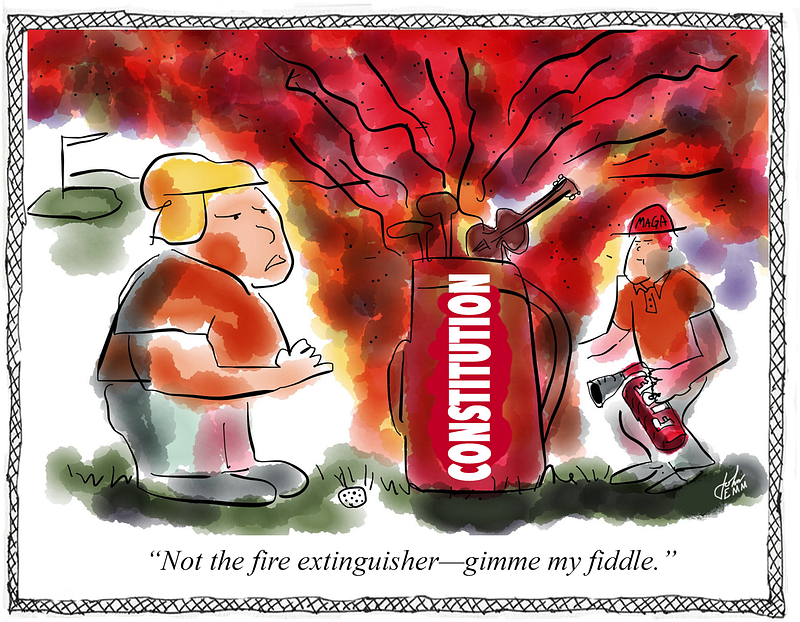
Carol has an idea that Trump on the golf course could be equated to Nero playing the violin. But we can’t think of the right “execution” nor can we draw. Can you take this to the next level?
Happy Thanksgiving! Alan
Jump inside my head and eavesdrop
Damn! The creative guy’s worst nightmare—“the client’s wife has an idea.”
My first reaction was to ignore the email. If asked about it later I’d just say: “Oh, sorry—must’ve missed that one.”
But then I thought:
Alan is a great pal—don’t be a jerk—go ahead and do a quick scribble . . .
A word about ideas
His wife Carol’s insight—Trump/golf course/Nero/violin—is not an actual idea. Rather, it’s a description of the place where the idea lives. I like to picture colorfully descriptive words—like Carol’s phrase above—as an “idea corral.” They outline an enclosure that’s like a corral. Inside its fences thousands of actual ideas mill around like unbroken horses. The vast majority of these idea ponies will be mundane or expected. Some will be downright lame. A few will show glimmers of promise. But somewhere in that whirling mass of horseflesh is a prancing brainstorm—a spirited stallion snorting for attention.
As creative director, it’s your job to find the stallion.
Here’s how it worked
I started fooling around with it using a sketch app on my iPad. Let my thoughts wander as my stylus began to scribble.
Hmmm. Something on a golf course . . .
Trump’s golf bag in flames . . .
And, of course, HE set the fire.
Hmmm. The roaring flames are something like Covid-19. He’s hoping the growing pandemic disaster will distract Americans while he claims non-existent voter fraud—and tries to steal the election. And sabotage the Constitution . . .
Wait! I should label the golf bag as CONSTITUTION . . .
Hmm. Carol mentioned Nero’s violin—I’ll stick a fiddle in the flaming bag . . .
And put a fire extinguisher in the caddy’s hand . . .
But Trump doesn’t want to use it . . .
By then I was starting to think:
Sonofabitch, this is actually pretty good.
At that moment, my wife looked over my shoulder at the iPad:
“Wow! I love that!”
So thanks, Carol. It’s always fascinating to watch the elusive creative process wander to an eventual conclusion.
LIFE LESSON: Here’s some timeless advice for every creative person on the planet. Take a good idea wherever you find it.
After all, an idea unused may be an opportunity lost.
Create well!
Quick video about thinking up ideas.