

Analyzing Employee Reviews: Google vs Amazon vs Apple vs Microsoft
Which company is it worth working for?
Overview
Whether it is for their ability to offer high salaries, extravagant perks, or their exciting mission statements, it is clear that top companies like Google and Microsoft have become talent magnets. To put it into perspective, Google alone receives more than two million job applications each year.
Working for a top tech company is many people’s dream, it was certainly mine for a long time, but shouldn’t we be asking ourselves “Is it really worth working for one of these companies?” Well, who better to help us answer this question than their own employees. In this article, I will walk you through my analysis of Employee Reviews for Google, Microsoft, Amazon and Apple and try to uncover some meaningful information that will hopefully illuminate us when deciding which company it’s worth working for.
I will start by describing how I cleaned and processed the data, and then talk about my analysis with the help of some visualizations. Let’s get started!!
Data
Data Collection
The employee reviews data used for this analysis was downloaded from the Kaggle Datasets and it was sourced from Glassdoor — a website where current and former employees anonymously review companies and their management. The dataset contains over 67k employee reviews for Google, Amazon, Facebook, Apple and Microsoft.
The reviews are separated into the following categories:
- Index: index
- Company: Company name
- Location : This dataset is global, as such it may include the country’s name in parenthesis [i.e “Toronto, ON(Canada)”]. However, if the location is in the USA then it will only include the city and state[i.e “Los Angeles, CA” ]
- Date Posted: in the following format MM DD, YYYY
- Job-Title: This string will also include whether the reviewer is a ‘Current’ or ‘Former’ Employee at the time of the review
- Summary: Short summary of employee review
- Pros: Pros
- Cons: Cons
- Overall Rating: 1–5
- Work/Life Balance Rating: 1–5
- Culture and Values Rating: 1–5
- Career Opportunities Rating: 1–5
- Comp & Benefits Rating: 1–5
- Senior Management Rating: 1–5
- Helpful Review Count: A count of how many people found the review to be helpful
- Link to Review : This will provide you with a direct link to the page that contains the review. However it is likely that this link will be outdated
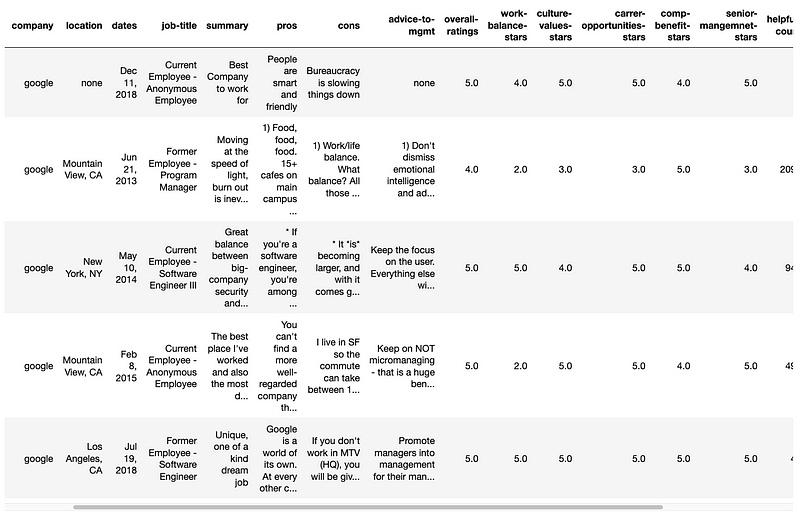
Here is what the data looks like in tabular form:
Data Cleaning
After doing some basic data exploration, I decided to do the following to get the data ready for my analysis:
- Only include employee reviews for Google, Amazon, Microsoft and Apple. Although Facebook and Netflix had a good number of reviews, combined, they represented less than 4% of the dataset, so I decided to exclude them from this analysis for simplicity purposes.
- The “Link” and “Advice to Management” columns were dropped since I didn’t think they would be as insightful as the other columns.
- Rows with missing values in the “Date” column were dropped.
- A new column named “Year” was created containing the different years when the reviews were made.
- Rows with missing values in the following columns were dropped: “company”, ‘year’, “overall-ratings”, and “job-title”.
- Rows with missing values in all columns were dropped.
- Columns containing numeric values were converted to the appropriate data type.
Insights & Analysis
Which company has the most reviews?
I began my analysis by visualizing the distribution of employee reviews for each of the 4 companies I selected.
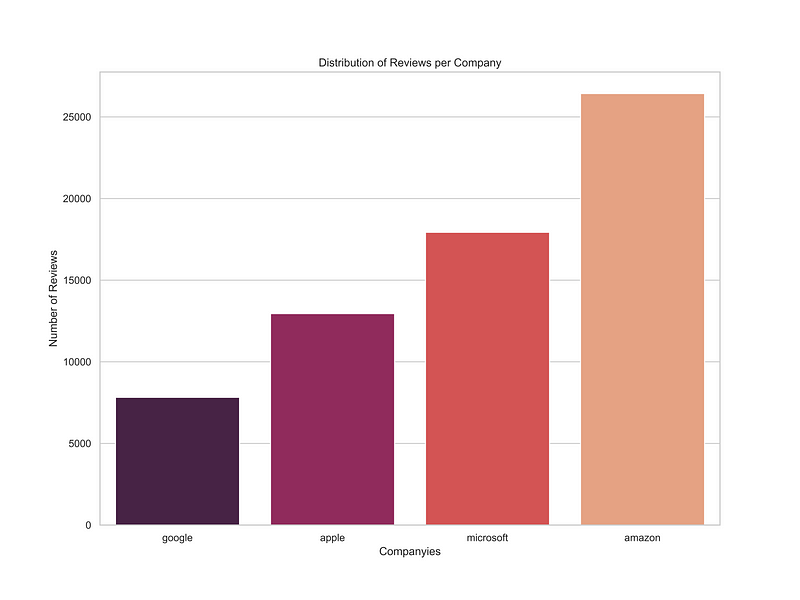
Interpretation: We can clearly see that Amazon has the most employee reviews (over 25,000). This is great since it probably means that we’ll see good mix of opinions. Although Google has the least amount of employee reviews, it is still large enough to be significant and be able to compare it to the other companies.
Lets take a look at how these reviews are distributed throughout the years for each company.
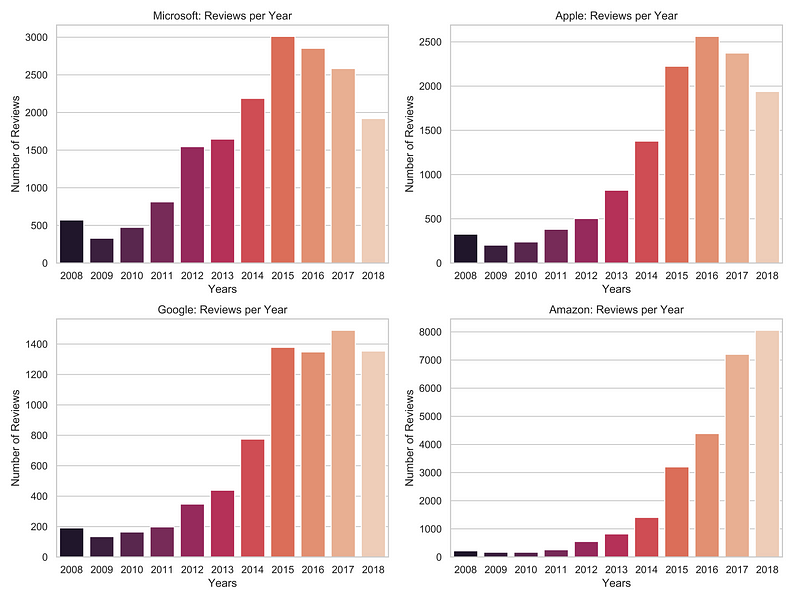
Interpretation: As we can see, there is a decade worth of employees reviews available, but they only go up to 2018.
- Microsoft: Most reviews are from the past 4–7 years
- Google: Most reviews are from the past 4 years
- Amazon: Most reviews are from the past 3–4 years
- Apple: Most reviews are from the past 2–4 years
Based on these observations and considering how fast these companies are growing and changing every year, I decided to continue my analysis with employee reviews from the last 4 years available (2015 to 2018), since I believe they will be the most relevant.
Who is reviewing?
Now that we know how many reviews we are dealing with, let’s figure out who is writing them. This question can be answered in many different ways and my first approach was to figure out the job title of the reviewers, here is what the top 5 looks like:
Anonymous Employee               21910
Software Engineer                  930
Specialist                         648
Software Development Engineer      618
Warehouse Associate                585
Unfortunately, most of the job titles are labeled “Anonymous Employee”. Considering that often times companies have a slightly different titles for the same job, I decided to not dig any deeper. Instead, let’s take a look at how many of the reviewers are current and former employees
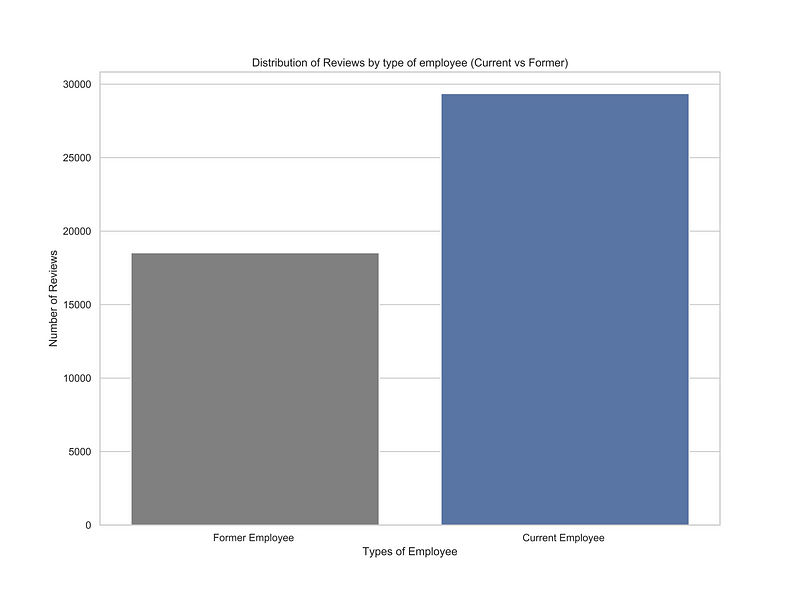
As we can see, most of the reviews come from current employees, but to get some more insight let’s see what this distribution looks like for each company:
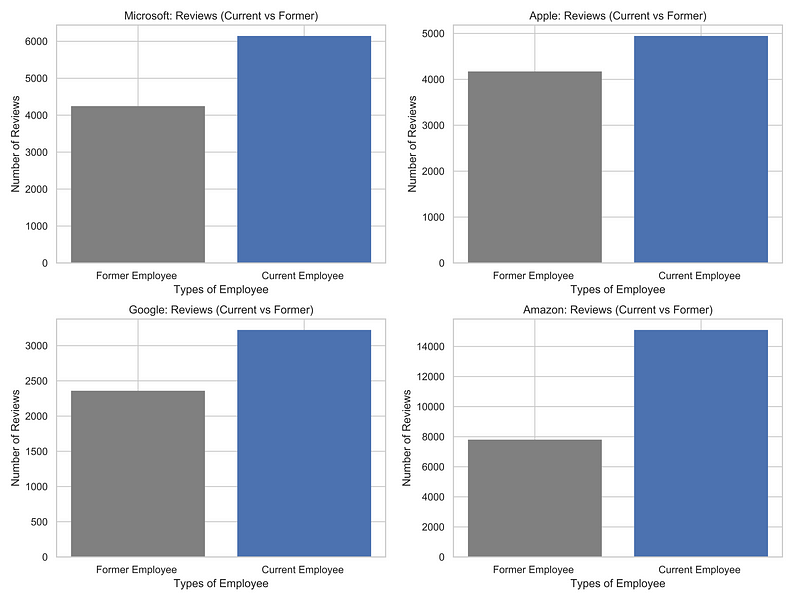
Interpretation: Once again, we see that most of the reviews for each company are from current employees. These are a few thoughts that came to mind when trying to interpret the data: Is having a large number of reviews from current employees a good thing or does it mean more bias? Perhaps, having more reviews from former employees could give us the type of insights that we don’t often read about these companies. Let’s continue…
Which company has the highest overall rating?
Let’s take a look at how the average overall rating for each company has changed over the past few years (2015–2018)
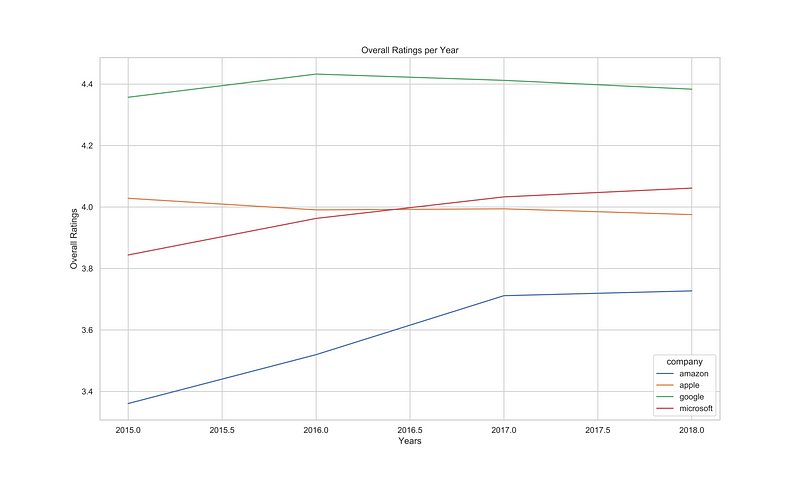
Interpretation: We can see that the average overall rating for every company, except Apple, has not decreased since 2015. Google holds the highest average overall rating among the 4 and it has remained that way for the past couple of years. Lets talk about the trends for each company:
- Google: Seems to have started decreasing slightly since 2016.
- Microsoft: Increasing slowly since 2015
- Apple: Seems to be decreasing slowly.
- Amazon: Has increased dramatically from 2015 to 2017.
Which company offers better Work-Life Balance?
Let’s find out how good these companies are at allowing their employees to have a life outside of work:
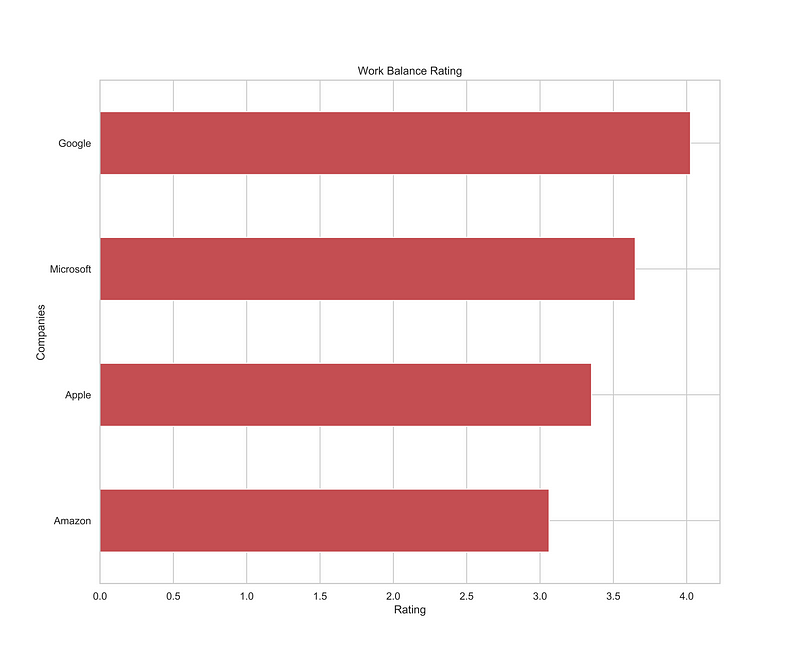
Interpretation: Google has the highest work-life balance rating (over 4 stars) and Microsoft comes as a close second. Amazon seems to fall short when it comes to providing good work-life balance.
Which company has better Culture Values?
Let’s find out how the employees the rate core principals and ideals of their company:
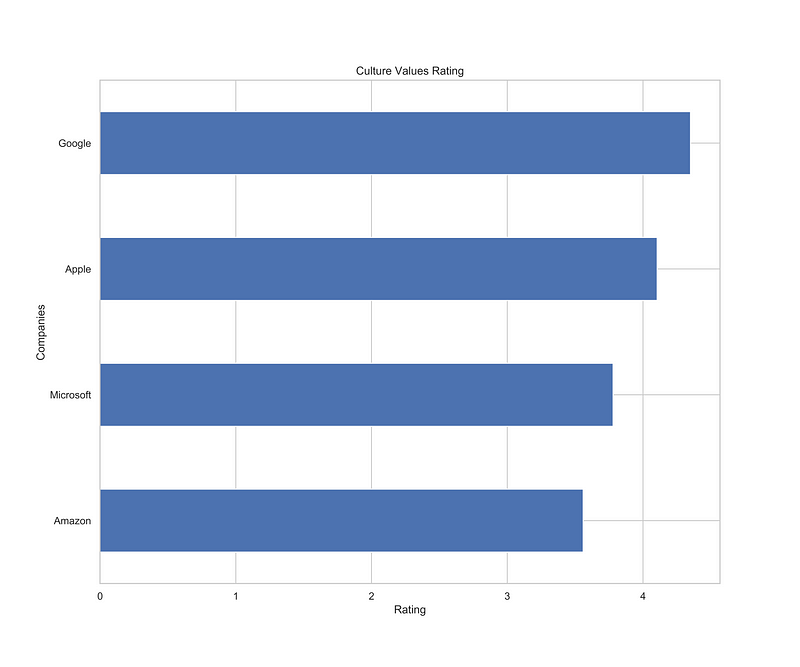
Interpretation: Google has the highest rating for culture values and Apple places second (over 4 stars). Amazon has the lowest rating of the 4, but with just over 3.5 stars.
Which company has better Career Opportunities?
How good are they at helping you advance your career?
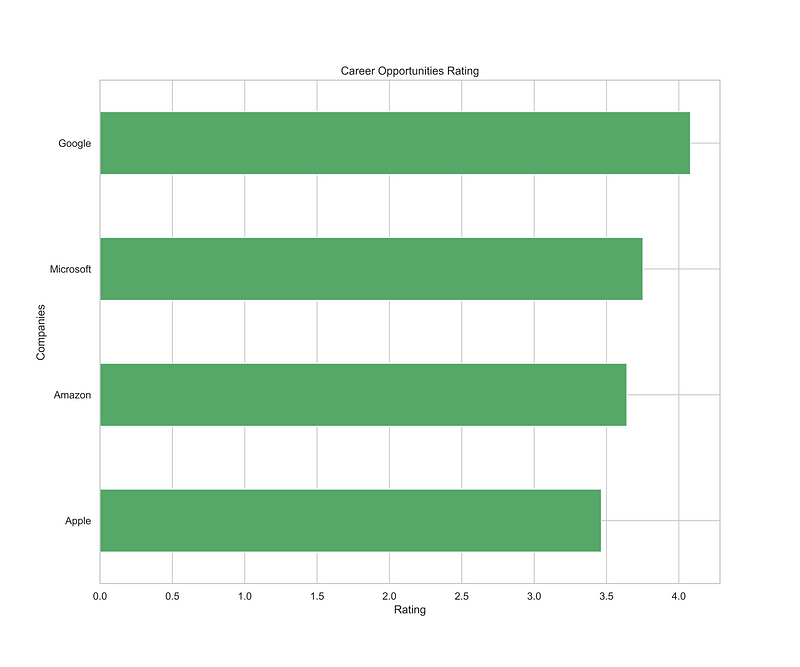
Interpretation: Google has the highest rating for career opportunities (over 4 stars). This shouldn’t comes as a surprise considering how big the company is and how many different types of technologies they are working with. Apple has the lowest rating at just below 3.5 stars.
Which company offers better Benefits?
Let’s find out how well these companies are doing in terms of benefits/perks for their employees.
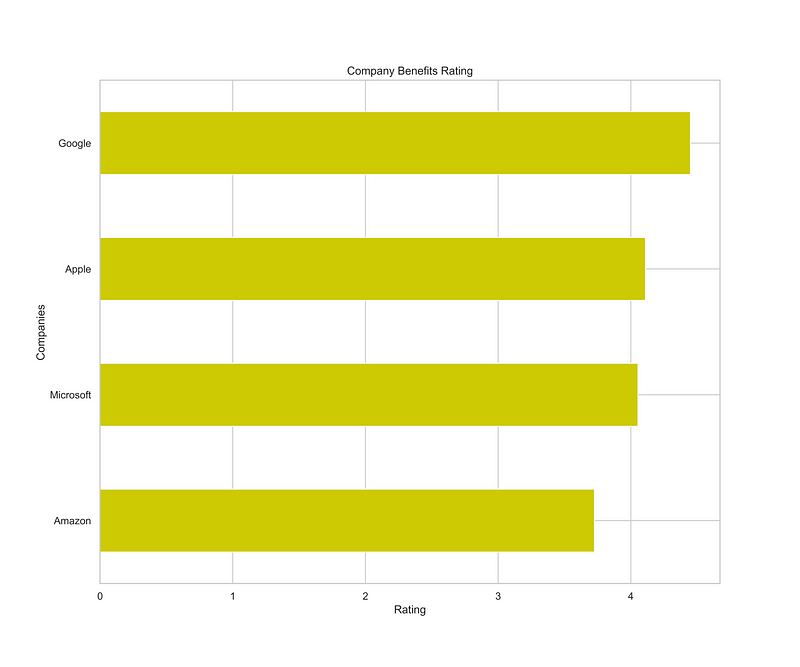
Interpretation: Google has the highest rating for benefits/perks with over 4.5 stars. Apple and Microsoft also seem to offer good benefits, but Amazon falls a bit short.
Which company has better Senior Management?
Leadership is an important function of management, let’s see how Senior Management’s leadership is rated at these companies:
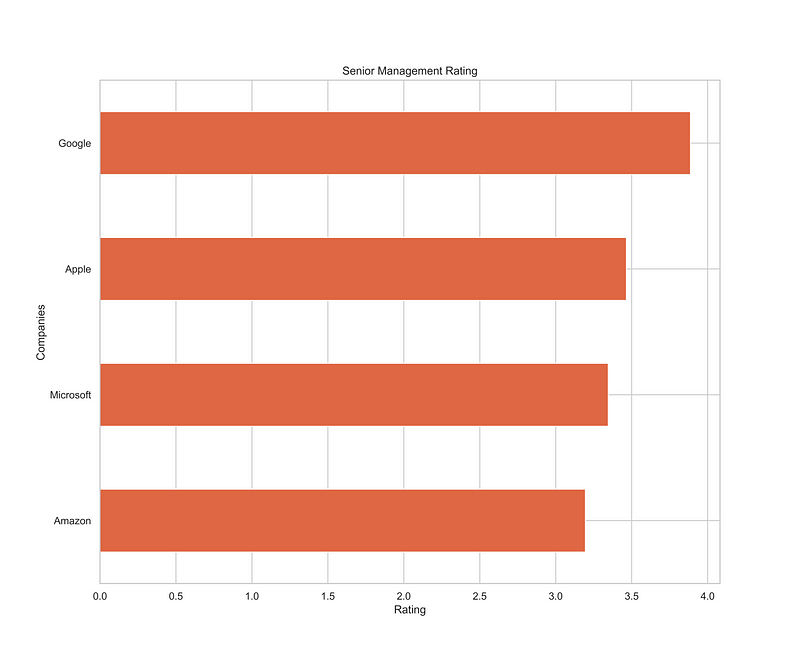
Interpretation: Google has the highest rating for Senior Management, but at just below 4 stars which is its lowest when compared to its other ratings. Amazon has the lowest rating for senior management.
What are pros of each company?
Let’s explore the pros comments using word-clouds:
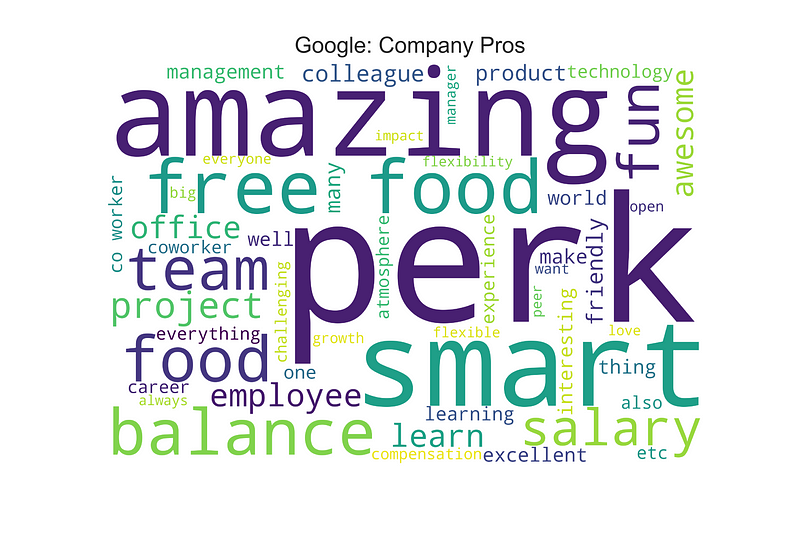
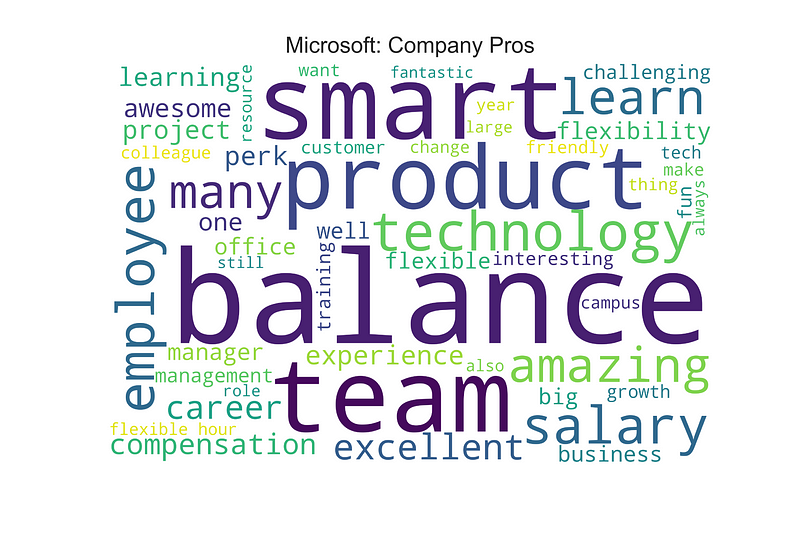
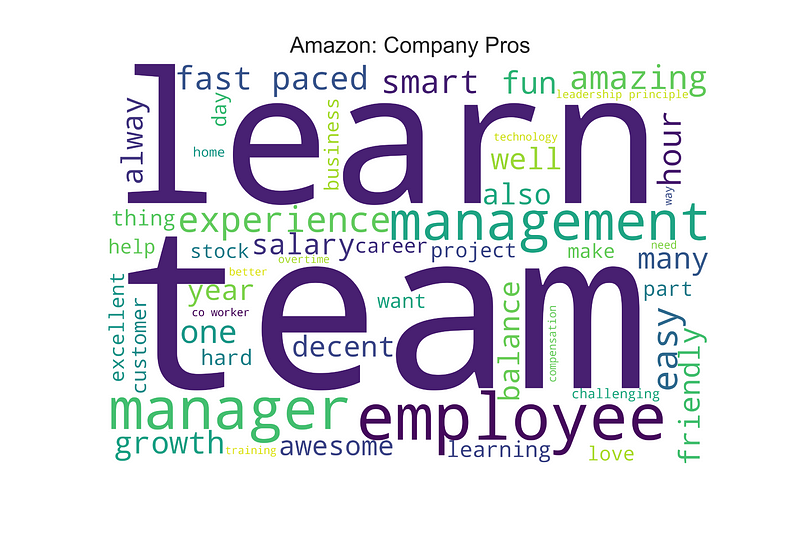
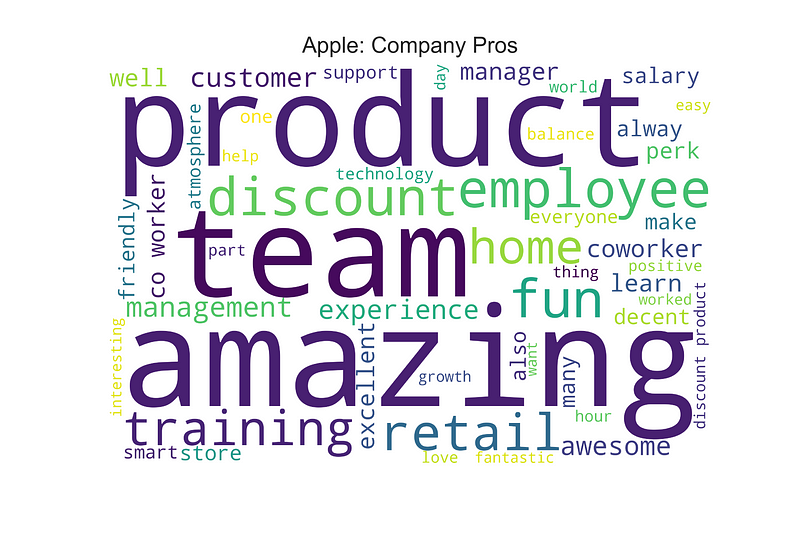
The following words were common (and very frequent) among all 4 companies, but were not included in the word-clouds: benefit, company, culture, environment, good, great, lot, opportunity, people, work, and working.
These words are all important in trying to figure out what makes these companies good, but I decided to leave them out in order to make room for other frequent keywords that may be more unique/insightful about each company. These are a few of the things employees like about their company:
- Google: The perks, smart people, free food, and good salary.
- Amazon: The ability to learn, their teams, smart people and management.
- Apple: The employee discounts, the products, their teams, the fun environment, and the good training.
- Microsoft: Smart people, the products, the salary, the technology, and their teams.
What are the cons of each company?
Let’s explore the cons comments using word-clouds:
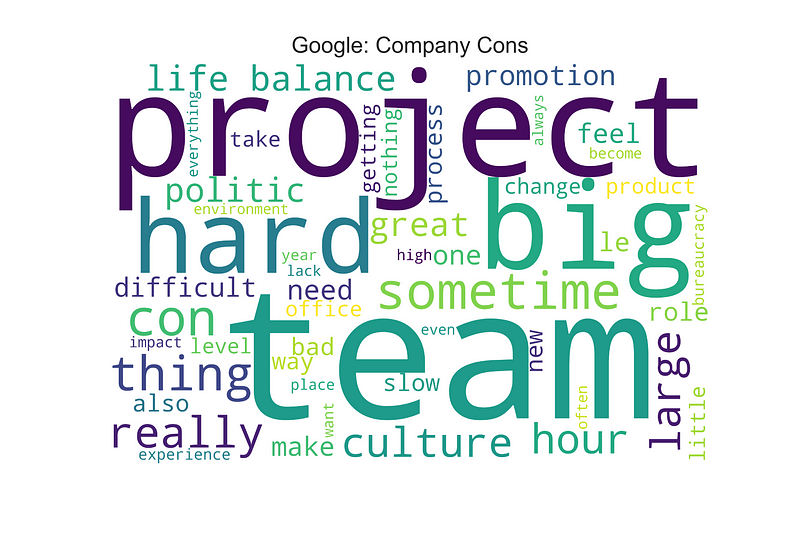
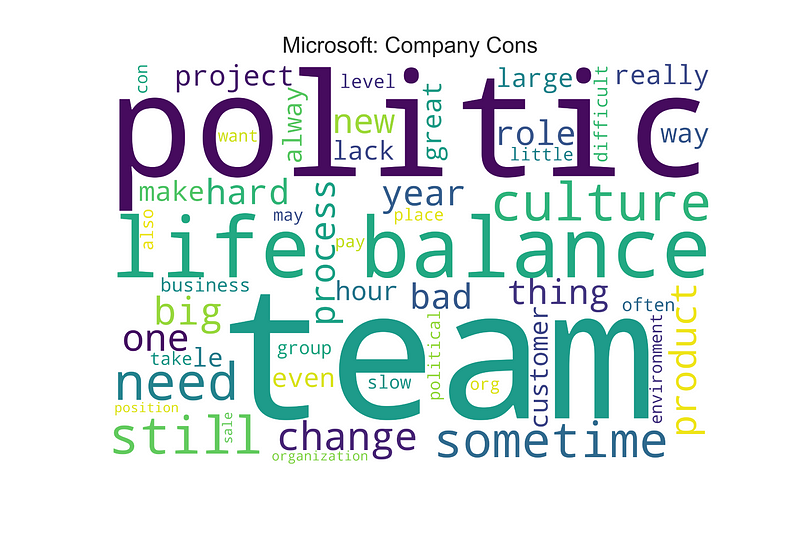
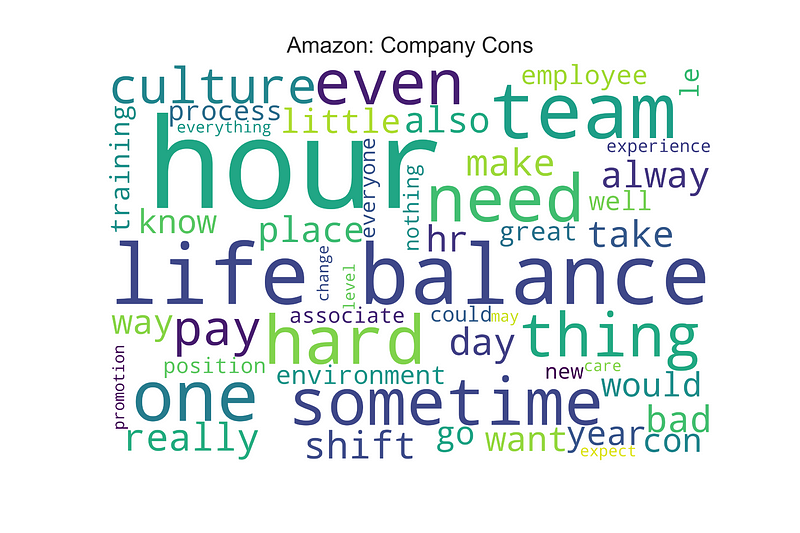
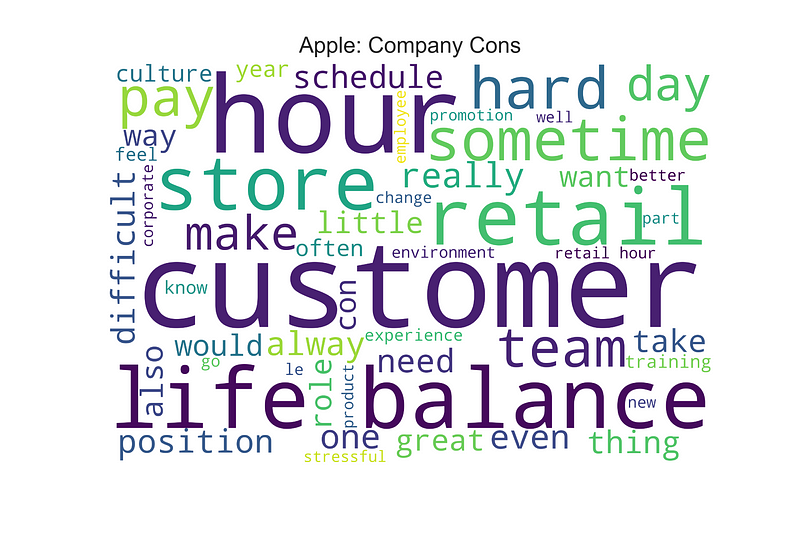
The following words were common (and very frequent) among all 4 companies, but were not included in the word-clouds: company, get, lot, management, manager, people, time, and work.
These words are all important in trying to figure out what makes these companies bad, but I decided to leave them out in order to make room for other frequent keywords that may be more unique/insightful about each company. These are a few of the things employees dislike about their company:
- Google: Their teams, the hard work, the projects, office politics and lack of work-life balance
- Amazon: Lack of work-life balance, the hours, and the culture.
- Apple: The lack of work-life balance, the retail store, the customers, and the pay.
- Microsoft: Office politics, the lack of work-life balance, their team, the hard work, and the culture
Conclusion
Through the analysis we found out that Google not only has the highest overall average rating at just below 4.4 stars (as of 2018), but it also places first when it comes to work-life balance, benefits/perks, culture values, senior management and career opportunities. Microsoft comes second in terms of overall average rating at just above 4 stars but Apple seems to have better Senior Management and culture values and offer better benefits/perks. Amazon comes last at almost every category except for career opportunities.
We also learned that despite the ratings, in general, employees find the lack of work-life balance at their companies problematic. In addition, the word-clouds reveal that the top cons among all 4 companies are management, people (other employees) and the work itself. These 3 cons are also among the top reasons why people quit their jobs.
Something we should be asking ourselves is, knowing how popular Google is, how come it has the least amount of reviews available out of the 4 companies we analysed? Is it because it has the least amount of employees or is there something else we are missing?
There are certainly a lot of other questions that come to mind and it is important to point out that this is by no means an exhaustive analysis.
Nevertheless, I hope that this article was insightful and you feel inspired to extend on this analysis or use your Data Science skills to investigate a different topic of interest. if you would like to go over the code, all of it has been carefully documented on this Jupyter Notebook.
Let me know your thoughts and feedback in the comments. Is there something you would’ve done differently? What other data could I use as part of this analysis?
Also if you wish to support me as a writer, consider signing up to become a Medium member ❤️


