
Analysis | The second Russia-Africa Summit and its discontents
Russia’s rhetoric and action toward Africa are misaligned, limiting its influence on the continent. Yet, to take advantage of this situation, Western powers ought to reconsider their own engagement strategies.
Mikael Pir-Budagyan
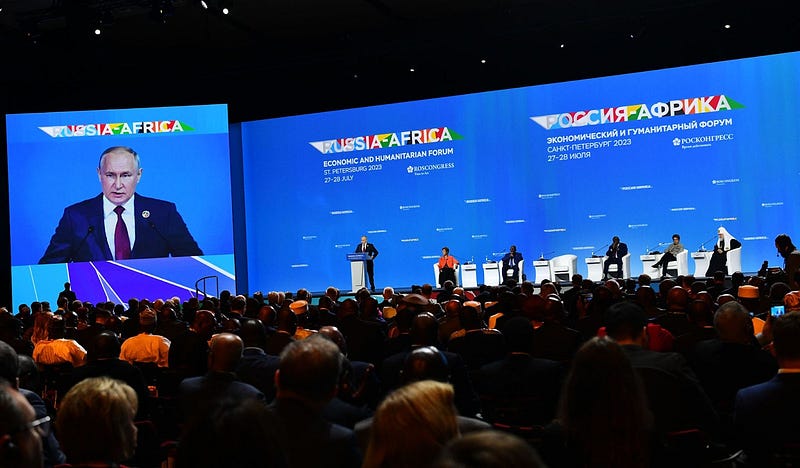
Held during the last week of July 2023, the second Russia-Africa Summit resulted in a range of deals from debt forgiveness to bilateral energy agreements. However, there was little breakthrough in the broader landscape of Russia-Africa relations, demonstrating the Kremlin’s futile attempts to spread its influence across the African continent. From noticeable decreases in the number of African heads of state who attended, to the far-fetched anti-colonial rhetoric, the summit resembled all things wrong in Russia’s public grand strategy. However, labeling the summit a failure and ignoring the apparent disconnect between African needs and Western actions is equally faulty. Despite Russia’s apparent incapacity to live up to its own power aspirations, build a new multipolar world order and challenge the U.S. global reach, Moscow still has cards up its sleeve.
The first Russia-Africa summit hosted in 2019 in Sochi was widely advertised as a pivotal moment in the Russian presence on the continent. It gave Moscow a window to return to the era of Soviet-African cooperation when the USSR supported African independence movements and leftist regimes. In 2019, Russian President Putin called for Russia-African trade to double in the coming decades and signed military deals to cooperate in the peaceful use of atomic energy through Rosatom, a Russian state atomic energy corporation. Putin also reminded the delegates that Russia had granted African states nearly $20 billion in debt relief.
Putin’s promises were far from reality. In fact, the setting appears significantly worse now than in 2019. By July 2023, Russia’s total trade with Africa had not doubled. There are reports of a decrease in Russia-Africa trade; however, these changes may be attributed to the effects of the global pandemic, and reliable data is hardly accessible. The number of African heads of state at the second summit fell to almost half of the previous one, with only 17 attending. This decrease in attendance is often attributed to the unwillingness to appear aligned with Russia on the international stage. Yet, despite the low attendance among heads of state, the Russia-Africa Summit still welcomed 49 African delegations.
The 2023 summit may well look like a pale shadow of the one four years ago. The summit took place shortly after Russia announced its withdrawal from the Black Sea Grain Initiative, leading to vocal criticism from some state delegations and the African Union Commission’s representatives. Putin’s pledge to deliver 25–50 thousand tons of grain to 6 African states does not come close to replacing the 2.5 million tons delivered through the grain deal. On top of that, the new offer did not include some countries severely hit by Russia’s exit from the deal, such as Kenya, Nigeria, and Ethiopia.
Apart from the official joint communiqué, the summit produced sideline bilateral deals. Among the 161 signed agreements are those related to international cooperation, education and science, scientific and technical cooperation, and exports and foreign economic activity. Russia also continued its long-established debt-relief-with-strings-attached policy by writing off $684 million worth of debt to Somalia. This comes as Mogadishu moves closer to completing the International Monetary Fund’s (IMF) Heavily Indebted Poor Countries (HIPC) Initiative and a subsequent 100 percent relief on debt owed to several international financial institutions.
Exports are one area where Russia has maintained and even increased its influence among African countries. Moscow has become the leading arms exporter to the continent, particularly in Sub-Saharan Africa, overtaking China’s position and increasing its market share by 5 percent from 2018 to 2022. Despite the sizable contractions in Russia’s global weapons exports (mostly due to Russia’s decreases in sales in India and Vietnam), Moscow vowed to maintain high supply levels in Africa.
Apart from traditional arms sales, Russia attempts to establish lasting energy ties with the rapidly growing continent projected to be home to at least 25 percent of the world’s population by 2050. Russia doubled down on its oil deliveries, increasing refined petroleum threefold in 2022, amounting to 214,000 barrels a day. This increase is likely part of the strategy to redirect Russian energy exports from Europe to alternative markets.
Russian state companies in the nuclear energy sector are an important additional pillar in Russian-African relations. There are reports about plans to construct a low- or high-capacity nuclear power plant in Ethiopia, as the Rosatom-Addis Ababa cooperation began with the first Russia-Africa summit. Coupled with the ongoing power plant construction in Egypt, new nuclear energy projects ensure lasting ties between host countries and Rosatom, given its unique ability to satisfy almost all operational and servicing needs. The contractual terms often include attractive repayment plans and lock host countries into procuring nuclear fuel from Rosatom for the plants’ lifetime.
Looking at a broader perspective, in almost every critical area, an endemic issue of Russian policy is the scarce substantive capacity to follow through on ideological rhetoric and loud promises. The Soviet involvement in Africa during the Cold War contained a solid ideological component and the determination to commit resources to achieve desired outcomes. Following the Soviet collapse, Russia has taken every opportunity to ride on the narrative legacy of its predecessor. However, its lamenting of the “unfair exploitation” and the “heavy legacy” of the colonial era appear shallow when faced with the effects of Moscow’s actions on African security and sovereignty. Russia accounts for a fraction of Africa’s total economic and trade activity, while Russia’s affiliate groups continue to undermine regional stability. For example, the Wagner Group’s presence on the continent resembles those neocolonial practices which Moscow publicly denounces. Unlike traditional contractors, Wagner is not interested in fulfilling the contract terms with the host state. Instead, its goals are to do “well enough to not be fired…but poorly enough to continue to be needed,” perpetuating the dependency and armed conflict cycle.
As grotesque as Russia’s pseudo-anticolonial and anti-imperialist rhetoric is, it has been echoed by some in Africa. However, such attitudes say more about the West’s failure to sustainably address the region’s endemic problems, which pave the way for malign actors like Russia’s Wagner Group. Given that state fragility persists — one of the region’s most prevalent problems — authoritarian and authoritarian-leaning African regimes have readily embraced Russia’s faux-anticolonialism in exchange for the Kremlin-controlled muscle. Similarly, democratic yet vulnerable governments are forced to choose between cooperation with rogue actors and the high likelihood that undemocratic alternatives will replace them.
Russia’s narrative may appear intellectually bankrupt, but it is resilient as long as Western powers fail to recalibrate their approach to African countries. In light of the downward trend in private sector investment in Africa, Western governments should incentivize private sector engagement on the continent, for it may be one of the few solutions that work in the long run. Recent initiatives are promising, such as efforts to expedite capital flows to the public sector through the short to medium-term private sector in areas including green energy. The two-way trade and investment initiative between the United States and Africa is an exemplary case of public-private partnerships that ought to be in place to offer long-term solutions to endemic problems faced by the continent.
Counteracting Russia’s influence requires fewer normative claims and more positive and sustainable alternatives that the Russian leadership cannot deliver. If Western powers realign their own strategies, then there will be no need to dispute Putin’s anti-imperialist rhetoric; it will be apparent that the anti-colonial emperor has no clothes.
Mikael Pir-Budagyan is a research assistant at the Institute for the Study of Diplomacy and a graduate student in the Eurasian, Russian, and East European Studies program at Georgetown University.
Interested in reading more about diplomacy in Africa? Check out ISD’s in-depth case studies library and join the faculty lounge to access free instructor copies.


