Gaming | Storytelling devices
Analysis of Masterful Storytelling Devices in Black Sails and their Application to Games
The power of the telling… that is clearly ours for the taking.
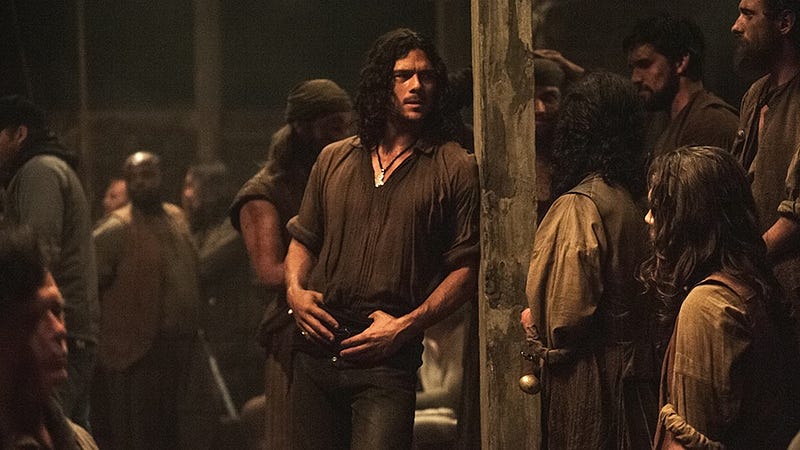

“…he knew the power of a story and how to harness it to his own ends.”
“When Captain Flint first arrived on this island, he gained influence faster than any man I’d seen before.
Or since.
I heard men say it was because of the violence.
I heard them say it was his charm.
But it was clear to me the reason why he was so good at bending men towards his will was he knew the power of a story and how to harness it to his own ends.
That man there, I would argue, may very well be his equal.’
‘You know it isn’t even his.’
‘What do you mean?’
‘The pirate story is Bernard’s. I’ve heard him tell it before. Can’t trust a f*cking thing out of his mouth.’
‘Yeah, the story’s his, the story isn’t his. But the power of the telling… that is clearly his. At the moment, he’s using it to help the captain. But God help us if he ever realizes what else he could use it to accomplish.’
Persuasive storytelling of Black Sails
Black Sails, on its surface, is a swashbuckling adventure during the twilight of the golden age of piracy. That is certainly true and if you cannot stand the setting it would be difficult to get into, but you would be missing out if you miss this show. Black Sails is a wealth of character study, character interactions, and brilliant storytelling devices expertly used to support a primary thesis that is cleverly stated and woven into the story throughout the series — a celebration of knowledge, will, and storytelling: its power to move people for good and for ill.
The plot and thesis, message, armature (however you want to call it) enhance one another. Take the above opening story-quote from the show as an example.
In terms of immediate plot, John Silver is the character using a story that is not his, expertly telling it to persuade his fellow crewmates. The conversation between two characters commenting on his story reaffirms to us that Silver is not just the devilish chaotic rogue, but that he has a power that has been developing and that the other characters are not just noticing it, but they are beginning to fear it, and we should too.
But it is also clearly reinforcing the overarching theme of the show on the powerful influence of storytelling.
As well as sowing seeds for throughline plot of the show from the pilot episode to the finale episode to beware of:
“‘You know it [the story] isn’t even his.’ …
‘Yeah, the story’s his, the story isn’t his. But the power of the telling… that is clearly his.’”
Consider what you are being told. John Silver is a growing accomplished storyteller with great persuasive power. He will claim another’s story for his own means. A narrator is never absolutely stated during the series’ run-time, though it wants you to consider and challenge perspectives. Flint is understood to be the protagonist, but it is suggested often that John Silver is the one telling this story.
Use the Black Sails persuasive storytelling formula:
Flint and Silver are not the only characters in Black Sails who prove to have the means to influence. It is many of the characters themselves that use this proven formula outlined below:
- Begin with gripping anecdote as a hook [emotional anchor]
- Follow up with validation (science, quote, study, some form of Authoritative figure) [appeals to logic]
- The application (why this matters and use urgency) [binds emotion and logic, calls to action]
Application in Games Storytelling
Black Sails uses what I consider a secret weapon in its storytelling during its climactic episodes. This secret weapon is used carefully, sparingly, and is built up to result in a payoff that elevates these climactic episodes.
I was enthralled when this method was used and in wonder at the possibilities. I began studying what it is, craving more examples, but above all, I have come to believe that video games are where this method would shine most as it is the interactivity of games that sets them apart. Their worlds and characters listen to you. They react to you.
This secret weapon that I love that Black Sails utilizes so well is not a formula, a loose past-present structure that gives a nice cause-and-effect flow that uses three literary devices called in medias res, analepsis, and prolepsis.
In medias res
“a latin phrase meaning ‘in the midst of things.’ It’s used as a literary term to describe when a story opens with the character(s) already in the middle of things…”
Analepsis
“a literary device in narrative, in which a past event is represented or narrated at a point later than its chronological place in a story.” Analepsis is further defined as internal or external.
Prolepsis
The opposite of Analepsis, “a literary device in narrative, in which a future event is represented or narrated at a point earlier than its chronological place in a story.” A form of this that is used often that I dislike is the ‘prophecy’ device, often used as ‘the prophecy of the chosen one’.
An Example in Video Games
The Witcher video game series is one that uses this in a game form well and is likely among the many reasons why I am so drawn to those games. It is also used in the original series of novels that the games are based on.
The first Witcher game follows Geralt just after experiencing a major paranormal event the mysteries of which will be unraveled over the first two games and come to a head in the third game. This is an example of in medias res that takes place over the three games series.
Each game has their own unique version of opening using in medias res.
The Witcher I opens with Geralt being chased by spectral beings after just appearing outside the keep Kaer Morhen, where he is discovered by other Witchers who know him. Geralt has lost his memory, and the keep is soon after attacked by an Alchemist and a Mage that steals their incomplete Witcher formula. The antagonist of this game is a foil of Ciri, Geralt’s ward, who shares the same special apocalyptic powers she does. The antagonist resorts to using his powers for his own means, causing death and suffering. The player as Geralt meets the antagonist early on and saves him when he is a boy. The boy does not know how to control his powers and so later in a moment of danger travels through time into the past, grows up and re-enters the events of the game later as the villain trying to manipulate the player and Geralt into helping him. The narrative threads are complex, but are analyzed very well by Joseph Anderson in this video I recommend checking out:
The Witcher I is old and can be difficult to get into, though I still recommend it. A remaster is in the works to bring it up to date.
The Witcher II opens with Geralt being tortured and interrogated, weaving in and out of a battle where Geralt was serving as the King’s protector, but the King was assassinated. The game has major branching paths where Geralt follows two distinct storylines in the second act with two separate locations, different sets of characters, on opposite sides that culminate into the final act, but the player can only take part in one during a single playthrough. This necessitates two playthroughs to get both halves of the full story.
The Witcher III opens with Geralt’s love, Yennefer caught in a battle as a great war breaks out between the kingdoms of the North and an invading Empire from the south. The opening scenes of the battle play out, while showing scenes of Geralt on the trail sometime later. This sets an expectation for the experience of the game. Geralt plays like a detective — hunting monsters. He will do so throughout the game, but after tracking down Yennefer and completing the prologue, Geralt learns that Ciri, his ward, whom he raised like a daughter, is back and is being pursued by a vengeful otherworldly force that wants to make use of her apocalyptic powers. This same force that Geralt had escaped from at the beginning of the series and that has dogged his steps throughout. Throughout the game, analepsis and prolepsis are used in the main storyline. The player and Geralt must piece together how to find Ciri, though her powers make nailing down her location and series of events difficult. As Geralt seemingly draws close, sections are played out from Ciri’s point of view, where the player gets to control her and see events seemingly before or after they’ve happened.
A course set
“Now, bring me that horizon…”
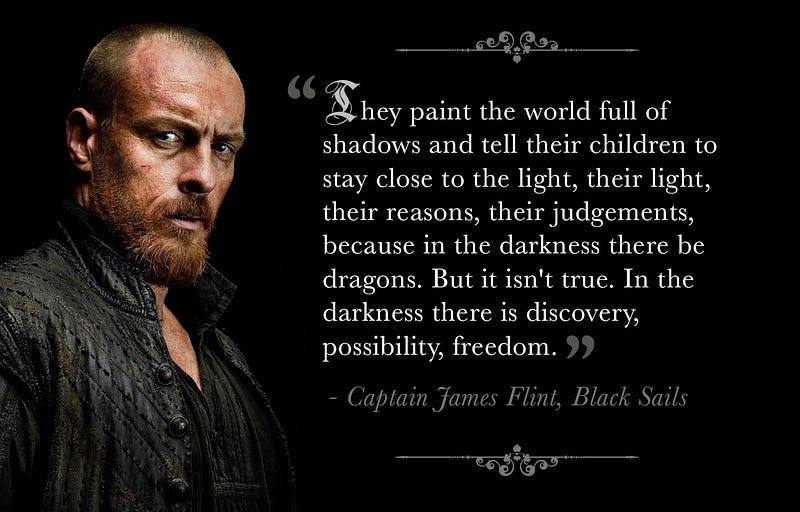
I’m excited for the future for games that have matured with the use of these literary devices. As for myself, I am dedicated to analyzing and crafting with these storytelling methods, maturing their use beyond conventional storytelling, but delivered through character action and play — through discovery, possibility, freedom.