
Analysis of Core Concepts in Notes on the Synthesis of Form
We shared insights and limitations gleaned from reading Christopher Alexander’s Notes on the Synthesis of Form in the previous article. Then, In this article, we will interpret the key terms in the book and link them to our actual design work.
Form and Context
Related design terms: Design object, Tangible thing, Usage scene.

Form and context are the fundamental elements of design. In other words, Form is the design objective — the thing design can control to change and the delivery of that design. Context is the ensemble of environmental constraints. “When we speak of design, the real object of discussion is not the form alone, but the ensemble comprising the form and the context.” (Notes). The kettle is the form, and the environment in which it is used is the context.
The form is the solution to the problem; the context defines the problem. The challenge is that it’s not straightforward in a real design problem. Different designers can create different forms based on different definitions of the direction of the design problem.
Regarding the context, there are two questions. Where is this context boundary? The context can involve many influencing factors; if you include more influence factors within the context, you have to balance more factors when making a design decision. The second one is which factors can impact your design decision. Since we can’t properly describe the context, not to say in a measured way, it leads to the designer’s subjective interpretation and decomposition of design problems. This brings the phenomenon that design seems to lack standard answers. One hundred designers can produce 100 different forms for the same theme.
Design Problems & Decompose Problems
Related terms: Human needs & Requirements, Design problem analysis.
We design because we want to address specific problems through it. The design problem we commonly understand is the requirements to be met. There is an interaction between the requirements and their different weights, making it hard to meet all requirements evenly. Sometimes, even designers try to meet all requirements, but it doesn’t mean it brings a good design result.
In this book, Alexander emphasizes that the problem that design wants to address comes from the context. The first step of the design process is to define where we will set the design problems. It needs to go back to the original (context) to understand where those problems are in the real world, considering the product’s usage in a particular context and how to decompose design problems. “Requirement list” that we take for granted may not be a good concept in Alexander’s view to identify the authentic problem design truly should address.
It has two ways to define and better analyze design problems.
- Decompose design problems structurally.
Alexander thinks we can break down design problems as we do with complex objects in the world. He believes hierarchical subdivisions of the world are objective features of reality, and designers can understand problems by looking at their pieces, just like scientists study the physical world by identifying its parts. So decomposing a problem structurally means breaking it down into smaller parts following the problem’s inner hierarchy rather than decomposing it equally.
His method uses the program G(M, L) to represent the design problem. If we can carefully decompose it, like solving a problem, we can dissect the design problem into a series of sub-problems. A sub-problem is generally an aggregate with a cluster of forces, each relatively independent and less entangled with other sub-problems. Solving the sub-problems allows us to combine them to solve M, the overall problem. (Still, honestly, I don’t think it can be easily applied in practice.)
2. Find misfits between forms and context.
You must test existing forms in their context to design a new mouse. This makes it easier to identify “misfits” and helps designers manifest the issues they can focus on solving. The second way is more practice for us to use quickly.
Fits & Misfits
Related terms: Design purpose, Pain points
In Alexander’s eyes, the design aims to build forms to fit the context. Fit means harmony and form adapted well within its environment. “Good fit is a desired property of the ensemble that relates to some particular division of the ensemble into form and context. … We want to put the context and form into effortless contact or frictionless coexistence.” (Notes)
Alexander said seeing misfits is easier than seeing a good fit. “Whenever an instance of a misfit occurs, we are able to point specifically at what fails to describe it. It seems as though in practice the concept of good fit can only be explained indirectly.” (Notes)
Generally, it’s easier to identify misfits between form and its context rather than abstractly define a requirements list or what exactly fit is. Designers can better know whether they solve a design problem by identifying misfits. When designing, we often say that it needs to solve user pain points, and pain points are misfits. While key pain points can be seen as problems to be addressed, this is the key force that can be exerted on the “form” being designed. It has many specific methods to identify pain points or misfits, such as usability evaluation, a typical method of putting the product in an actual use environment to find misfits between form and usage context.
Forces & Tradeoff
Related terms: Factors that influence design, Constraints
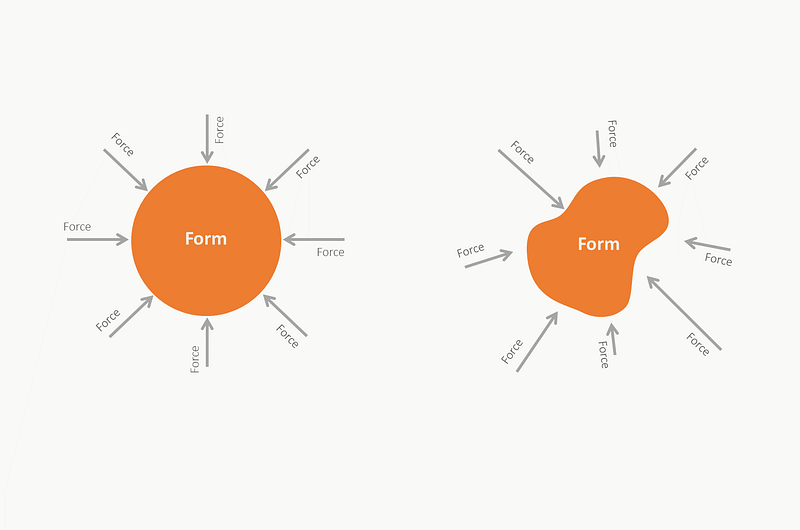
The term “force” in Notes on the Synthesis of Form refers to the various factors or influences that shape and interact with a design problem. “Context” is the system of forces. Identifying forces making demands on the form is crucial since they are the actual power exerted on it. These forces can include functional requirements, user needs, environmental constraints, technical constraints, and other considerations that impact the form and solution of a design problem. Alexander emphasizes the importance of identifying these forces systematically to address the design challenges at hand effectively.
We can generally divide those complex factors into two types:
- Internal forces_the primary driving force): human needs (pains), cultural and social factors.
- External forces_ the secondary driving force: External forces are more like all kinds of design constraints, such as technical constraints, manufacturing, and business factors.
The primary factors are more critical for designers to keep in mind, and they need to decide which fundamental human needs (pain points) to focus on; on the other hand, they need to consider external constraints factors as well, but can’t be controlled by all constraints; otherwise, it leads them to the miss the direction that they should focus on the primary forces with top priority.
Analyzing those factors is key to reframing the design problem and broadening the problem scope. Designers have to look at those factors as an entire “system”; then, they can truly reframe the problem. Also, we must care about the biggest forces in the system, “We take just those relations between form and context which obtrude most strongly, which demand attention most clearly, which seem most likely to go wrong.” (Notes)
Some highly desirable design projects ignore the complexity of factors. Designers ignore cost and technical feasibility and thoroughly consider key internal strengths. The resulting design is very conceptual and unusual, but it is often challenging to implement on the scale. There are many classic cases of academic conceptual design in history, such as Gerrit Rietveld’s Red Blue Chair, which overemphasizes a certain concept and ignores other limiting factors. So, it went into museums, not ordinary people’s lives.
But if the design’s purpose is for people to use, the more realistic problem for designers is the trade-off between different forces. It means designers must carefully consider all forces influencing design and make tradeoffs, which is the hardest part of design work. One example Alexander mentioned in the books is the case below.
“In any reasonably complex problem these misfits are interrelated — mediated by common considerations — and a design must make appropriate tradeoffs when misfits conflict. For example, a kettle needs to heat up quickly yet keep its water hot for a sufficient period of time, and these requirements (i.e. potential misfits) depend on the properties of the material used in construction. Perhaps the most common design tradeoff is that of expense: the lower bound on quality of materials conflicts with the upper bound on price of the resultant product.”
Diagram and Pattern.
Related terms: Shaping, Form synthesis
In addition to the idea that Alexander thought that we could structurally decompose design problems, another key idea of him is that there is a deep correspondence between the structure of design problems and form-generating systems. After correctly decomposing the problem, an explicit diagrammatic mapping of the problem structure is necessary. Each relatively independent sub-problem can be expressed with a constructive diagram, which bridges the problem and the final form.
The “diagram” mentioned in the book is the early term for the pattern he later developed in “The Pattern Language.” A design pattern is earlier represented as a diagram, which clarifies a specific design problem and presents a preliminary physical form. For example, the diagram of our “door” represents the particular problem it wants to solve (providing an entrance) and, at the same time, presents the basic formal pattern of the physical form that solves the problem.
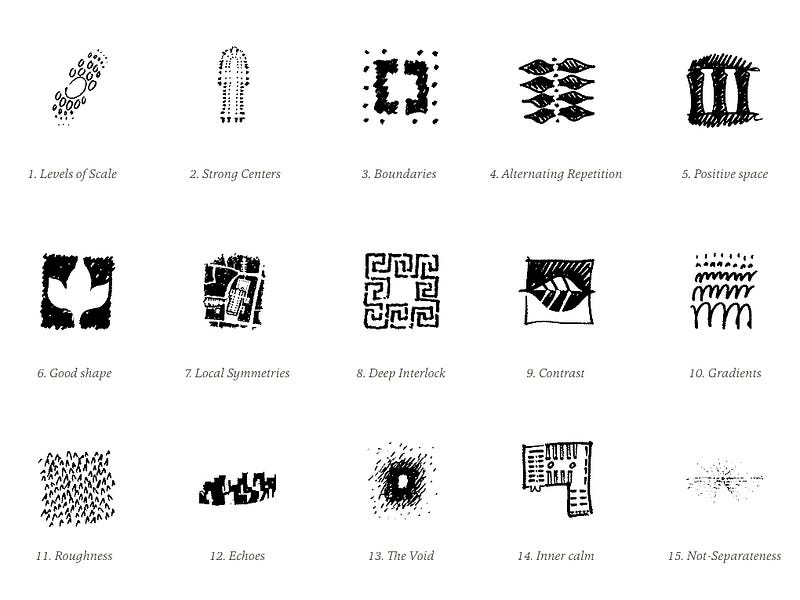
Every diagram has a dual nature: a unit and a pattern. As a unit, it will adapt to the hierarchy of its larger components; as a pattern, it will specify its own component unit hierarchy. The designer’s goal is to make each diagram both a component and a unit, highly independent and reusable.
A component is both a unit and a pattern. This idea from Alexander is very core, profoundly affecting the development of the design patterns in the software engineering area nowadays. Coupling (computer programming) in computer science refers to modules in a program and the degree of dependence on information or parameters between modules. Low coupling is a characteristic of a well-structured program. A program with low coupling will have better readability and maintainability. Today, the design system we have been familiar with aims to develop a series of highly independent and reusable UI components. Also, each module is a unit of the whole and can be combined to solve a larger problem. The fundamental thinking of it originated from Aelxaner’s pattern idea.
It’s further to prove Alexander’s ideas vitality. Although the initial idea came in 1964 from building design, it matches computer science’s thinking well and is now applied well in software development.
Read related articles:


