
An Unexpected Visit To Mesopotamia
James Jacobson and Julie Jamison on an outing together in Hadleyburg
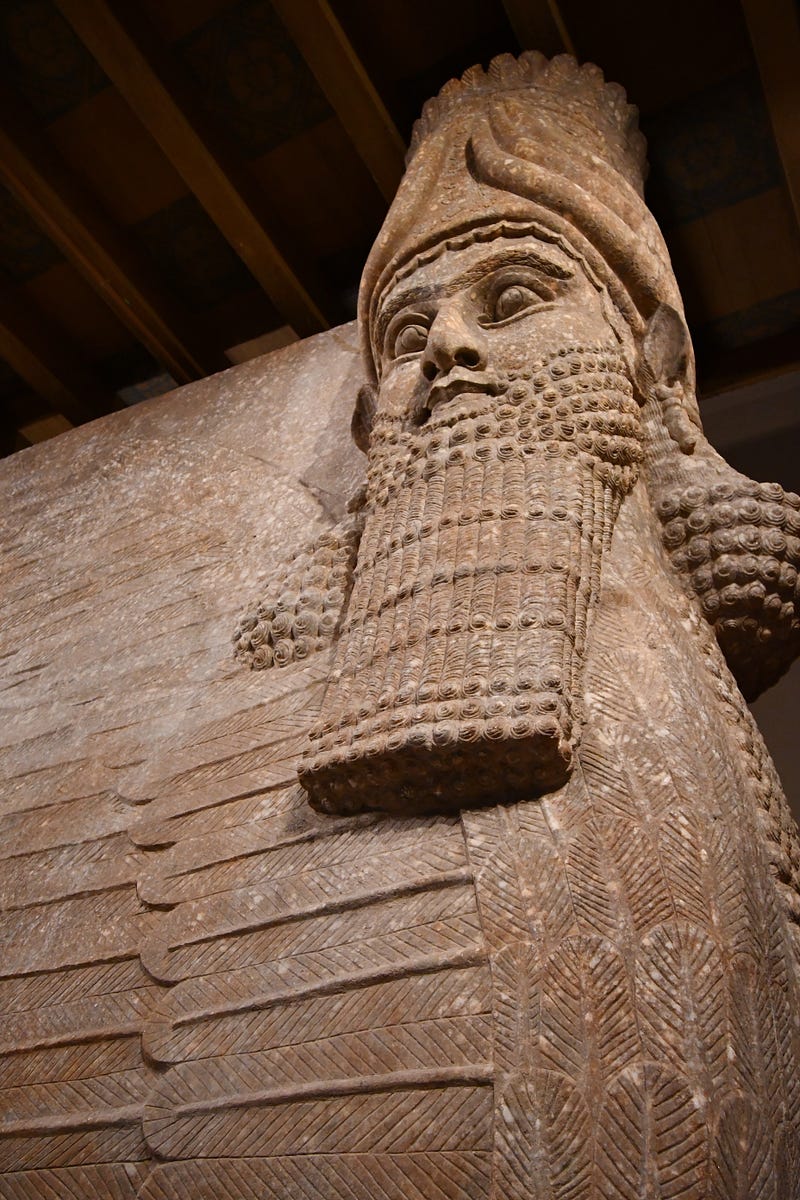
Jim Jacobson was standing on the top of a ziggurat attempting to make a difficult shot into the small hole cut in the center of a lion mosaic while Julie Jamison, balanced on a small portico, looked on.
“I’m getting better at this,” he told her as he swung the putter and gently tapped the ball, it rolled slowly toward the mosaic, broke left a moment and then right and finally fell inside the hole.
“What is time is it?” he asked.
“About five o’clock,” she answered.
“And how many more holes do we have to play?” he questioned
“Four,” she responded.
“I’m very tired,” he responded.
“So am I. We could stop now if you like.”
“We could,” he responded. “But that’s the challenge, isn’t it? To move beyond our limited capacities. All human achievement begins as a struggle against limited potentialities.”
“So, you’re being philosophical again?” she commented.
“Now that’s a mouthful. It’s more like whining banally.” He paused. “To continue, we know we’re just dust. Here for a moment in an eternity so we try to leave something to the future to remember us by, something permanent, something that stands against our fragile transience, hence the pyramids. And why do we value Gold so much of all the metals? It is the most permanent, the one most resistant to the inevitable decay of oxidation. It’s ironic, isn’t it? The one element which sustains our life, oxygen, is also the element which destroys us.”
“I’ve never thought about it that way before,” she responded. “But I must be taking at least half a dozen anti-oxidants.”
“And no matter how many of them you take over how long a period; you, like all of us, will eventually lose,” he commented.
“So, this is what you’ve been doing with yourself, thinking about these kinds of things?” she asked.
“I have had plenty of time to think about a lot of things, months of contemplation.”
“I don’t know that having so much free time is such a good thing. The human imagination can be tremendously self-destructive,” she affirmed.
“I can’t see that I had much choice,” he responded. “Time to think was one thing I had in abundance.”
She tapped the ball effortlessly into the hole and then began to descend the steps of the ziggurat.
“I don’t think the Mesopotamians would have wanted to be remembered as a miniature golf park.” Julie commented, “We ultimately have little control over how we’re remembered, if at all.”
“But everyone wants to be remembered,” he acknowledged.
Jim reflected the fragility of his own memory and of the tenuous connections. Over the past two weeks, no aspect of his past had escaped his scrutiny. He wondered if his view of his experiences to the present had been altered by present experiences, and even with the gaps, he struggled to impose coherence upon the disparate pieces, to bring cohesion through fixed points of reference, as though telling a draft history to himself, in the same way he conjectured that civilizations would codify their pasts in fixed traditions passed on by word of mouth or in written form. His mind had created his own tradition and clung to it as fervently as the most pious zealot.
“If you want to skip the last four holes,” he told her, “and get something to eat, I’m more than willing.”
“Alright,” she responded. “Let’s get the balls.”
They walked down a curved set of brick steps that lowered into a pit where the two balls emerged near a small waterfall, and she bent down and picked them up.
“Follow the signs with the eagle heads,” he answered, placing the cane firmly on the pavement to balance himself. “This place is certainly beautiful, but I could think of better motifs for miniature golf.”
Several teenagers ran in front of them, one almost tripping as Jim slowly moved across the piazza.
“I think I’m going to rest for a few minutes,” he told her.
She helped him to a concrete bench at the eastern edge of the piazza and he sat down. His right hand was trembling.
“Despite my appearance, this is good for me,” he told her.
Her expression projected concern. She grabbed his hand to stop the shaking.
“I care for you,” she told him. “My offer about the magazine and coming to New York is a serious one.”
“I don’t want to be a burden on anyone,” he responded. “I don’t expect people to take care of me.”
“Who’s going to look after you here?” she asked.
“I don’t want anyone to look after me.”
“I think you have to be realistic,” she told him, “It may be months before you regain enough strength to live unassisted by anyone. I know how much you value your self-sufficiency. But we all at some time in our lives need help.”
She said these words with such compassion and such earnestness in her voice, his eyes began to tear.
“Why are you doing this for me after so many years?” he asked. “No one has taken such an interest in me before.”
“Over a year ago, when Father Michael took me off the street, I met your mother at the shelter, she prayed for you every day of her life, even to her dying breath, she asked me to pray that wherever her Michael was that God would watch after him; that he would send an angel to protect him…how can I let her prayers be in vain?” she paused, “I know you don’t believe in God, or prayers or angels. But it will not be because of me.”
“I don’t know what to say.”
“Good.” She paused. “Silence is good. Now where would like you to eat?”
“How about Italian food?” he responded, “there’s a place called La Trattoria in the historic district.”
“Sounds perfect.”
“It’s a little on the upscale side and we would have to dress for it.”
“Then I’ll drop you off at your apartment. You can shower and change, and I’ll go back to my hotel.”
“Sound’s wonderful,” she expressed, “So are you up to walking now?”
“I think so…”
She helped him up to his feet and they began to walk toward the exit of the park.
“Courage,” she told him as they began to ascend a flight of steps. “It’s all going to work itself out.”
When they returned to the car, it was nearly six o’clock and Jim was breathing heavily. As he waited for her to open the doors, he noticed the same blue sedan he had seen at the post office, parked only three spaces away.
“It’s that car,” he told her. “I’m sure of it.”
Though winded, he left her car to get a closer look at it.
“It has New Jersey plates,” He shouted to her. He reached into his pocket and struggled for a pen, which he used to scribble down the license number ICJ724 on the back of his ticket.
“You’re still obsessed with this,” she scolded him. “Come back to the car. No one is following us.”
She went over to the car and grabbing his arm, helped escort him back.
“We have to do something about this paranoia,” she chided him. “People are going to think you sound crazy.”
“I’m not crazy,” he almost repented his commitment to withhold his suspicion and tell her everything, but he held his tongue.
“I won’t say another word about it,” he asserted.
She opened his door for him, and he climbed inside. As she drove him back to his apartment they said very little to each other, and when she parked the car at the curb, she asked him, “Do you want me to help you walk to the door?”
“I’m fine,” he responded, taking his cane and his small satchel from inside the car. “Could you open the trunk? I can get my package.”
“Of course.”
She pulled a lever and the trunk snapped open. Then he reached inside and snatched the package, which he placed inside the satchel.
“I’ll see you in forty minutes,” she hesitated a moment but then kissed him on the cheek.
She lingered a few minutes at the curb as she watched him slowly stride to the door, his gait was irregular and with every other step he used the cane to support himself. Then she crossed herself and pulled the car away from the curb.
Once inside, Jim took the satchel to his kitchen table and laid it beside the box of other objects. He went to his cupboard and found a large glass, which he filled with cold water from his refrigerator. In one huge swallow he emptied the glass. Filling it again for another huge swallow, he set the glass inside the sink and returned to the table to sit down. Emptying the contents of the satchel, he laid the objects all out on the table: “The butterfly box”, a composition note book, and small tape player and a calculator. Then reaching into his box, he removed other objects, first the small porcelain Greek statue, then the photographs, then Beth’s Fox scrapbook, finally setting in front of him the box of Nigel’s cassettes; all the pieces of a puzzle laid out as though a child’s play station. But something was still missing: the pattern to put them together.
He went into the kitchen and returned with a steak knife which he carefully stuck inside the package cutting it slowly to reveal its contents. Inside he found a videocassette and a CD labeled “Omega.” The videocassette had a jet-black label, which simply stated in white letters “Welcome to Omega.”
‘I’m not going to solve this now,’ he thought. ‘I better get ready.’ He quickly placed all the objects back in the box including his satchel and slid the box to the edge of the table.
As the hot jets from the shower had begun to pummel his back, Jim couldn’t clear his mind of everything that happened to him in New York. The conversations, the chase, those final moments as he stumbled into the television store after being shot, all burst into his awareness, competing for his attention and then as quickly fading. He pondered whether Julie was right about him. Had his fears become paranoia? Was his itching sense of trepidation no more than an overactive imagination? He had hoped Hadleyburg would remain for him a bastion of the mundane and the uneventful with county fairs, and well-kept lawns and noodle-salad, but even here he found no solace.
As he dressed himself in a coat and tie, struggling incessantly to make his fingers do what he wanted them to do, he could think of nothing, other than Nigel’s burning house and those moments, when it was uncertain to him if his father and Burgess were still alive. It had been a minor epiphany for him, a moment of deepening understanding of the world.
When Jim finished dressing, he went to the living room to wait. An anxious forty-five minutes passed while he waited for Julie to arrive. He occupied himself by scribbling a few words in his black composition book. He was struggling to remember how “plethora” was spelled when the doorbell rang.
To his surprise Julie was not at the door but a Federal Express delivery man. He had a package measuring one foot square.
“Who is it from?” He nervously asked.
“Holy Protection Orthodox Monastery, Lexington Avenue NY, NY.” The delivery man read aloud. He signed for the package and brought it back to the table.
He went to the kitchen to retrieve a knife to open it. Inside he discovered a letter, which he unfolded to read.
Dear Michael,
Your father, Nigel, entrusted in me these journals, a series of reflections and investigations about your kidnapping. He always had hopes that this would lead to some resolution. If you need anything please feel free to call me.
Jim carefully lifted six leather-bound notebooks approximately 250 pages thick each containing notes and reflections beginning in November 1957 through October 1994. He skimmed each book, rifling the pages, and shaking his head, thinking to himself, ‘How am I going to absorb all of this?’
When Julie arrived, he was sitting on the sofa with Book #5 on his lap. He remembered that Julie had told him that Nigel had kept a journal, but it was something in the haze of information, which bombarded him in New York that he had simply forgotten. When he opened the door, he still held the journal in his hand. Julie, wearing a red evening dress with her auburn hair pinned back behind her ears. Julie with her red evening dress never looked so attractive.
“Do you like it?” she asked. “I’ve worn it only once before to a dinner sponsored by the magazine. I feel awkward dressing up so much now.” He remembered what a debutante she was before, with designer dresses and expensive make-up and shoes she wore no more than once. For a moment when he looked at her, he remembered the woman that she was once, when she could have had any man, she chose, and did.
“What is that you’re holding?” she asked him.
“Nigel’s journals,” he firmly answered.
“Father Michael must’ve sent them.”
Jim was beginning to realize that he was not going to escape delving deeper into his mystery even here in Hadleyburg and he sensed with nebulous anxiety that his struggle with his past was only beginning. The clock on the wall read seven o’clock and his stomach was growling from hunger. He returned the journal to the box on the table, and he rejoined Julie in the foyer.
“Alright, let’s go.” He told her.
It was on a ten-minute drive from his apartment to the restaurant. Throughout the short trip, she turned her head a couple of times, smiled and snickered nervously and for a moment he thought that all their differences in social position, temperament and religion could somehow be overcome.
“Do you still have access to the Lexus Nexus search at the magazine?” he asked her.
“Yes, why?”
“If I asked you to do an address search for past addresses on someone, would you have access to that information?”
“Probably,” she answered, “but who do you want to find out about?”
“Dr. William Harvey,” he answered.
“What possible reason would you want to know that?” she asked.
“Just a suspicion.”
“You and your suspicions. I wish you would be honest with me. Don’t keep me in the dark about what’s going on inside your head.”
“It’s not much, just random impressions without anything coherent to tie them all together,” he answered.
“I could call them tonight if it’s that important. But I wish you’d tell me why.”
“On second thought,” he said, “it’s really silly.” He couldn’t take the risk that she might tell her father.
When they pulled into the parking lot, Jim saw the same blue sedan parked as though waiting to meet them there.
“Wait a second,” he told her. “That car is here again.” He paused. “Three times today in three separate places, we find this car? It’s not just a coincidence.”
“It’s a coincidence,” she affirmed.
“It’s no coincidence.”
“Jim, you’re beginning to scare me with this talk.”
He breathed deeply several times and resolved to drop the matter. Once inside the restaurant, an elegant establishment resembling a large patio with trees and shrubbery and rows of flowers circling the walls, with thirty small tables elegantly set with starched white tablecloths and tall bee wax candles on crystal stands, they waited a few minutes until the maître de led them to a table in the back and laid two menus down.
“This must be very expensive,” Julie told him. “You’re sure you can afford this?”
“Don’t worry about it I have a little money saved,” he responded.
It was as Jim pulled a chair out for her to sit down out of the corner of his eye, several tables away that he discovered the same man whom he had seen driving a blue sedan on their way from New York to Hadleyburg.
“What are you doing?” She told him. “Come back and sit down.”
“No, I’m getting to the bottom of this,” he affirmed.
He approached the young man about 35 years old sitting quietly at the table and confronted him.
“Why are you following me?” he questioned.
“Following you?” the man responded. “I’m not following you.”
“You’re the man with the blue sedan with New Jersey plates ICJ724?’
“Yes.”
“You were at the post office, the mini-golf place, and now here at the restaurant.”
“I’m not following you around. I live here. I’m the new music teacher at James Buchannan High School.”
“Well, what is your name?” Jim asked.
“I’m not telling you my name.”
Julie got up from the table and approached Jim.
“Please don’t do this,” she pleaded with him. “This is not the time or place.”
He reluctantly agreed and returned to their table. She didn’t know what to do about this, but she was happy that Jim sat down and seemed to be more complacent.
“I’m sorry,” he told her. “I don’t know what got into me. I’m OK. I’m OK.”
“Yes.”
“You should talk to someone about this.”
“I’m not crazy.”
“But you can’t confront total strangers in public places. No matter what suspicions you might have about them. You’re lucky he was reasonable about it, Sit down. Relax, we’re supposed to have a good time.”
“All right, I’ll sit down.” he acknowledged,
“The food here looks very good,” she commented.
“You should try the linguine with mushrooms and marinara,” he suggested.
“Okay, I’ve already decided on something else.” She paused. “I really wish you tell me the secret you’re keeping from me. It’s an awful thing to carry such a heavy burden alone.”
“God, I wish I could. But I want to be sure. No doubt in my mind.”
“You’re like Thomas.” she told him, “There’s no truth so frightening that we with God’s help can’t deal with it.” Then the waiter came to take their orders.
Jim noticed after the waiter left, that the man he confronted had departed from the restaurant.
“I promise you there won’t be any more incidents like this again,” he assured her.
“I’m not worried about that. I’ve got other things on my mind,” she replied.
“Like what for example?’
“Like how I can communicate with you, the tremendous changes in my perspective in the past year. I’ve learned so much and I don’t think there is an opinion that I haven’t reconsidered. And it’s not just religious ideas.”
He was quiet a moment, watching her meticulously wrap her fettuccini around a fork and finally, broke the prenatal silence. “I have a question for you.”
An anxious grimace began to spread across her face.
“Relax, it’s not what you think.” He paused. “Do you think human beings are wired pretty much the same or are there distinct differences between individuals?”
“That’s an unusual question, and if I had to guess, and that’s pretty much a guess, I’d like to think they’re remarkably similar.”
“But we’ve all had experiences of seeing two people observing same set of objective factual stimuli and coming to entirely different conclusions, now is this hardware problem or a software problem?”
“I have a major problem with the whole idea of observing the human mind as some kind of supercomputer. I think human beings are more than machines,” she paused. “I don’t know how to say this exactly. But I see a divine spark in everyone.”
“But that’s based on a belief, on faith as I’ve heard other religious people say. You either have it or you don’t.”
“But the church doesn’t accept this Western philosophical dichotomy. We believe in God because we’ve experienced God and our knowledge is empirically based on testimony of those who have seen him.” She paused. “I do so wish I could share with you what I’ve seen with my own eyes over the last few months. I’m not so sure you would be as sceptical as you are now.”
“But that’s the central problem, I haven’t been. It would take something outstanding like maybe Nigel coming back from the dead to make me reconsider things.”
“I shall pray that God in some tangible and ineffable way reveals himself to you,” She told him.
He could not conceive of any so-called revelation, which would convince him of the existence of God. If some spirit appeared to him or some voice from heaven told him, “I am God.” He would as Aristotle put it, attribute it to delusion or psychosis and certainly not attribute it to divine intervention. Such intervention seemed to contradict the rules of logic and causality, as he understood them.
He knew it was a dispute he wasn’t going to resolve that evening, if ever, and he resolved to change subjects diplomatically, hoping to avoid appearing ungracious.
“I’m grateful for all that you do for me; driving from New York, spending this time with me, thank you.”
“The pleasure is all mine. I enjoy these stimulating conversations, even when we disagree. I have so little time for conversations in New York, too many deadlines, too many obligations.”
Jim remembered the hectic pace of Chicago, the slower rhythm of Hadleyburg was one of the things he had to recommend about the place.
“Then maybe you should move to Historic Hadleyburg. One thing we have here is plenty of time, so much of it, I think the town council is thinking of renting it out.” He laughed.
“You keep saying Historic Hadleyburg,” she responded. “Can you tell me about what is historic about it?”
“Don’t you know? Didn’t you see the sign when we entered the city limits: Welcome to Historic Hadleyburg. The home of Legendary William Hadley.” He paused. “I don’t know if I should tell you anything. Might spoil the museum tours if we make it tour.”
“Tell me about William Hadley,” she told him.
“You better brace yourself,” he began. “What I’m about to tell you might change your whole life.”
“Don’t be sarcastic about it. Just tell me.”
“Well William Hadley or should I say Sir William Hadley was an English Astronomer, Royal Society member, I just wish I could feign an English accent to give the full effect. He was the heir to considerable fortune from gold mines in Africa who at ripe old age of thirty devoted himself to study of the stars. He’s credited with several earthshaking innovations in telescope designs; from which he claims to have learned from reading in ancient Mesopotamian texts. Of course, we know about Mesopotamia, they didn’t have telescopes. He retired at the age of fifty and looking for a country estate in Americas settled here in Virginia.”
“What years are we talking about?” she asked.
“He died in 1827 at the age of 65. But let me continue, he set about to construct a large observatory as what is now called Mount Moriah. A task I should say in which he failed because of tremendous gambling debt. He built the outer structure, but he could not finish the observatory. He was convinced it would be there so that the space visitors would finally land.”
“Space visitors?” she interrupted him.
“Need I go on? As you will soon discover, the man was a real kook.”
“Yes, this is beginning to fascinate me,” she answered.
“You should probably go to the museum tour. They do a much better job of explaining him. But I digress. He spent a considerable part of his family fortune trying to build the largest telescope in the world, because he was convinced that space men were living on Mars and would one day come to this planet. In fact, he spent the last years of his life living in a specifically constructed tower, waiting for them to take him when they arrived.”
“I think remnants of the tower are still on the mountain.” Jim continued.
“You’ve piqued my interest now in seeing this museum, I didn’t know.”
“I don’t think it’s something most people would give a hang about. But it’s there for the asking if you’re interested.”
“We’ll see tomorrow if we have time.”
She seemed amused by this whole discussion of William Hadley. She knew of their common disdain for UFO enthusiasts. She had once engaged in a ten-minute tirade outlining all the physical improbabilities required to believe in UFOs and one story she edited about UFO abductees had been particularly scathing.
“That’s one opinion that hasn’t changed,” she expressed. “I still find it difficult to believe in UFOs.”
“As do I,” He paused. “So now you understand what Burgess and I mean when we call it Historic Hadleyburg. It’s like a metaphor for what on the surface appears perfectly normal but is completely insane. I’m sure now that I’ve told you about this, the Mesopotamian miniature golf course has taken on a different meaning. That’s how malleable human perception is, which goes back to my first point, how we view something is often determined by how much information we have about it or to quote the maxim, which Burgess has grown fond of limited perception brings limited understanding.”
“I don’t know what else I could add after that,” she responded.
“I don’t mean to be so intense about it. It’s just been a long time since I’ve had anyone to talk about these ideas. I hope I haven’t said anything wrong.”
“Not at all,” she acknowledged graciously. “Limited perception brings limited understanding.”