
An Overview of the Oculus Rift, a New Technological Improvement of Mark Zuckerberg
When Facebook first announced plans to develop the oculus rift, the feeling of virtual reality was taken up a notch
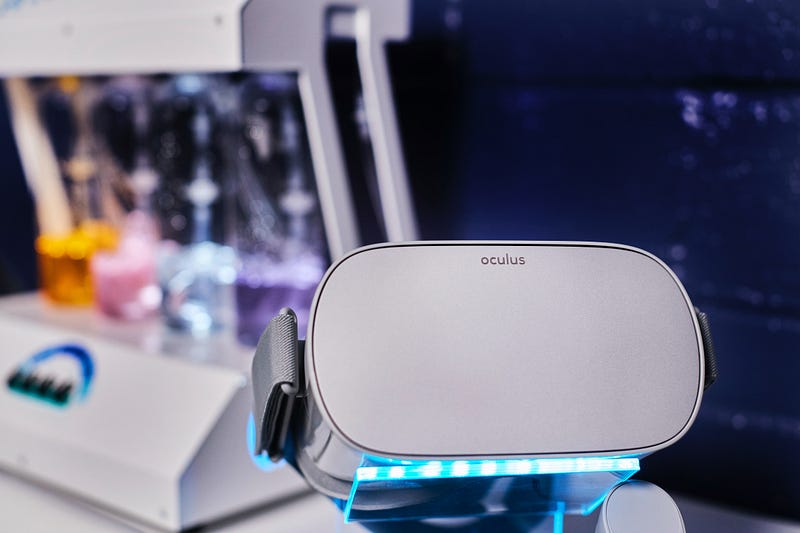
When Facebook first announced plans to develop the Oculus Rift, the feeling of virtual reality was taken up a notch.
Virtual reality has long been seen as an essential step towards achieving true computer-mediated communication, which would allow for both the virtual and physical worlds to be indistinguishable.
With this new development, Facebook bought two of the largest VR companies on Earth for 7 billion dollars in order to make it happen.
The Oculus Rift is a VR headset that was first developed by a team of scientists and engineers from USC.
It is fitted with a head-mounted display and sensors that track head movement to produce a realistic 3D environment.
The system’s graphical processor allows for more realistic rendering on the screen, as well as low latency video rendering at 60 frames per second.
In addition, the Oculus Rift is compatible with standard Xbox One controllers as well as Oculus’ Touch controllers.
The headset itself is able to display images at a resolution of 1080p, and the outer shell can be adjusted based on one’s face size.
Unlike other VR systems, the Oculus Rift is not tethered to a computer.
It requires no additional equipment other than an HDMI cable and can be turned on and off, as well as adjusted with ease.
The Oculus Rift has been praised for its relatively low price ($599) as well as its portability ($199).
All of these features make for an exceptional VR experience.
The Oculus Rift is not only used for gaming; it is also used for educational purposes.
The University of Edinburgh has created an anatomy program that allows users to dissect a virtual frog on the screen, and Abertay University has used the Oculus Rift to allow students to experience short horror movies in virtual reality.
The headset itself relies heavily on personal interaction with avatars, which can be seen as a natural progression from video conferencing systems such as Skype and Google Hangouts.
The Oculus Rift is a “magical” invention.
The Oculus Rift has been met with much skepticism from the scientific community, not only due to its price but also due to its potential limitations.
In one instance, Stanford University scientists were unable to produce an image with 3D depth in a virtual environment for over seven minutes.
If a person were to use this headset for hours on end, the lack of depth perception could result in a number of issues.
In addition, a study was conducted by Microsoft’s Applied Sciences division where test subjects were asked to solve puzzles in virtual reality.
The results showed that the test subjects relied heavily on their vision rather than their vestibular system when solving the puzzles, although the vestibular system is thought to be more strongly correlated with spatial awareness.
Despite these potential setbacks, the Oculus Rift has opened up new doors in the VR field.
Other companies, such as Google and HTC, have also released VR headsets of their own.
The miniaturization of VR hardware has allowed companies to pursue the development of VR technologies in ways that were previously impossible.
While virtual reality may never overcome all of its existing limitations, it seems inevitable that VR will be used for gaming and other third-party applications at some point in the future.
The Oculus Rift is being used in the gaming industry to enhance gaming experiences, allowing users to feel more immersed in their environments.
A notable example of this is the game “Job Simulator” by Owlchemy Labs, which allows players to learn how to do common jobs.
The game uses hand controllers that are similar to the ones that will be used for the Touch Controllers that are being released later on.
Another game, Arizona Sunshine, is an extremely realistic zombie shooter with graphics that put the player right in the middle of a post-apocalyptic world.
Some other games that were released with Oculus Rift integration include:
- Farlands — A game in which the player explores the planet of Farlands, searching for valuable minerals to trade with other players.
Like many games released with Oculus Rift integration, Farlands is a multiplayer game, but it is also available as a single-player adventure.
- Keep Talking and Nobody Explodes — A party game in which two players need to work together to defuse a bomb.
The defusing player is wearing the Oculus Rift, while the other players are looking at bomb-defusing documents.
The Oculus Rift player needs to describe what they are seeing to the other players so that they can defuse the bomb.
- EVE: Valkyrie — ‘An online multiplayer game in which players control spaceships in an intergalactic war.
This game was designed specifically for first-person shooting, and it gives players a genuine sense of being surrounded by enemies.
Players have called this “space combat on crack.”
Oculus Rift’s release date was originally set for March 31, but it was delayed to the first quarter of 2016.
The final price of the device has not yet been set, but an estimate is likely to be around $600.
Project Lighthouse is a clean-room, open-source custom server for LittleBigPlanet. This is a project conducted by the LBP Union Ministry of Technology Research and Development team. — source; Github
Project Lighthouse is a clean-room, open-source custom server for LittleBigPlanet.
The Oculus Rift does not just stop at gaming; it has also been used for educational purposes.
The University of Alberta has created an anatomy program that allows players to dissect a virtual frog on the screen, and Abertay University in Dundee, Scotland has used the Oculus Rift to allow students to experience short horror movies in virtual reality.
The Oculus Rift has been used for a variety of other purposes.
The University of Sheffield has partnered with Facebook to create a virtual reality model of DeepMind, a deep learning company that is owned by Google.
DeepMind Technologies is a British artificial intelligence subsidiary of Alphabet Inc. and research laboratory founded in September 2010. — source; Wikipedia
The partnership enables students to see how conventional data-processing techniques could be applied in an artificial intelligence setting.
Another area where virtual reality can prove useful is education.
In this case, people can be trained on the basics of engineering and medicine for their careers without having to physically get into a simulator or attend hospital simulations.
The VR classroom by the University of New South Wales uses the Oculus Rift to allow groups of students to learn how helicopters work without leaving a classroom.
In addition to gaming and educational applications, the Oculus Rift has been used for therapy training.
Lasting a few minutes at a time, a VR experience can be effectively used for therapy by alleviating the symptoms of PTSD and combat veterans.
The virtual reality field is also seeing some use in the medical field.
For example, many hospitals use simulators to train doctors on how to perform certain tasks, such as surgery.
Students and professionals alike can experience environments that would not be available in a physical setting such as an operating room or a neonatology ward with the Oculus Rift.
The University of Washington has also created a virtual reality system that allows players to explore possible future cities and buildings.
The virtual cityscape is used to serve as a visual aid for educational purposes, but it can also be used as a meditation tool for patients who must learn how to adapt to their surroundings.
Another use of the Oculus Rift is for training artists.
The “Hanging Gardens of Babylon” project is an example of this; players can manipulate the environment around them and paint whatever they see within the virtual space.
The Oculus Rift has also been used for virtual tourism.
Players can visit monuments, relax on beaches, and walk through cities through the Rift.
Virtual reality headsets are mainly used for gaming; however, some companies are starting to diversify the use of their technology.
For example, the American company Epic Games was recently awarded $500 million in funding by Microsoft to create virtual reality software using the Unreal Engine 4 game engine platform.
As virtual reality headsets improve, more people are also seeing the potential for other applications.
The possibilities for virtual reality technology in markets such as healthcare, education, entertainment, and design have been discussed.
In the case of government and military uses of virtual reality technology, the military has been experimenting with programs that can effectively utilize this technology to conduct training or assessments.
Other sectors that may benefit from the use of virtual reality include marketing and advertising, real estate, art and design, retail, and pharmaceuticals.
The Oculus Rift is one of the most significant technological advancements of recent history.
It has all the potential to revolutionize the way we view and interact with technology; not only that, but it may even extend beyond computer technology altogether.
It will be the first of its kind, and anyone who gets their hands on an Oculus Rift has quite a lot to look forward to.
The Oculus Rift is much more than just another virtual reality system.
It’s a resource that will revolutionize our daily lives.
Eventually, it will become the standard means for communication in much the same way that the internet has done in recent years — if not, even further than that.
As Mark Zuckerberg said in his letter announcing the release of the Oculus Rift, “It is time to put yourself at the center of your world. Because the world around you isn’t real.” This is a statement worth reflecting upon.
It is a statement worth treasuring.
It is a statement that has profound implications for the future of society.
The Oculus Rift will change the world.
Consumers have been able to get their hands on this amazing piece of technology since March 28th, 2016, when it was released for pre-order.
It concerns the original Oculus Rift and not the second one.
The headset was discontinued earlier this in 2014, and Facebook acquired Oculus VR in 2014 for $2 billion.
Author’s Notes: If you enjoyed the article, then hopefully you will inquire about a good headset to have a good time with it. This is one of those things that many people have been waiting a long time to purchase and now that they have it, they do not know what to do with it. However, if you already know what you are going for with your Oculus Rift, then you can get started right after reading this article.
Follow @Mediumitesocial
If you found this article informative and helpful, feel free to support me and other writers you read by becoming a Medium member. If you have any comments or questions, feel free to post them below in the comments section!
J.D Rehbein-Wrightstein founder of The Savytech articles is a writer who loves to help people discover their potential as well as their true purpose in life. He inspires and educates people on living an awesome life with inspiring articles. Connect with him on Twitter!


