
An outrage on every page: states making American children poor and criminals
Daniel Hatcher is a powerful writer. He gathers the facts and lets loose, in an unimpeachable salvo of accusations, all vetted and verified (and footnoted). Readers will be left reeling from the Introduction alone. Hatcher is the only author I know who does that. As I said when I reviewed his stunning first book, The Poverty Industry, readers will wonder how he could possibly keep up that pace. But for two hundred more pages, he goes from high to high, from outrage to outrage. So with Injustice, Inc. his latest. It is a further dive into the murky world of making revenue out of foster children, the poor and the disabled. And especially the Black. It then tackles probation and property seizures. All of them far more corrupt than readers could imagine. It is scarcely believable that American states operate this way. But Hatcher details it for all to see.
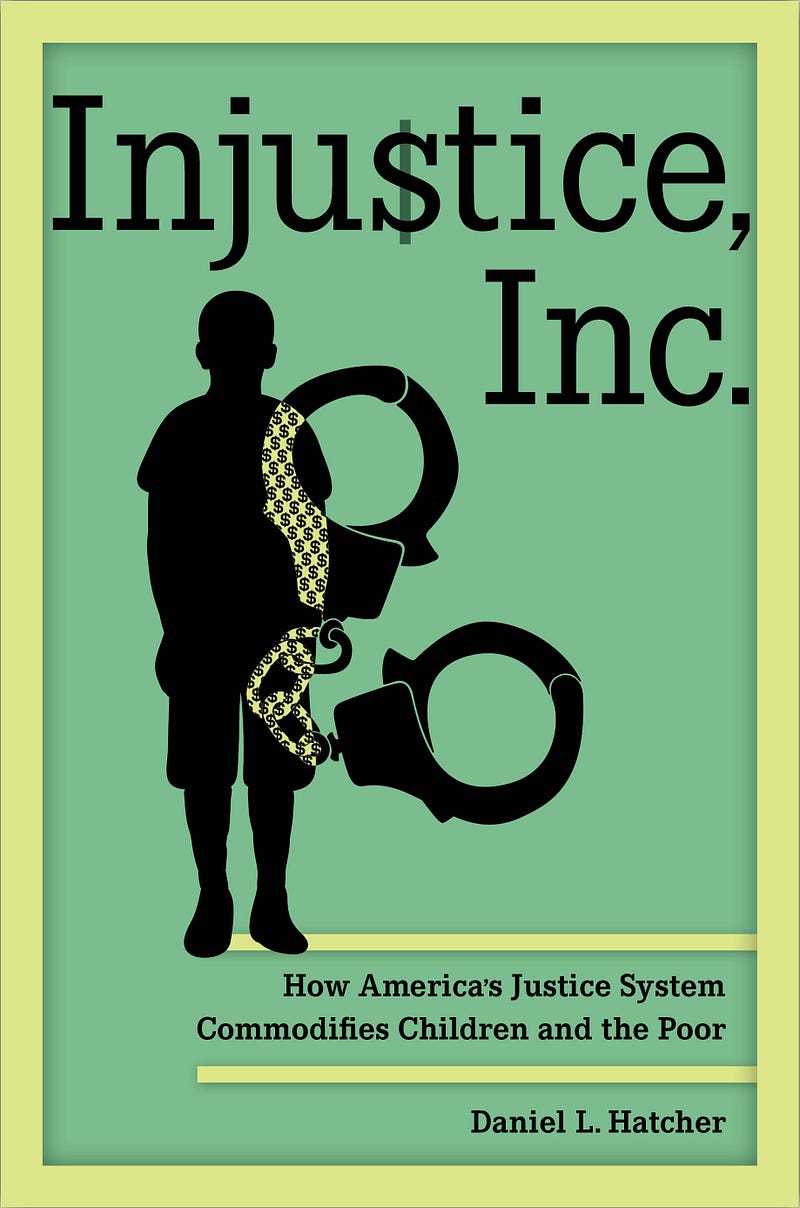
If I could even attempt to summarize, the states have completely ignored the constitution and any kind of ethics in setting up a money machine to bleed the poor, the disabled and in particular children, completely dry — for life. They have done it by converting the justice system to a vertically integrated business. They contract out services like police, probation and foster care, but they maintain ownership and control. They send a steady stream of bodies to those kinds of institutions in order to collect massive amounts of money from federal programs. They process everyone in-house, involving every aspect of criminal justice. The executive branch runs the show. It often places the state Justice Department under Finance instead of Justice or Public Safety, just to make the point. Courts report to the Governor in far too many states.
Once captured by the system, victims’ lives become instantly worthless and will not recover. Their debts to the justice system will keep ballooning until they die. County officials run contests among the staff to see who can rack up the most new live bodies. Judges get pay and benefits based on convictions. So do sheriffs. It’s all about profits. It not the least concerned with Justice or rehabilitation.
Their private sector advisors, who get a large percentage of the take, instruct them that things like probation reports cannot say everything is fine. They need to be as negative as possible in order to keep people in the system, because they are all multiple revenue streams. Jail contracts require the state to keep them nearly full at all times, for maximum profit. The result in California is that 50% of Black and native children are investigated by the criminal justice system. Across the country an incredible 14 million children are taken into the system. Every year.
An absolutely astonishing list of fees keep growing every day of their lives, and they are periodically sent to jail for nonpayment, often because they are already in jail or unemployable thanks to their “criminal” record. As part of vertical integration, states may have their own collection enforcement units. They will seize private property, sell it off and divide the spoils. Basically, they damage people such that they cannot function in society, which leads them back into the criminal justice system, which has been waiting for them. Hatcher cites a federal government report that $63 billion in property and cash was seized in a recent 16 year period — in just 20 states. Naturally, 65% of the victims were Black. Typically, victims have no way to get their property back, as it requires a lawyer, forms, fees and hearings to come out favorably.
This is a taste of what Hatcher his discovered in state after state, all over the country. In Hatcher’s lovely and restrained style: “Rather than providing vulnerable populations with equal justice, the institutions are mining them, using commodification tools strengthened and modernized through time and technology.” His elegant writing style is what the saves the book from causing total rage: “The injustice enterprise inflicts a starkly disproportionate racial impact while using hundreds of thousands of children and impoverished adults as fuel for a money-making fire that burns the ideals of justice.“
It is all the more remarkable because he lives this on a daily basis himself. Hatcher tries to shepherd clients through a legal system set up to not merely to capture them but to destroy them. He is dumbfounded by the lack equal treatment under the law, by the lack of justice, by the unfair piling on of bogus fines and surcharges on them, and the outlandish severity of penalties meted out to people who can’t even afford a lawyer. Their single crime is not being rich.
The first part of the book has far more detail about the foster care system, the focus of his first book. Here, readers learn that foster children suffer PTSD twice as much as military veterans. They get it from being pumped full of psychotropic drugs to keep them manipulable, docile, and basically easier to store. They are taken from their mothers at the slightest pretext, in order to apply for welfare, Medicaid, SSI — any kind of revenue stream the system will then keep. Hatcher found that 80% of the money obtained for foster children is never used for their benefit. The state however, seizes all their assets first, so they qualify. One child, the sole survivor of a car accident, lost the family home before being shunted around the foster care system.
This section also introduces readers to the reality of child support. Child support was originally meant to protect the state from the expenses involved in maintaining children of the poor. Because once a child is born, the state wants nothing whatever to do with it. So today, American states go after mothers and (absentee) fathers to recoup whatever money they claim to have spent warehousing their former children. Failure to pay means parental rights are quickly terminated — the parents no longer have any involvement with their children. They belong to the state, while parents deal with ever-mounting debt for the rest of their lives. The states claim former parents owe them –not the children — $23 billion in repayments, while they also keep the money from the federal government. Hatcher cites one 20 year old woman who pays for her own child support in order to keep her ill mother out of prison for nonpayment.
As for family values, the states want them broken up. It is common for a woman to lose all benefits for her family if a man is found in the house, often during invasive surprise overnight inspections. She will have to pay them all back, with the goal of terminating her status as a parent so the state can claim several new revenue streams from her former children. Similarly, the man will have to pay “child support” to the state, ruining him as well.
States go to extreme lengths to keep the foster care production line churning. Hatcher found family courtrooms right in county jails. He found totally nonprofessional officials acting in place of judges, and courts without judges at all. Some states use artificial intelligence in place of judges to speed things up. Counties take pride in juvenile trials that take less than five minutes. They can process thousands of children a month in their family and juvenile courts.
In Pennsylvania, two judges were convicted of sentencing endless numbers of children to their own for-profit reform schools. Hatcher also found that in PA, lawyers only need six hours of training to be licensed in the field of foster care, but it takes 600 hours to get a massage license. In Ohio, he says, the courts themselves are essentially foster care agencies. Hatcher tells the story of teen escapees from foster care, hiding out in the forests because they said they felt much safer there. The beatings, the torture, the humiliation and the “care” in these institutions might be legendary, but they are true.
This is as good a place as any to point out that this entire scenario is not merely unethical, but unconstitutional. In the USA, the constitution provides for separation of powers. The justice system stands as equal to the executive and legislative branches. Having it report to the executive branch is not allowed. As for judges, who absolve themselves of conflict of interest when challenged, Founder James Madison said: “No man is allowed to be a judge in his own cause; because his interest would certainly bias his judgment, and, not improbably, corrupt his integrity.” But this is precisely what is happening on a daily basis today. State administration after administration does nothing to stop it. Hatcher claimed New Hampshire got 40% of its budget from foster care.
There have been lawsuits, mostly by entities like the American Civil Liberties Union. They win. The counties get fined. They might even break up the system. But no one is dealing with this as a national scandal. The ACLU is free to sue each county in the country. That would take centuries. Racketeering by state Justice Departments is beyond reach.
On the probation scam, Hatcher minces no words titling it “Unconstitutionally Extorting Fines and Fees from Children and the Poor.” Probation is a money machine. There are fines for everything. There are surcharges on the fines. If community service is required, victims have to pay daily registration fees, monitoring fees and evaluation fees. If classes are required, victims pay per class, and if they miss one, they have to take whole course over, and pay. “The probation officers also enforce numerous conditions of probation, such as frequent drug testing, mandatory classes, attending therapy, and wearing electronic ankle monitors, all of which add substantial fees owed by the probationer… If probationers fall behind on payments, they are charged additional fees and interest.”
As I read, I felt queasy. This is not the kind of country I expected. In the state of Georgia, one out of every 17 people is under the supervision of private law enforcement. Blacks, who typically make up 12–20% of a population, generally account for 80% of those in the clutches of the system. In Black communities, the number of arrests often exceeds the number of residents. From an initial traffic stop or a teacher complaint to eviction and imprisonment, the system has it in for Blacks.
When I read Hatcher’s The Poverty Industry seven years ago, it affected me more than any book I had ever read. That I still remember the details without rereading it is testament enough. Injustice, Inc., if anything is at least as affecting. It covers a wider humanitarian scandal with the same depth, clarity and proof as the first book. It exposes the states as corrupt, venal, greedy, uncaring, racist, bigoted, prejudiced and criminal. It is sickening to think that this is the United States of America, and except for a handful of nonprofits that have the monetary stamina to sue, no one is doing anything to stop it. The book is a visceral gut punch for anyone who cares at all about human life.
David Wineberg
(Injustice, Inc., Daniel Hatcher, February 2023)
PS. I know most people won’t go on to read the comments and responses, but I hope you will read this most worthwhile one from Morgan Summer :
I might add that this injustice extends into family courts having to do with protecting children from abuse and sexual abuse. The same approach is used to bankrupt the parent trying to protect the child once disclosure happens. As one would expect, it’s often the mother. I am one of them. I have legions of fellow mothers, who came out the other end with no justice, no money, and often, no child. Just like you point out in this book., no one seems to know about it.
I was raised by a lawyer, and I didn’t know…. I thought the system is set up to protect children. No. The system is set up to extort money and control women and children.
To make it worse., I’m now encountering the same situation trying to manage my survivor’s school. One in three girls and one in six boys are sexually abused before 18 and yet for the life of me, I I can’t find a single person that knows how to deal with it regarding education. They are much more focused on getting my kid back into school then helping her heal from 11 years of violent trauma. Can you imagine? My point is that I think my entire view of this country was rocked sideways from the experience. There’s a pervasive evil running inside our government system and I feel like the media protects it.
Thank you for sharing this article and I will be purchasing the book today.
.
For more by Daniel Hatcher, see my review of The Poverty Industry: https://readmedium.com/states-scam-their-poor-for-billions-in-fed-funds-9b7edc0251db
.
If you liked this review, I invite you to read more in my book The Straight Dope. It’s an essay collection based on my first thousand reviews and what I learned, including my review of Daniel Hatcher’s first book, The Poverty Industry. Right now it’s FREE for Prime members, otherwise — cheap! Reputed to be fascinating and a superfast read. And you already know it is well-written. https://www.amazon.com/Straight-Dope-learned-thousand-nonfiction-ebook/dp/B07Z48VQMT/