
An Open Apology To Smokers
Many of you will be afraid to read this story

Dear Smoker,
I want to apologize and let you know I’m truly sorry for all those times I tapped you on the shoulder and asked you to blow your smoke in some direction other than my face.
Please forgive me. I just didn’t know.
I had no idea your actions were so well-planned — so well thought out.
Thinking back on our too-many confrontations, I can’t believe you’ve been so tolerant with me, sometimes even putting out your cigarette to calm my rising temper.
I must have seemed like an over-reacting, insensitive, rude, selfish, thoughtless moron.
Now that I look at your habit from a different perspective, I understand just how vital it is for you to smoke at every opportunity.
For you, smoking is not rude — or inconsiderate.
Smoking is simply part of your plan.
And it’s a plan so effective, it’s convinced you to embrace life’s consequences as enthusiastically as its pleasures.
Perhaps if I explain it to others — revealing the scope and timing — I can help non-smokers to understand. My efforts might even result in a new level of public tolerance for you, the next time they encounter your trail of drifting monoxide.

You began years ago.
Maybe it was curiosity or your friends convinced you to try your first one. But it wasn’t long until you really believed you were receiving pleasure from smoking.
For you, it was Phase One — the beginning.
Sure, you read the warnings. But you stayed with it. You even acknowledged the risk. Well-meaning concern from family and friends became frustrating reminders of a future so far away, it was unimaginable.
But no self-delusions for you — no need to white-wash the truth. You continued because, by then, it was a part of your identity.
You were … a smoker.
Phase One passes without incident — a good ten, twenty, or thirty years.
Then comes Phase Two of your plan.
Ironically, Phase Two is a non-smoking one — or it should be.
Oh, at first, you’ll tell your family — even your doctor — you’ve quit.
But you’ll still sneak a puff or two when you’re sure no one’s around.
Make no mistake, even with a gradual tapering off, you’ll definitely reduce the amount of smoke, tar, and nicotine you force into your lungs.
But that nagging cough wasn’t going away. And you were tired of being winded after climbing a single flight of stairs.
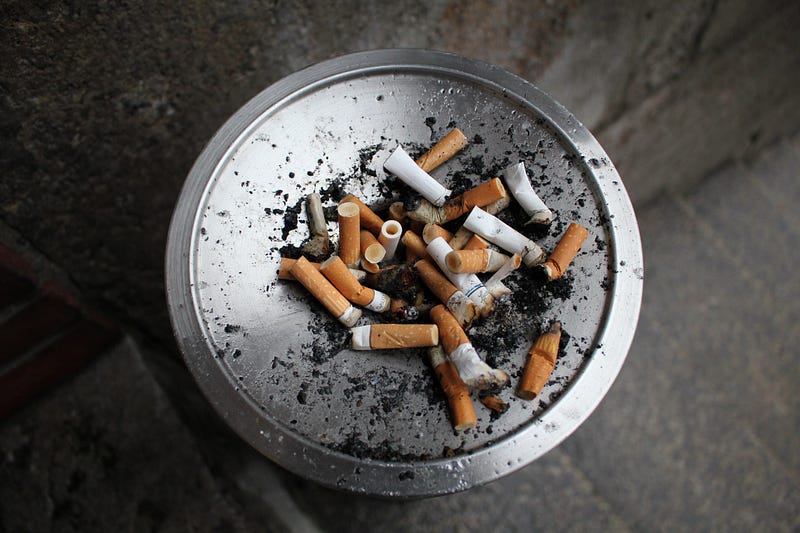
Quitting was hard.
But you did it. And you’re surprised over your renewed stamina and how much easier it is to take a full breath.
Then, before you know it, Phase Three arrives. It usually arrives as a phone call.
“The x-ray shows a spot on the lung,” the doctor says.
“Serious?” you ask.
The doctor responds with well-rehearsed generalizations — non-committal rhetoric leaving you with more questions than answers.
Because it’s the way he’s been trained.
Compared to the first two, Phase Three is relatively short. And like Phase Two, it’s also a time of total abstinence.
Because it’s become all too real.
At some point, your doctor will recommended a procedure designed to remove the corrupted and malignant tissue from your body.
He’ll call it a procedure — you’ll know it’s surgery.
You’ll think it strange as your doctor explains the risk to you with the same level of emotion as an auto mechanic describing a transmission repair.
There’s an odd thing about cutting your body open — how it persists in the memory as a kind of milestone or benchmark.
From then on, you’ll forever think about your life in two parts: The events that happened before the operation, and those that occurred afterward.
The actual procedure will be short or long, depending on how much the doctor decides to leave in and how much is taken out.
And as the day approaches, you’ll be scared, wishing and praying there was an alternative. But you’ll do your best to smile at your family as you try to reassure them.
You won’t sleep much the night before, watching the clock, wondering if your doctors are getting plenty of rest.
As the nurses move you from the bed to a gurney, you’ll feel the sedative kick in, and you’ll struggle to get out a few final words before they wheel you toward the operating room.
“Don’t worry, it’s going to be alright,” you mumble.
But no one hears you.

You’ll awaken slowly.
The sounds of rustling nurses’ uniforms and that low pitched hum that lives inside the walls of every intensive care unit are in the background. At first, you’ll fight to remember where you are. But as the anesthesia lifts and the dull, numbing sensation gives way to a solid aching pressure, it comes to you.
The doctor drops in that afternoon to tell you what he found.
You manage a few questions.
“Had it spread? Did you get it all?”
An hour later, you can’t remember what he said.
A week passes. Your vitals are stable. You can go home.
As the nurse goes over a list of instructions for post-operative care, you nod at the blur of words, most of which are lost in an avalanche of triplicate release forms requiring your dazed signature, and confirming the fax number of the pharmacy for a handful of prescriptions that must be immediately filled.
But there are exceptions — words that cut through the noise and lingering after-effects of the pain pills.
Radiation.
Chemotherapy.
Regular visits to the oncologist.
And so you go back and forth, once or twice a week, depending on how much your body can tolerate, since it must now fight the added burden of fatigue, blistered skin, nausea, and the effects of caustic chemicals no human should have to ingest.
But at least you get to go home.
Until it’s time for a second procedure.
You were told it might be necessary.
Maybe the tumors returned, or they didn’t get them all the first time. But regardless of the reason, it has to be done.
“The sooner the better,” the doctor says.
Because your life depends on it.
Like remembering a bad accident, the familiar assaults your senses — the antiseptic smell of stark-bright hallways, the battery of forms for insurance and consent, and the uncanny resemblance of hospital food to a tasteless frozen dinner.
As the nurses arrive with the gurney, you think, “I’ve done this before. Why am I doing it again? Will it make any difference?”
The sting of the needle tells you there are mere seconds left to be conscious — to tell your family not to worry, that you love them.
You dream.

A scene from your childhood …
You’re playing baseball — with doctors and nurses. You ask questions, but they can’t hear you.
Suddenly, you’re lying on top of the pitcher’s mound. They hover over you, ready to open your chest. You try to tell them to stop, that this isn’t the right time or place. But their faces are blurred, their fingers transformed into razor-sharp talons.
A part of you knows it’s not real. But still, you wonder why you can’t wake up.
The anesthesia lifts slowly. You fight to remember what’s happened to you.
At first you won’t think it’s true.
You’ll wonder how something so manufactured and alien could be connected somewhere inside of you. You won’t touch it, because having something this abnormal imported into your body doesn’t deserve to be touched.
The two-inch diameter tube rises out from your chest like an alien tentacle. Slowly, an inch at a time, you scan the contents.
You’ll wonder what your kids will think about this tube packed full of blood, pus, and dead flesh slowing inching its way out of your open chest.
Until now, there was always a part of you that believed you would beat the odds.
The part that thought you would walk out of this mess alive, and you would live another ten or twenty years.
But looking down at this newest attempt to prolong your life, you know there’s no point in lying to yourself.
You’re going to lose.
No more plans for the future, no more “normal” left in your life.
And so your plan continues.
The late afternoons drag by.
You’ll ache for your own bed, wishing the time would pass, while you fight to savor each moment.
You’ll watch all those afternoon TV re-runs that occupy the mind and dull the senses.
And when the nausea forces you to lie absolutely still, you’ll count the thousands of tiny pin holes in the acoustic ceiling tiles.
Friends from the office will drop by. Once.
You won’t want them there, seeing you like this. And you’ll wonder if it’s selfish to be embarrassed about dying.
But those thoughts pass.
By now, your family has worried themselves sick.
At first, there were the all-nighters — taking turns, waiting in shifts, sometimes trying to get an hour’s sleep on the couch in the visitor’s lounge.
Now, there’s not much they can do but watch as your skin becomes so thin and transparent the joints in your fingers become traced and outlined.
So they touch you extra gently. And as if to confirm the growing decay inside your chest, your breath will take on the most revolting, nauseating odor you can imagine.
But they still kiss you.
As you continue to lose weight, your face becomes drawn and sunken, making it difficult for others to recognize you — especially those who haven’t visited in a month or two. Although they do their best to hide it, you see it on their faces — the shock, the painful realization that it’s really you inside that crumbling shell of a body.
And now a very special part of your plan will begin — a part reserved for those who love you the most.
The daily visits from your son or daughter will be more strained than usual.
The sympathy and pity will be gone, replaced with poorly hidden frustration and anger — at you, the doctors, themselves — over being forced to watch as you take forever to die.
You’ll realize they’re making plans, looking forward to a more pleasant future — after you’re gone.
By now, the disease has strained your organs to the point of failure. And in your mind’s final attempt to disassociate you from your painful surroundings, something odd will happen.
The last few emotional circuits you have left will disconnect.
In a most absolute and final way, you simply won’t care.
You will say things — things that will rip away the love and compassion that holds families together.
You will say them to those who should never hear them, not realizing the years that will pass before they’ll be able to put their anger and guilt into perspective, and live comfortably with your memory.
All part of the plan.
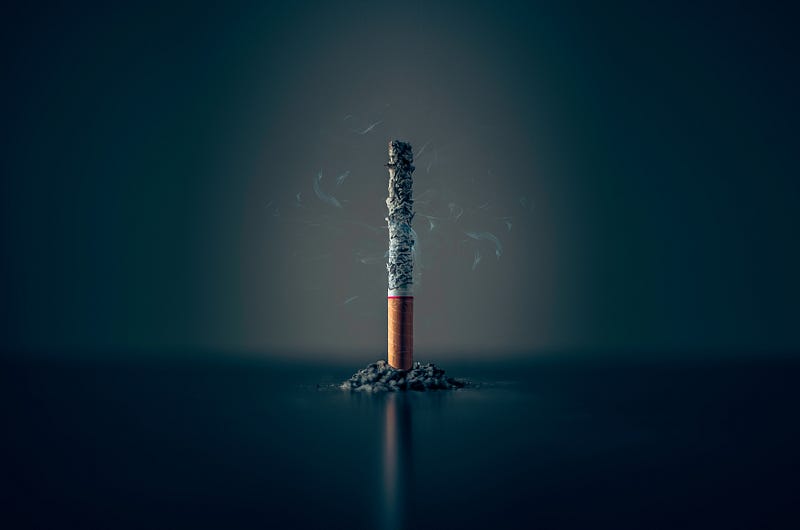
And so, my smoking friends, I hope it is not too late to set things right between us.
Just last week, during my lunch hour, a woman in her early twenties sat down at the outside table next to mine. She had barely finished tossing her coat across the empty chair when she pulled a cigarette from her purse.
In seconds, it smoldered between her fingers.
Waiting for her food, she asked if she could borrow the extra napkin on my table. As I handed it to her, we began a conversation.
Unapologetically, she asked if her smoking bothered me, continuing to inhale without waiting for an answer.
She told me she had started about a year ago, because it calmed her nerves and improved her focus — as if smoking had magically made her more effective at work.
“Magic smoke?” I asked.
She laughed.
So I wished her well with her plan — as I do with yours.

I urge you not to fall behind.
Stay on schedule. Take one out right now and light up.
Really suck back on it. That’s it. Take that smoke deep into your lungs. Now hold it.
Hold it in as long as you can . . . so it can do its magic.
Dedicated to:
My father — a smoker for thirty years, he passed away from lung cancer at age 62.
My sister — a smoker in her teens, she passed away from lung cancer at age 37.
My niece — a smoker in her teens, she passed away from lung cancer at age 61.
© 2020 Roger Reid. All Rights Reserved.
Find more tips & strategies for personal and career success in Better Mondays
Roger A. Reid, Ph.D. is the founder|host of Success Point 360 Podcast and author of Better Mondays: The New Rules for Creating Financial Success and Personal Freedom (While Working for the Man) and A certified NLP trainer with degrees in engineering and business, Roger offers tips and strategies for achieving higher levels of career success and personal fulfillment in the real world.


