
THE NARRATIVE ARC
An Ode to My Two Grandmothers That I Didn’t Love
How I celebrate the difficult women in my life after they died
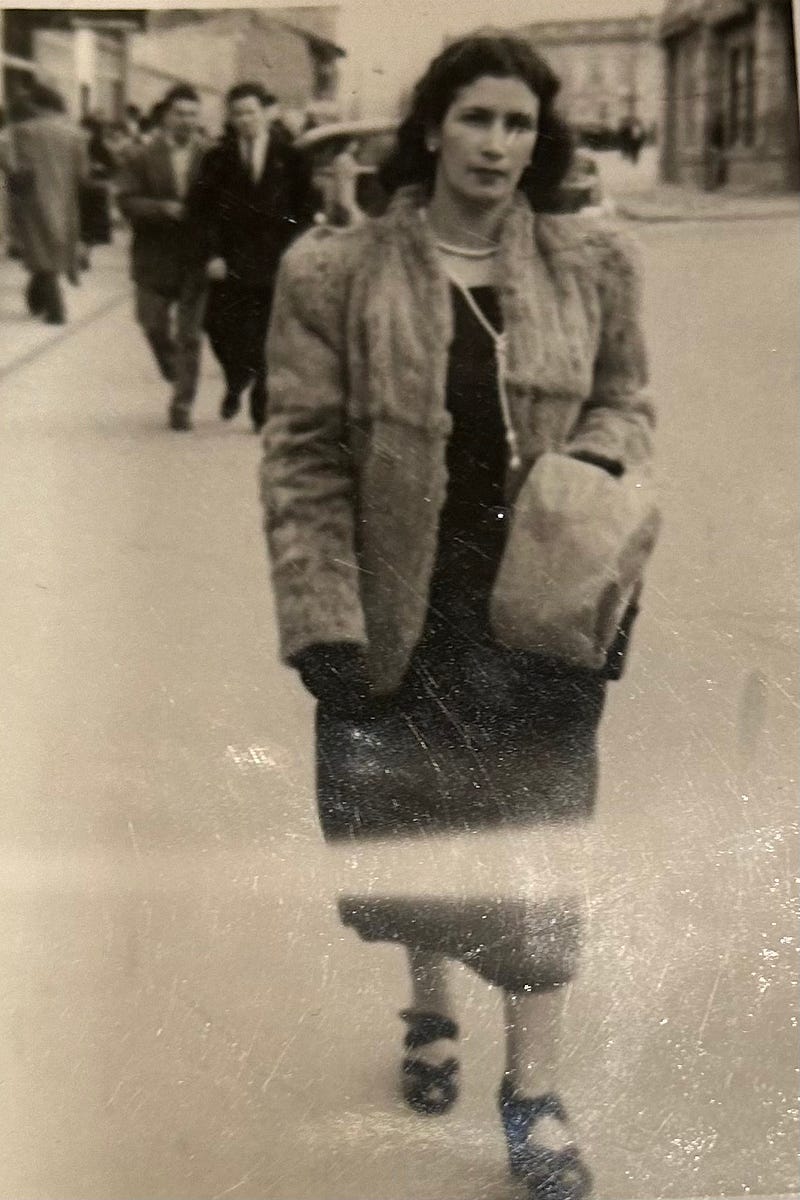
Unbeknownst to my grandmothers, some of the qualities I appreciate the most about myself, I inherited from them. My grandmothers, one Jewish, one Colombian, were not of the cute and cuddly strain.
No one was baking me muffins whilst reading me Mother Goose on her lap.
We tend to feel nostalgic or obligated to say something sweet at just the mention of the word grandma. She’s the adorable old woman knitting on the porch, with the roast in the oven. She lived for your success. You are the future of the family. Her doily-filled home was your soft place to fall.
I had friends with this grandma. I never identified with the reverence they felt— the love they had for their grandmother. This had me worried. I wasn’t jealous. I wasn’t longing for a grandma. Instead, practical kid that I was, I worried about one of my own grandmothers dying. They were old. I knew I wouldn’t cry.
I didn’t love my grandmothers. I didn’t feel a loss — it was just a fact. They didn’t really love me either. Not a love I could recognize.
Half a century later, this sounds sad. But it wasn’t, I had a Mom that loved me tenderly. I thought that was all I needed.
But it was weird. Of course it was weird. Suffice it to say that weird is just the tip of the iceberg once we start probing around the bedlam of my childhood.
My grandmothers were just there. One, quite involved in my life, the other, an almost extraneous figure that I had to pretend to care about.
I understood that my grandmothers were limited, they were stuck somewhere inside. I never took it personally. I’ve always had the ability to see people for who they really are. I was very literal and couldn’t be tricked. This is why I could never utter the word grandma. I almost found it repulsive. I was not a liar and I was not going to call someone grandma who wasn’t one.
My Jewish Grandmother was named Geraldine, and I never called her anything. She was nice, kind of mushy, a little dopey, and completely absent in my presence. To get her attention I would just say hey and waive my hand.
I didn’t feel unliked or slighted. I just felt nothing. Very little came from her towards me, so I responded in kind and gave little back in return.
This appears hostile, but it wasn’t. It was just empty. Just like the boarding houses she used to run that were mostly empty. I did enjoy roaming around these giant old houses for hours. That’s what Geraldine gave me, freedom to wander around and explore at will.
My Colombian grandmother, Maria, offered us, my mother and I, actual housing. This is how she loved us. She did her duty and took care of her family. But she wasn’t all that nice, especially to my mother. I hated her for it.
Both of my Grandmothers were the product of the hell it was to be female 100 years ago. I’m not categorically saying it was a nightmare to be a woman a century ago, but it had it’s challenges. There may have been plenty of woman having a lovely existence — my grandmothers’ were not amongst them.
Maria had the quintessential wretched South American childhood of the 1900’s. Abject poverty, no shoes at times, no toys, no love, no joy. Toilet paper was a luxury that only her rich cousin enjoyed. Her childhood stories, that I listened to intently, were filled with cruelty.
Her father was abusive. Maria was the eldest of nine — from that family. Of course, he had another family with another woman, on the other side of town. Such was the fate of poor Colombian women.
Maria’s mother, Carmen, was a sweet soul. I shudder to think of what her life was like with her husband, poverty stricken, having child after child, barely able to feed them. God bless my great grandmother Carmen.
Maria was an excellent student, there were high hopes, she was on her way out. Then, the inevitable happened. She got pregnant by a beautiful, light eyed, poetic man, unlike anyone she had ever met before. He was classy, elegant, and educated. He wore a suit.
And like every tragic cliche, he was also an abuser. He abused Maria’s daughter, their daughter — my mother. Maria finally made her escape, with her now 17-year-old daughter, and came to the United States, leaving Colombia behind like a dead cat on the road.
She never looked back.
I was acutely aware of Maria’s limitations. She used all of her strength to survive and maintain a decent life here. She was there, she made me dinner, I found her interesting. It wasn’t great, but it wasn’t terrible.
Her treatment of my mother was rough, though I knew she loved her. My mother was a burden, something she couldn’t show love to. No one showed Maria how to love. Plus my mother was difficult, profoundly difficult. But that’s another story.
I called Maria “Nana” sometimes. It was her title, it never really meant grandmother to me. It was her position in the family.
As a teenager I made a conscious decision to form a slight relationship with these woman. I wanted to know who they were.
It was clear they were not okay. In fact, they were really fucked up. I wanted to find out if there was anybody underneath that layer of devastation, affliction, and mystery.
Remarkably enough, both of them loved to travel. The surprise stems from the fact that they were both on the poor side, often overwhelmed. They were distracted by things we couldn’t see. Yet every once in a while they would take off.
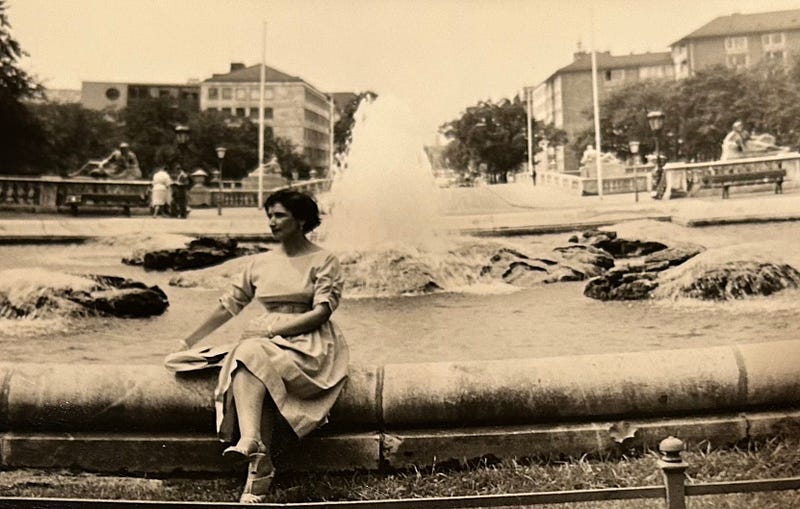
Maria traveled all over Europe with my mother in the early 1960’s. I found the photographs fascinating. There they were, dressed to the nines! Suits, hats, gloves, heels, standing in front of a fountain in Italy.
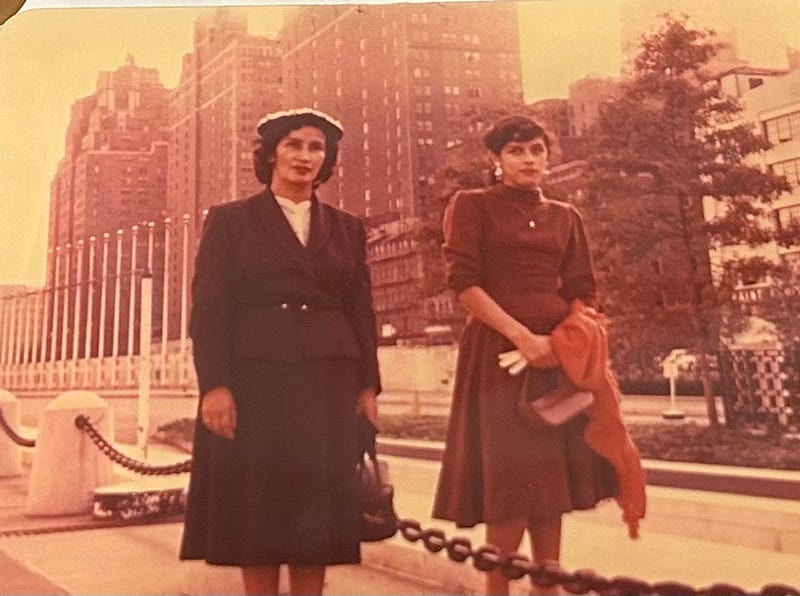
Geraldine, who I hardly saw out of a house dress, would suddenly go to Czechoslovakia to get a mud bath. Maria took off to Mexico City to see the art work and the architecture.
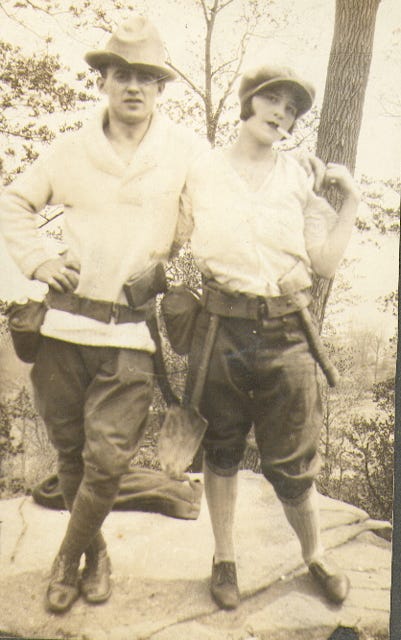
Geraldine looked like a movie star in all of her photographs as a young woman. It’s what she wanted to be, glamorous — a starlet. She came from a theatrical family. I’m sure the calling came from deep within. My guess is that she never planned a large family. She had many children — too many. Some died — some she abandoned. By the time I entered the picture, she had morphed into an almost ghost of herself — not all there.
She was a hard worker, plowing ahead through her daily routine, loving her children, the ones she kept, my father and aunt. She ran around like she was on fire, busy, busy, but she was kind, and earnest.
As a child I said, “She’s touched in the head.” It’s clear she was somewhere on the spectrum. She never sat down, never stopped moving. She never slept. Probably ADD, a family trait.
Whether the constant misfiring in her brain was a neurological issue or caused by a psychological break — we’ll never know. My guess it was probably a combination of both. Yet, she was sweet, in a far, unavailable way.
If I asked about her past she would burst out crying. The rule of thumb was to never ask. I assumed there was a murder somewhere. Yes, I grew up in a family where I assumed a murder had happened. I still wonder.
What I did find out about Geraldine was not pretty. As a matter of fact it was shocking, but I wasn’t shocked. Just like with Maria, I knew they came from the many rings of hell, some they created themselves. They were distracted by pain. They couldn’t be my grandma’s. I always forgave them, I didn’t care that much, but I never blamed them.
I never got close to Geraldine, but I started to have a bit of affection for her, a tolerance for her. She was always nice, but I was a sensitive child. I needed connection.
Maria on the other hand thawed out as I got older, and I relaxed my heart as well. It was understood that she loved me. She was a surviver and she assured my survival.
She almost complimented me once by saying, “Now this is how you should dress and wear your hair!” I had come over to show her my gown on the way to a black-tie affair in NYC. I looked like a million bucks. I knew she would love it. She was blown away but that’s all the compliment she could muster.
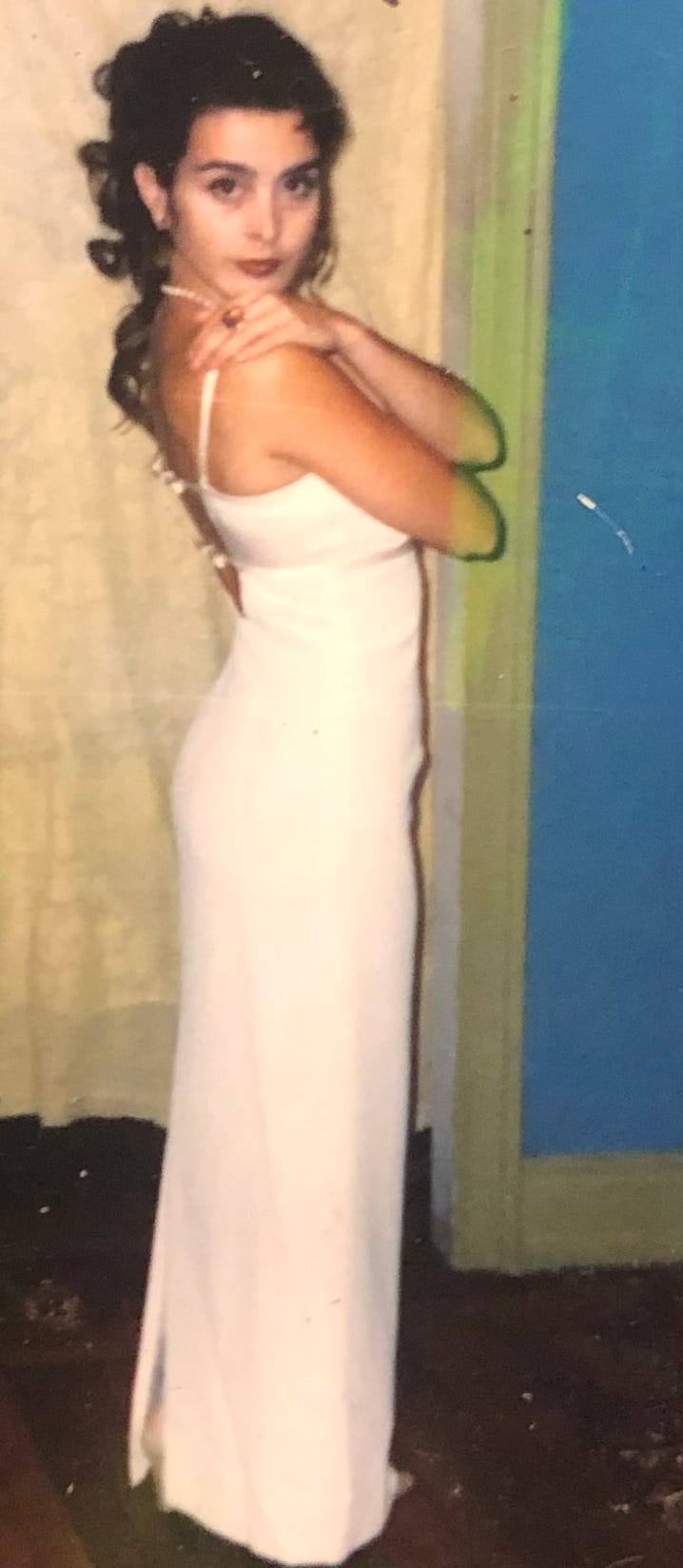
“Nana, this is an updo done in a hair salon, and I’m wearing a gown. I can’t look like this everyday.”
She harrumphed and looked at me critically, as if I looked like a vagabond the rest of the time. But I could tell she thought I was beautiful, like her daughter.
I remember Nana telling me that my mother had the longest and most beautiful lashes as a child. My mother was drop-dead-gorgeous! But that’s all Nana said. That’s the best she could do that day.
She said my fingers were almost translucent when I was born. She noticed me.
One day in Colombia Maria stood up from her table, putting her hands in the air, gathering her strength. She would escape. She felt her power.
Maria came to America, learned English, and got an accounting job that paid 14K a year. She saved every penny and started buying her homes in cash. She was a miser of the first degree, but the American dream she did achieve.
Geraldine worked at the race track. I liked the track. She made tuna sandwiches in the kitchen and would always offer me one. I loathed seafood, and everyone knew it but her. I hated tuna until, fifty years later, I suddenly like it. I always think of her when I eat a tuna sandwich. Sometimes connections come through a back door.
Geraldine was in a slight fog, but she managed to keep buying strange houses, turning them into boarding homes, full of old men shuffling around, cooking soup.
Where did these woman get their Moxie? In spite of their wounds, regrets, and guilt, they eked out a decent life. They persevered without pause, never complaining — ever. Never blaming a soul for their lot in life.
And by some sort of grandmother osmosis, they taught me this — How to go after what you want no matter how badly you are limping.
I know I have real guts, I’ve been told this all of my life. I’ve watched myself bravely face some God awful shit. Let’s face it, the grandma’s are just a peek into the chaotic world I grew up in.
But I have Moxie. Nerve. And I know where I got it from.
And by some sort of grandmother osmosis, they taught me this — How to go after what you want no matter how badly you are limping.
I went to Paris by myself when I was sixteen. I have a pull to travel that is out of my control. It’s taken me as far as the South Pole, over to New Zealand, and back to Europe. I have to travel, and I know where I got this from.
I bought my first property when I was 25, I was a dancer, everyone thought I was nuts, but I knew it was a good deal. I know a good deal when I see one, and I know where I got that skill from.
As a child I accepted that no part of my family resembled a Norman Rockwell painting. And this certainly included the lack of an apple pie- baking Grandma showering me with love.
Yet, my grandmothers gave me parts of themselves — their best parts.
I was keenly aware that without them I wouldn’t be here. I liked being here, being alive.
This may seem like an extreme form of connecting with my grandmothers. Cutting back all delusions of normalcy and just sticking to the cold facts. I exist because they exist. If anything, I am practical.
By the time I was fifteen, I was fully aware that a road was not being paved for me to have a great life. I would not be launched into a bright future. My entire family was in survival mode at all times.
At the same time I could taste the great life that awaited me. There was no way I was going to stay on this horse and buggy of despair. My future was in my own hands, and when a relative made a suggestion or tried to intervene, I mostly ignored it. They had no clue. I got this, thanks.
I took me years to understand why I craved a certain amount of glamour. A blue collar life, the one implied, was a hard no.
No. I would see the world. I would travel in circles beyond my rank. I would know how to behave at a table with people my Nana would describe as elegante.
I had the drive to jump out of my situation. I learned not to do what they did. I would not get caught in a life that I didn’t want. The overcoming of many a struggle of the women behind me helped push me into the life I wanted.
It is both the strength and weaknesses of my grandmothers that informed me. Being present and expressing love has always been key. I knew not to take out my pain on others.
The ability to just get it done, to piece it together even when life is in fragments — this skill I directly inherited from Geraldine and Maria.
When Maria told me that story about standing up at her table with her arms in the air, gathering up the balls to leave behind the unspeakable — I felt her strength.
I had that too — serious Moxie.


