An Introduction to “The Wild Bunch: Gods, Guns, and Gangs”
Excerpt from my new DELUXE edition . amazon.com.author/johnsibley
January 15, 2022
By Steve Balkin, Professor Emeritus at Roosevelt University
Sibley’s literary essay is amazing for the number of elements he brings together to construct his viewpoint on crime and violence. Usually, when one writes about crime and violence, the arguments are based solely on a social science perspective. Taking off on a different path, Sibley writes from a humanities point of view, focusing on film criticism, history, biblical interpretation, gender studies, observations on contemporary day-to-day life, and movements in the political sphere.
There are paragraphs where Sibley describes scenes from Sam Peckinpah’s 1969 film, “The Wild Bunch”. He immediately shows its parallel in violence directed against Blacks, as in Charleston, South Carolina, and Ferguson, Missouri. The cadence of those sentences reads to me like hip-hop poetry. It is a slam for sensibility in an unpleasant and violent world.
Sibley raises many issues, from urban street violence, to right-wing political extremism following a presidential election, to Chinese history. He makes the reader consider themes of civil unrest, which, at this point, may relate to a possible second American civil war similar to that between the Chinese Leftist Maoists and the Rightist Chinese Nationalist followers of Chiang Kai-shek. Sibley senses that Peckinpah’s observations of the conflict in China during and after World War Two are what he now observes America becoming: a contested political environment leading to a more violent world.
Sticking with Asia, he draws the Viet Nam War into his arguments, seeing the relevance to the My Lai Massacre. This horrific incident was caused by the revenge mindset of soldiers left free to implement extreme brutality in the heat of war. This Asian civil war was fought as a proxy conflict between the U.S. and the Communist East. No one involved in the massacre was convicted of a crime that resulted in hard prison time. American government officials immediately denounced the few soldiers who tried to shield the villagers from the violence as traitors.
Sibley compares Peckinpah’s directing artistry in “The Wild Bunch” to Italian Renaissance painters, then to Picasso and musician John Coltrane. These being in the realm of modern art and jazz music, they give power to the jazz-like lyrical verbal form of Sibley’s descriptive metaphorical poetry.
Sibley proposes that street gangs of Chicago might be just another Wild Bunch. They both use guns and speak of loyalty as an important part of gang character. But The Wild Bunch are older men, outcasts fallen from society, appearing as grizzly losers. There are similarities. However, street gangs of today are younger, and their contemporary violence seems due to a lack of social controls caused by gang factions splintering off from the older, larger hierarchical gangs. The kings of street gangs are killed off, have died off, or are in prison. If gangs can transform back into larger groupings, as in the street gangs from the past, and with a heightened sense of what is bad for business, that could result in less violence on the streets.
Sibley’s conclusion asserts that Capitalism, as a broad-based concept, may not be the cause of violence in American society. That is a good and relevant point. However, he goes on, it is the lack of an adequately regulated Capitalism that contributes to violence. His key to a better regulated Capitalist system is improved income redistribution policies and a better functioning educational system. I think Adam Smith and Reverend Martin Luther King Jr. would both agree.
Sam Peckinpah
M
y focus is not on writing a biography about Sam Peckinpah, but on using his movie as a prophetic metaphor to explore American violence. Peckinpah’s cinematic genius is discussed to shed light on existential violence in urban communities because, after forty-two years, his movie still serves as a metaphor. As author Huntington points out, “The West won the world — not by the superiority of its ideas or values or religion…but rather by its superiority in applying organized violence.”
As I write this today, July 17, 2021, at least seven people were killed, and another forty-eight were shot this past weekend in Chicago, including four teenagers and a twelve-year-old girl. According to the Sun-Times records, at least ninety-one children ages fifteen and younger have been wounded so far this year, eleven of them fatally. There have been 2,254 shootings through July 17th, 2021. Over a hundred people were shot on the Fourth of July weekend, and nineteen were killed.
I live on the Southside of Chicago, not too far from the infamous O Block, where rappers Lil Durk and 26-year-old King Von, who was recently murdered in Atlanta, were both affiliated with a faction of Chicago’s Black Disciples street gang. The crackle of gunfire late at night is a constant reminder that I live in a war zone. The violence in Chicago’s west and south sides makes me think about the million Hutus and Tutsis slaughtered in 1994 during the tribal war in Rwanda.
Black Gang
You may ask what urban violence and tribal war in Africa have to do with Peckinpah. Well, just like television showed the horrors of the Vietnam War and the civil rights movement in the South, Peckinpah’s lens gives us a prophetic look at a future purge-like carnage, captured ‘live’ on video and the nightly news for the world to see.
“The whole underside of our society has always been violence and still is. Churches, laws — everybody seems to think that the man is a noble savage. But he’s only an animal. A meat-eating, talking animal. Recognize it. He also has grace, and love, and beauty. But do not say to me we are not violent. Because we are.” Sam Peckinpah.
One year ago, on January 6th, 2021, was it a pro-Trump mob or a gang that breached the U.S Capital to try to block the certification of President Biden’s Electoral College victory? George Papajon, a Tribune staff writer states, “Gangs like the Black Disciples may be a scourge on communities that cower when the bullets fly and bodies fall.” Most gangs worship Satan because violence is part of his nature. His violence is ungodly. Did he not persuade Adam and Eve to oppose their Maker? I use the noun “Gods” in this book because it broadens the meaning of the definition of God. In Revelations, the returning Messiah is presented as a bloodstained warrior on horseback. Time Magazine writer Samuel Perry writes about a Christian Nationalist God: a god that thirty million white adults believe America’s success plan is based on.
Insurrectionists stormed the U.S. Capitol on January 6th, 2021
Perry writes, “…unless we look back at countless photos and footage of the violence — are the Christian banners and flags, the wooden crosses, the impromptu praise, and worship sessions, the “Jesus Saves” sign, the Christian t-shirts, and the infamous corporate prayer in Jesus’ name in the Senate chamber.
Having stormed the Sanctum of American democracy, the “QAnon Shaman” thanked God for “filling this chamber with patriots that love you and that love Christ,” allowing them to send a message to their enemies “that this is our nation, not theirs”. Many of those Christian Nationalists believe, as David Hume wrote, “In the Book of Revelations with its violent overthrow of a globalized human religious and economic system by the returning Jesus Christ as encouraging on God’s behalf.” Which raises the issue: is there a difference between human and godly violence?
Former U.S. President Barack Obama recently wrote, “One year ago, a violent attack on our Capitol made it clear just how fragile the American experiment in democracy really is. And while the broken windows have been repaired and many of the rioters have been brought to justice, the truth is that democracy is at greater risk today than it was back then.”
Critics said that my sci-fi thriller, Bodyslick, published in 2008, was full of gratuitous ungodly violence. I was outraged. Did the critics see the violence in The Wild Bunch? As one of my favorite fiction authors, James Lee Burk, said, “There is something bestial and cruel at work in the human race.” The Wild Bunch is a Machiavellian movie. ‘Machiavellian’ comes from the Italian philosopher Niccolò Machiavelli, who wrote The Prince in the 1500s, and encourages “the end justifies the means”, or, as Malcolm X stated, “by any means necessary.”
Peckinpah’s 1969 western is not for the faint of heart. The movie is centered around an aging outlaw gang having one last adventure on the border of Texas and Mexico, a reactionary group of outlaws terrified of modernity living in a modern world that is slowly re-shaping their identity. Although the movie was set many years ago, similar visceral, violent, and gory scenes appear in Tarantino’s recent Once Upon a Time in Hollywood, particularly the scene with Brandy the pit bull as she ravenously cannibalizes the male Manson follower’s genitals. Peckinpah’s influence can also be seen in Mel Gibson’s brilliant and grisly movie Hacksaw Ridge and Antoine Fuqua’s classic Brooklyn’s Finest, which equal Peckinpah’s cinematic scenes of dread, gloom, heroism, and the atmosphere of death. Peckinpah, Tarantino, Fuqua, and Gibson must make room for the genius writer-director James Samuel, whose Netflix western The Harder They Fall captures the themes of love, extreme violence, class, and culture.
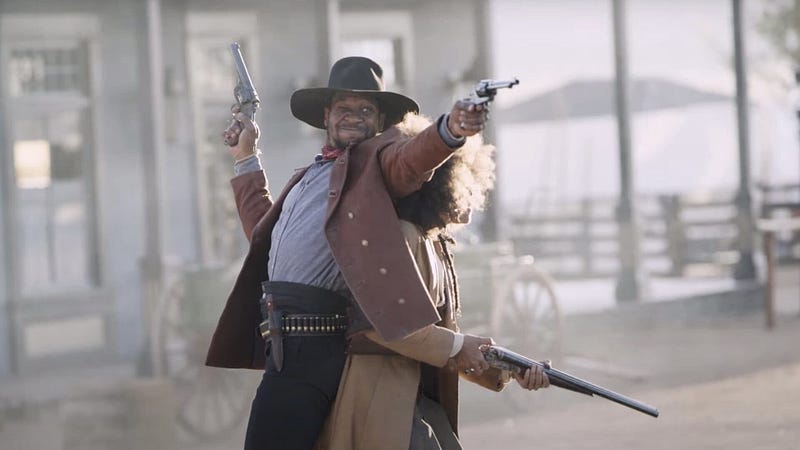
A scene from The Harder They Fall
His movie, like Tarantino, Gibson, and Fuqua’s, is male-led, saturated by the obsession with the “good old days” when “men were men,” when no ‘fluid’ or ‘metro males’ seemed to exist, nor the #MeToo movement or gender-neutral washrooms. Peckinpah’s movies are an unflinching formal accusation of P.C. culture, of men lying on the grass and smooching with their dogs. A culture where you would never see a father let his daughter put make-up on him and dress him like a woman. And do not forget the cowboys in Brokeback Mountain.
The Wild Bunch is about revenge and conquest as well as frontier justice. Pike and his posse became heroic anti-heroes because they rejected the empirical philosophy for how things work, instead choosing the path of redemption through an honorable warrior’s death. Activist Rap Brown said, “Violence is as American as apple pie,” and Pearse writes, “The unprecedented comfort of our lives allows us if we are not careful — and we have been careful to lose hold of the fundamental realities that underpin all human existence. We can use our wealth to cocoon ourselves from those unpleasant realities, at least for a while. In so doing, we fail to empathize with the poor majority of the Earth’s inhabitants who cannot escape, setting ourselves up for conflict with them.”
A scene from The Wild Bunch
I was riveted in my seat as I watched the cinematic masterpiece highlight a violent, masochistic blood bath as a rite of passage for bounty hunters, led by Pike Bishop’s gang in the fictitious no-man’s land of the Texas-Mexico border in 1913. I sat in the theater, grinding my teeth as the Mephistophelian odor of the bullet-ridden carnage seemed to float off the screen. As Harlan Ellison wrote, “The bullets pulverized their bodies as blood poured from them like a cloud burst, and yet they were still alive, twitching, with the involuntary horror of a frog’s leg shocked with electric current, as their organs were squeezed and bile, shit, and skin sizzled.” It was like thinking about Dylann Roof, an avowed white supremacist who used a .45 caliber Glock pistol to kill nine people at the Emanuel Methodist Episcopal Church in 2015. It was like looking at 18-year-old Michael Brown, face down in the middle of the street, blood streaming from his head. Dead for four hours, his corpse rotting in the hot noonday sun, shot and killed by a renegade police officer in Ferguson, Missouri. It was like hearing the howl of dogs boiling alive at a wet market in Wuhan or the butchering and squirming of pigs at an Iowa meatpacking plant. It was like watching the visceral murder of George Floyd on video. Author David Waddell writes in his book, “If they move…kill ‘em.”
“Peckinpah was not a detached iconoclast, cynically manipulating his audience about the violence in his movie and within himself. Compelled by the romantic concept of masculinity in provoking barroom brawls with stuntmen, he was mortified and racked with guilt when his drunken rages scalded loved ones — Marie, Begonia, and his kids. He was not alone when Vietnam, Watts, and other American cities went up in flames. America’s entire blood-drenched history and mythology graphically illustrate that Peckinpah’s struggles were a microcosm of those tearing his country apart at the seams.”
The Wild Bunch is not a morality tale concerned with ex-nihilo or the beauty of the sunset of the Old West or Mexico. Rather, the movie reflects the existential violence Peckinpah saw while serving in the Marine Corps in China, where the 1st Marine Division had been assigned the task of disarming 630,000 Japanese soldiers and civilians and shipping them home. Peckinpah’s battalion (the second) was stationed at Tientsin, which is the same size as my city, Chicago. He witnessed the U.S. prop up Chiang Kai-shek’s nationalist regime during Japan’s invasion of China in 1937. Nationalists and Mao Tse-tung’s communist forces rallied against them; however, the two factions began to fight again once the Japanese were defeated. The U.S. would not let Mao’s communist forces control China’s vast population. Peckinpah saw the alleged defenders of democracy, Chiang Kai-shek’s nationalist regime, perform public executions on spies and thieves every Saturday morning.
Devaluing Chinese life had a powerful influence on Peckinpah’s worldview through his movies. Bloody combat between Maoists and Kuomintang forces after WWII inspired him to shoot the “Battle of Bloody Porch” scene, where Mexican warlord General Mapache uses his knife to slice Angel’s throat. Angel, a member of Pike Bishop’s gang, is himself Mexican, born in a nearby town and where General Mapache slaughtered Angel’s people. Angel pleaded with Pike to give him guns for revenge, but he was captured and tortured. All hell breaks loose, as The Wild Bunch open fire on Mapache after their compañero falls dead from a sliced throat and a rapid-fire, hand-cranked Gatling gun scene spews out a smoking 26.5 in barrel .58 caliber bullets which fired 350 rounds a minute.
I agreed with W.K. Stratton when he wrote, “Most of General Mapache’s federal troops who die are killed by the machine gun. It presaged what would happen years later when the technology of killing had progressed even further when a lone killer with an assault rifle could kill dozens of unsuspecting people in moments.” Violence in The Wild Bunch also reflects the horrors of the Vietnam War, particularly the Mỹ Lai massacre. Charred napalm bodies, soldiers rendered headless from bombs, mines, and grenades, legless torsos, and raped Vietnamese women come to mind. The Mỹ Lai massacre was the mass murder of unarmed South Vietnamese civilians by U.S. troops in Son Tinh District, South Vietnam, in March 1968. Between 347 and 504 unarmed people were killed, including men, women, children, and infants.
The Wild Bunch was released on June 18, 1969, during one scorching summer amid the riots in Watts, Detroit, and Chicago on college campuses across the nation and the assassination of Bobby Kennedy in 1969. The movie shows us the reality of violence as an unholy yet unavoidable truth — violence that haunted him ever since his military service in China, as he abhorred the sanitized violence of his day. He exposed America’s thirst for combat sport, gangsta’ rap, and gory movies. His movie was also the first to explore the PTSD of violence as a Vietnam-era veteran.
The irony is that the Vietnam War was the first telecast “live” on T.V. You could view the carnage while eating dinner and gulping down a beer. In a way, the war prepared movie-goers for the existential violence of Peckinpah’s genius. I was stationed at Osan Air Force Base in Songtan, South Korea, and eating Kimchi when I watched the 1968 NBC footage of South Vietnamese Brigadier General Nguyễn Ngoc Loan pulling a Smith & Wesson pistol out of his holster, raising it, and shooting point-blank at the temple of a Vietcong officer. The barbaric image helped Americans question the war effort, which led to the antiwar movement in 1966. Caravaggio, the famous 16th-century Italian painter, showed his biblical characters in a non-idealized fashion. Peckinpah did the same with his western characters. The difference is that Peckinpah was not trying to humanize his outlaws. As the writer Baggot states in Farewell to Reality, “I want to persuade you that reality is like liquid mercury: no matter how hard you try, you can never nail it down. It is only when you synthesize the information being processed by your visual cortex in your conscious mind that you experience the sensation of a beautiful rose.” In Peckinpah’s universe, the rose would be violent. Does the Gatling gun in the movie represent the violence of the future?