
WRITING INSPIRATION
An Introduction to the Flashku, Hemingku, Kindku, Pareiku, Sepigram, Sixku, and Vardhaku
New forms to boost your creativity!

An Important Note
All the forms in this post focus on inspiration. Positive / uplifting elements must be included in your pieces. Also, references to nature are encouraged.
Interested in sharing your pieces with David Ellis and me for a chance to be featured in the Auroras & Blossoms publication? Please read our rules here.
The Flashku
I created the Flashku in 2021.
A Flashku is a short piece of flash fiction (50–100 words) inspired by an image. It contains minimal descriptions and uses seven words borrowed from another piece. The climax should be reached at about 80% through the story, while the ending must contain a positive / inspirational twist or resolution.
Example of Flashku
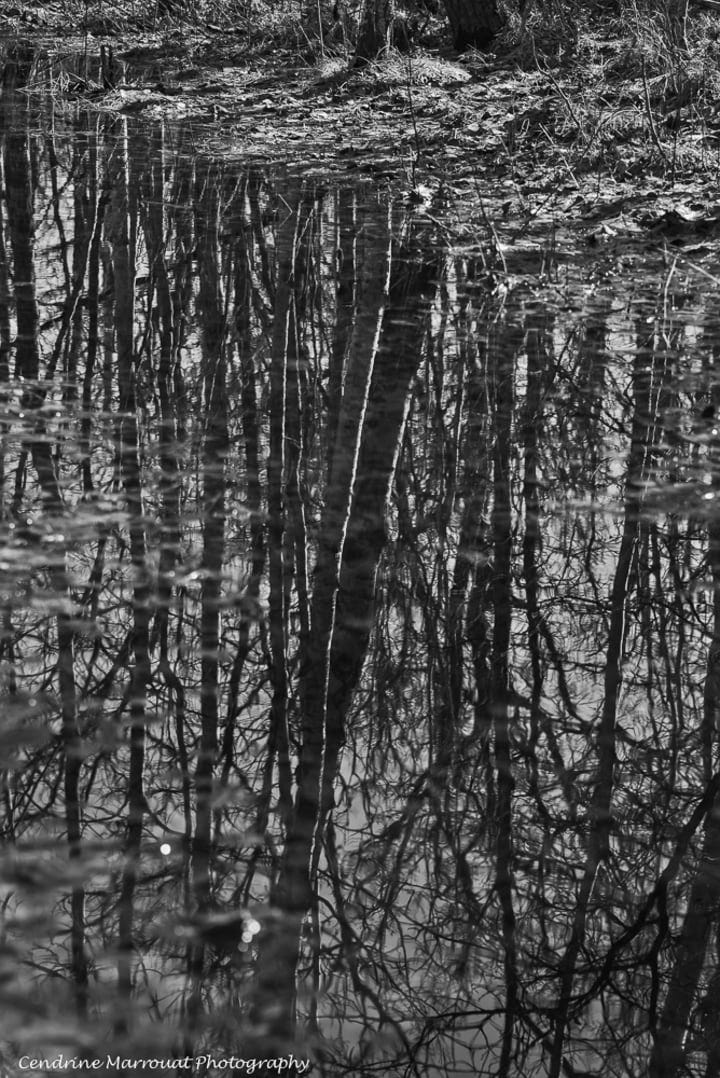
When they greeted each other, she asked herself if it was love.
Suddenly, the reflection in the puddle was disturbed. “Pitter-patter,” said the rain. They smiled.
“The garden is not far. Just at the end of the road,” he said, gently inviting her to follow him. Their wanderings together always were a unique source of comfort. So, she jumped over the puddle…
Mesmerized by the crackling fire, she remembered the silence of their first kiss.
And now, a lifetime later, as they looked at each other, she finally knew.
© 2021 Cendrine Marrouat
Flashku inspired by Kahlil Gibran’s The Wanderer
The Hemingku
The Hemingku is one of three poetry forms I co-created with author and poet David Ellis (2022). The word is a portmanteau consisting of the following elements:
- “Heming”, taken from the famous writer “Ernest Hemingway”, who is known for his six word story prowess and writing a powerful story with a tiny amount of words; and
- “ku”, as in ‘haiku’.
The idea behind the Hemingku is to allow writers of all sorts (poets, prose / short story writers, novelists, etc.) to create a poem that tells an impactful and inspirational story with a very limited number of words.
A hemingku must be composed in the following format:
- 7 to 10 words picked from two seemingly unrelated sources;
- The words can be spread across a maximum of 4 lines; and
- They must tell a complete story or scenario.
A hemingku poem can have a title (which does not count towards the overall word count) and punctuation. No matter the topic covered, the tone must be uplifting or inspirational. Finally, you must credit and link to the inspirations behind your pieces.
Example of Hemingku
Eden
Eden: the wild sea a flower the hour to dawn.
©2022 Cendrine Marrouat
Hemingku inspired by: Wild nights — Wild nights! (Emily Dickinson) & Nothing Gold Can Stay (Robert Frost).
The Kindku
Here is the second form I co-created with David (2020), this time as an invitation to promote kindness, positivity and inspiration through poetry.
The Kindku is a short poem of seven lines. The syllable pattern is 7 / 5 / 7 / 5 / 7 / 5 / 7 or 5 / 7 / 5 / 7 / 5 / 7 / 5.
The Kindku must include seven words that are taken from one specific source — a poem, a book, a newspaper article, etc. In the case of a book or long piece of writing, those words must come from the same page.
Words must be used in the order they were found. Their placement also depends on the line:
- Line 1 starts with word 1
- Line 2 ends with word 2
- Line 3 starts with word 3
- Line 4 ends with word 4
- Line 5 starts with word 5
- Line 6 ends with word 6
- Line 7 starts or ends with word 7
Kindku poems can have titles and punctuation. No matter the topic covered, they must sport a positive tone.
Kindku poets are encouraged to credit and link to the inspirations behind their pieces.
Example of Kindku
Art Writes Itself
Art writes itself in the heart before other things; intent lingers for a while inviting practice, lost hope to find a new map. on this continent you are the only master.
© 2020 Cendrine Marrouat
Kindku inspired by Elizabeth Bishop’s One Art
The Pareiku
The Pareiku is the third poetry form that I co-created with David (2020).
The word “pareiku” is a combination of two ideas:
- ‘pareidolia’ — the tendency to perceive a specific, often meaningful image in a random or ambiguous visual pattern.
- ‘-ku’ — a tribute to Japanese poetry forms like the haiku and tanka.
The Pareiku is a unique type of art that features the visual and poetic elements. Two seemingly unrelated images are linked together as one by a short 19-syllable poem that follows the 7/5/7 syllable pattern.
A Pareiku must have a title, but the punctuation of the poem is optional. The two images can feature the same or different types of visual art (photography, paintings, drawings, sculptures, etc.). However, you must own copyrights or have permission from the artist(s) to use those images. Furthermore, credits are required at the end of your piece.
Pareiku are meant to be positive / inspirational and family-friendly. This means: no erotica and no swear words allowed.
Example of Pareiku
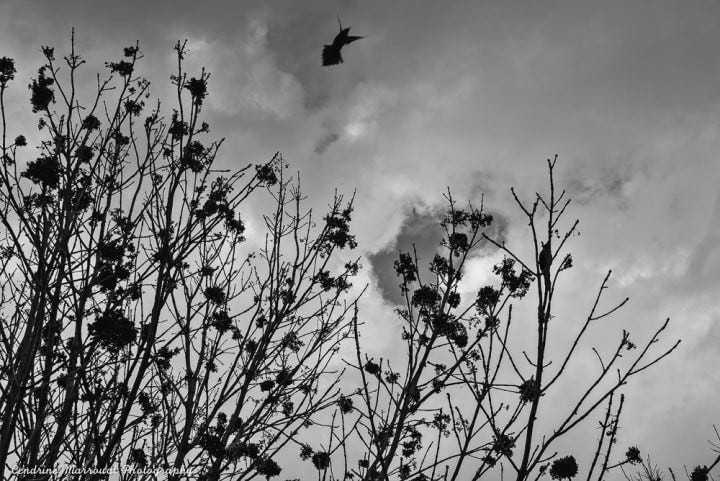

Years ago, we did not know: even hidden notes find their way into bird songs.
© 2020 Cendrine Marrouat
The Sepigram
The Sepigram is a poetry form I invented in 2022. The word is a portmanteau of “seven” + “pi” + “-gram” (‘something written’ or ‘drawing’). The “pi” part refers to the number π (3.14159 rounded up to 3.1416), which is the ratio of the circumference of a circle to its diameter.
The Sepigram is an unlimited poem that follows a “fractal” (or repetitive) pattern. Each part contains 14 lines and must be divided into 2 stanzas + 1 concluding line. Punctuation and titles are optional.
Part 1:
L1–1 word L2–7 words L3–8 words L4 — repeat word from L1 L5–7 words L6–8 words L7 — repeat word from L1 or use a different word
L8 — repeat word from L1 or use a different word L9–7 words L10–8 words L11 — repeat word from L8 L12–7 words L13–8 words
L. 14: Use seven words from preceding lines (in any order) to make a sentence.
The poem can end here or continue.
Part 2:
L15 — repeat word from L8 L16–7 words L17–8 words L18 — repeat word from L8 L19–7 words L20–8 words L21 — repeat word from L8 or use a different word
L22 — repeat word from L15 or use a different word L23–7 words L24–8 words L25 — repeat word from L22 L26–7 words L27–8 words
L. 28: Use seven words from preceding lines (in any order) to make a sentence.
The poem can end here or continue.
NB: As with all my other forms, sepigrams must feature positive / uplifting elements. A reference to nature is encouraged. For example: season, weather, month, time of the day, etc.
Example of Simple Sepigram
Night came to us in a soft whisper in the dance of rain at five o’clock. Night settled among the embers of our fireplace like an old friend who knows her place here.
Day followed quietly when night forgot to look such an unruly child, we could truly say. Day settled in our chairs, bed and kitchen, bringing smiles on our faces, in our hearts.
Night came, day followed, smiles settled quietly.
© 2022 Cendrine Marrouat
The Sixku
The sixku (pronounce ‘sis-ku’) is a poetry form that I created in 2019.
Sixku are six-word, untitled poems which must be inspired by and contain a photograph. A reference to nature is encouraged.
The Sixku has three lines:
- Line 1 = idea 1 (one or two word(s))
- Line 2 = idea 2 (two or three words)
- Line 3 = twist, surprise (remaining words)
A seventh word is acceptable, only if it is an article or preposition (e.g. ‘a’, ‘the’, ‘up’, ‘down’…). Do not abuse this exception, though.
Complete sentences and punctuation are optional and the use of the past tense is allowed.
Example of Sixku
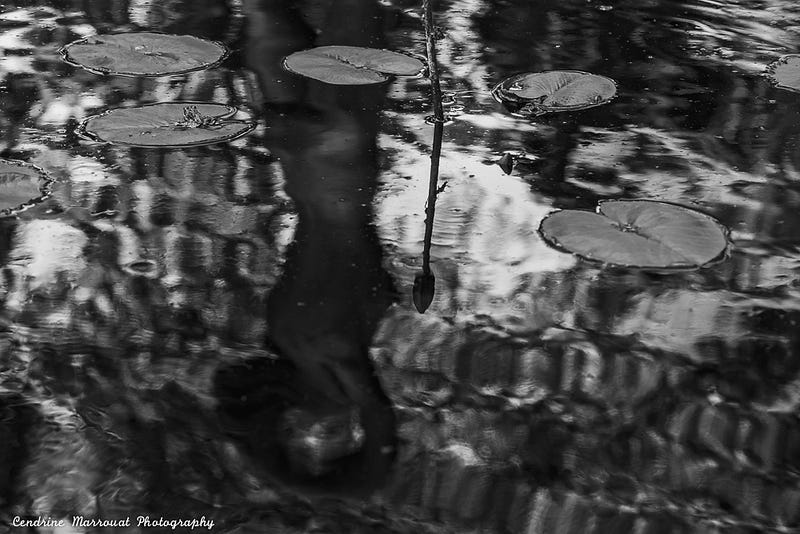
Afternoon shadows; fluid shapes are poetry.
© 2020 Cendrine Marrouat
The Vardhaku
The Vardhaku is a poetry form I co-invented with Vocal writer Justin Smith in 2021, as an invitation to reflect on one’s personal growth.
The Vardhaku is a portmanteau word consisting of the following elements:
- “vardha”, a Sanskrit word meaning ‘the act of increasing, giving increase or prosperity; augmenting; gladdening’ or ‘cutting, dividing’ (Source: Monier-Williams Sanskrit-English Dictionary)
- “ku”, as in ‘haiku’
The Vardhaku is an expanding five-line poem divided into two parts: The first four lines describe a problem or situation, with the fifth line offering a positive / inspirational resolution. Title and punctuation are optional.
Using a combination of syllables and words, the Vardhaku mainly focuses on conciseness to deliver an impactful message to the reader. It must be composed in one of the following formats:
- 1, 3, 5, 7 words (lines 1–4) / 10 syllables (line 5)
- 1, 3, 5, 7 syllables (lines 1–4) / 10 words (line 5)
- 2, 4, 6, 8 words (lines 1–4) / 11 syllables (line 5)
- 2, 4, 6, 8 syllables (lines 1–4) / 11 words (line 5)
Example of Vardhaku
This the long hours the long forgotten embrace of our yesterday: we are still swimming in a deep ocean of love.
© 2021 Cendrine Marrouat
That’s it for today!
If you enjoyed this post, consider supporting my work.