avatarAdam Deitsch

Free AI web copilot to create summaries, insights and extended knowledge, download it at here

3777

Abstract

8°C and less than 15°C, saturation of the soil can lead to a decrease in oxygen content, and the soil is acidic, lies in a humid region, and has low natural fertility. This places the series under the order <a href="https://www.nrcs.usda.gov/wps/portal/nrcs/detail/soils/edu/?cid=nrcs142p2_053588">Inceptisols, which makes up for approximately 17% of the world’s ice-free land</a>.</p><h2 id="9424">Texture and Horizons</h2><p id="eda2">Texture of Paxton soils can range from fine, sandy loam to coarser loam as it approaches the lowest horizon. The soil is mostly sand (about 52%) with a small portion of silt (33%) and clay (15%). It is considered an actively developing profile.</p><p id="8c1e">A pedon (smallest sample of soil for surveying) of Paxton will usually have 4 horizons (Ap, Bw1, Bw2, Cd), with Ap referring to plowed topsoil, and Cd referring to unconsolidated, dense till. There are some samples which have more (O, Ap, E, Bw1, Bw2, BC, E’, Cd).</p><figure id="a530"><img src="https://cdn-images-1.readmedium.com/v2/resize:fit:800/1*412HH4oq9UIP_-BIBMET2g.jpeg"><figcaption>Horizons of Paxton soil, including some features (O, E, BC, E’) that do not occur in all pedons. Horizon segments are not to scale. Image by <a href="https://deitsch-halevi.medium.com">author.</a></figcaption></figure><p id="8d91">The horizons are all acidic and increase in gravel content with depth. The Ap horizon is dark brown and can extend to around 20cm before abruptly transitioning into the Bw1 horizon. This horizon is dark yellowish brown of mostly fine, sandy loam, and has a gradual, uneven transition to the Bw2 horizon (olive brown). Bw2 has similar properties to the Bw1 horizon, with notable differences in the percent of gravel, number of fine roots, and a well-defined, wavy transition to the Cd horizon. The Cd horizon is olive, with very gravelly (five times as much gravel as the Ap or Bw1 horizons), fine sandy loam, which is very brittle.</p><h2 id="f9fe">Use and Management</h2><p id="74e6">The characteristics of Paxton soil make it <a href="https://www.soils4teachers.org/files/s4t/k12outreach/ma-state-soil-booklet.pdf">viable for the cultivation of various crops</a> in areas that have been cleared of larger stones and obstructions, with typical crops consisting of apples, birch, corn hemlock, hickory, maples, oaks, pine, and silage. Paxton has also been used for light construction or pastureland.</p><p id="76a5">There are limitations with the use of Paxton soils, which can be correlated to some of the qualities that make them suitable for prime farmland. As Paxton has a high holding capacity, it can generate seasonal perched water tables as deep as 4 ft. While this can be beneficial for agricultural purposes, it is can also impose stressors to the soil itself, causing increased erosion and leading to anaerobic conditions from heavy saturation. This excess water can also be a hazard in harsh winters, when frost expansion can cause structural damage to the area (e.g., housing projects, roadways, and septic systems).</p><p id="2722">Management practices can include use of conservation tillage, as well as using cover crops or methods of strip cropping, to slow down the potential for water-based erosion. Other current conservation and management issues are related to loss of farmland and forested land in the Commonwealth. <a href="https://www.wbur.org/earthwhile/2020/11/10/dual-use-solar-farms-agrivoltaics-massachusetts">Thousands of acres have been lost to development of solar farms</a>, and there could be <a href="https://www.bostonglobe.com/2020/07/12/metro/woods-give-way-solar-farms-state-issue-controversial-rules-that-could-harm-solar-industry/">anywhere from 70,000 to 150,000 acres destroyed to meet future solar needs</a>. W

Options

hile there are some areas being used for dual purposes, with farming taking place beneath elevated solar panels, there is uncertainty about the long-term effects of these installations on soil health and arability. Conversion of greenspace to residential areas is also driving soil degradation by means of compaction, which is <a href="https://www.ecolandscaping.org/02/developing-healthy-landscapes/soil/the-massachusetts-healthy-soils-action-plan-overview-survey/">expected to affect over 370,000 acres in the next few decades</a>.</p><h1 id="2cb3">What to Do with This</h1><p id="b1d1">Now that you’ve gotten through this very brief primer on state soils and the Paxton series, what are you going to do with it? Well, hopefully now you’ll have an appreciation for the complexities of the ground beneath you, and how our use, or misuse of it, can hurt us down the line. Literally all of our food is sustained through soil, whether it be plants or livestock feeding off the plants.</p><p id="4ee5">As the climate continues to change, factors that play a role in the functionality of soils and their ability to sustain life are changed. Temperatures, precipitation patterns, concentrations of <a href="https://pubs.acs.org/doi/10.1021/acs.est.9b03304">pollutants like microplastics</a> — all of these things are part of our contribution to the detriment of our survival.</p><p id="5bf5">So go look into the soil of your region. Learn a bit about the magic that happens and why that soil is so unique. Appreciate the gift that keeps giving, and make a point to protect it.</p><p id="b9be"><a href="undefined">Adam Deitsch</a> is an environmental scientist and climate speaker. His writings range from pointed pieces on climate and environmental concerns, to poetry, humor, and life in general. Information presented in this article was aggregated from research on the Paxton series for a Soil Science class.</p><p id="3a32">More from the author:</p><p id="1a02">Poetry:</p><div id="60b4" class="link-block"> <a href="https://readmedium.com/reclaiming-our-land-4f4f69686790"> <div> <div> <h2>Reclaiming Our Land</h2> <div><h3>A Prompted Poem on Resistance</h3></div> <div><p>medium.com</p></div> </div> <div> <div style="background-image: url(https://miro.readmedium.com/v2/resize:fit:320/1*kReNGKJZQp_alcuMqShhng.jpeg)"></div> </div> </div> </a> </div><p id="601b">Science:</p><div id="2cd0" class="link-block"> <a href="https://readmedium.com/who-owns-your-water-c78f061c8eec"> <div> <div> <h2>Who Owns Your Water?</h2> <div><h3>A Crash Course in United States Surface and Groundwater Rights</h3></div> <div><p>medium.com</p></div> </div> <div> <div style="background-image: url(https://miro.readmedium.com/v2/resize:fit:320/1*TFJgBBbni3hghYZRIcXo3A.jpeg)"></div> </div> </div> </a> </div><p id="b495">Humor:</p><div id="05c8" class="link-block"> <a href="https://readmedium.com/how-to-make-six-figures-in-one-month-on-medium-422f815f065e"> <div> <div> <h2>How to Make Six Figures in One Month on Medium</h2> <div><h3>An Itemized List for Success</h3></div> <div><p>medium.com</p></div> </div> <div> <div style="background-image: url(https://miro.readmedium.com/v2/resize:fit:320/1*5W4aegS1TEefWL9_DN0l0A.jpeg)"></div> </div> </div> </a> </div></article></body>

An Introduction to State Soils

The Paxton Series
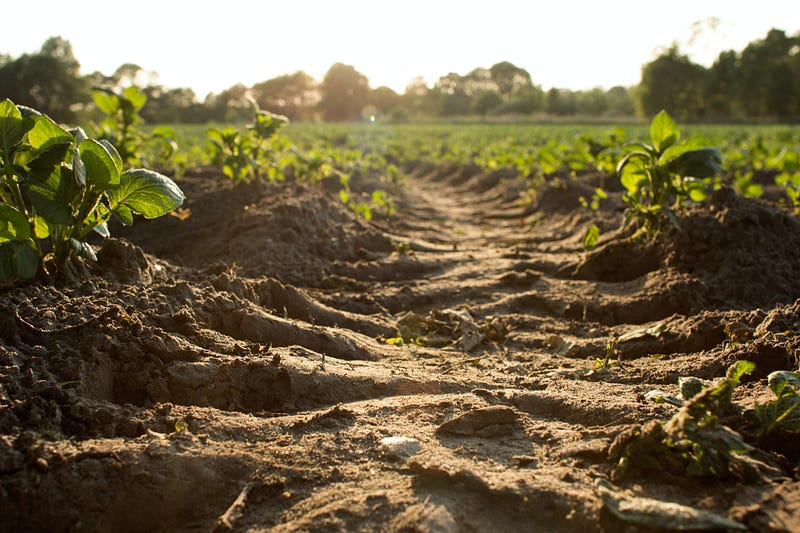
Photo by Dylan de Jonge on Unsplash

What are Soils?

Let’s start with defining soils and how they are classified. They are not dirt. Soils are living ecosystems that cycle nutrients and carbon, help filter water, and support all terrestrial life to some extent. The texture and developmental profile of soils determine the viability of soil for various crops and other use.

There are twelve orders of soils, each referring to principle characteristics of the soil itself. For example, Alfisols refer to the aluminium (Al) and iron (Fe) content of the soil, Aridisols refer to arid, dry soils, and Inceptisols refer to newer forming soils at their inception.

Soils form from parent material (you know… rocks) that have eroded and been exposed to various forms of transportation, climates, and organic materials. Like onions or parfait, there are noticeable layers (horizons) of material and compounds in different soil formations, showing the distribution of minerals and development of the series.

Series are the lowest ranking of soil classification, like species is with biological organisms. There are over 20,000 series within the United States, its territories, and island nations recognized by the Natural Resource Conservation Service of the US Department of Agriculture. It is at this point where we get into State Soils. Like official state foods, plants or animals, with significance to the region, states have official state soils too.

The Paxton Series

Paxton series is the official state soil of Massachusetts, a commonwealth located around 42.4°N and 71.4°W. The area is still rebounding from the last glacial retreat. As such, Paxton is formed around dense glacial till, with parent material comprised of eroded and compacted gneiss, granite, and schist.

The series covers approximately 816,626 acres in the New England area, and accounts for around 400,000 of the 5.3 million acres in the Commonwealth. Typically found around convex slopes such as drumlins and ground moraines, Paxton is notably not present in the Cape Cod, Martha’s Vineyard, or Nantucket areas.

A series of relatively young development, Paxton is classified as coarse-loamy, mixed, active, mesic Oxyaquic Dystrudepts. Meaning the soil is mostly sand, with some silt and clay, no one mineral dominates the series, there is active development, the average annual soil temperature (at 50cm deep) is greater than or equal to 8°C and less than 15°C, saturation of the soil can lead to a decrease in oxygen content, and the soil is acidic, lies in a humid region, and has low natural fertility. This places the series under the order Inceptisols, which makes up for approximately 17% of the world’s ice-free land.

Texture and Horizons

Texture of Paxton soils can range from fine, sandy loam to coarser loam as it approaches the lowest horizon. The soil is mostly sand (about 52%) with a small portion of silt (33%) and clay (15%). It is considered an actively developing profile.

A pedon (smallest sample of soil for surveying) of Paxton will usually have 4 horizons (Ap, Bw1, Bw2, Cd), with Ap referring to plowed topsoil, and Cd referring to unconsolidated, dense till. There are some samples which have more (O, Ap, E, Bw1, Bw2, BC, E’, Cd).
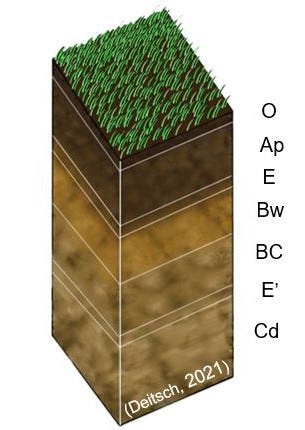
Horizons of Paxton soil, including some features (O, E, BC, E’) that do not occur in all pedons. Horizon segments are not to scale. Image by author.

The horizons are all acidic and increase in gravel content with depth. The Ap horizon is dark brown and can extend to around 20cm before abruptly transitioning into the Bw1 horizon. This horizon is dark yellowish brown of mostly fine, sandy loam, and has a gradual, uneven transition to the Bw2 horizon (olive brown). Bw2 has similar properties to the Bw1 horizon, with notable differences in the percent of gravel, number of fine roots, and a well-defined, wavy transition to the Cd horizon. The Cd horizon is olive, with very gravelly (five times as much gravel as the Ap or Bw1 horizons), fine sandy loam, which is very brittle.

Use and Management

The characteristics of Paxton soil make it viable for the cultivation of various crops in areas that have been cleared of larger stones and obstructions, with typical crops consisting of apples, birch, corn hemlock, hickory, maples, oaks, pine, and silage. Paxton has also been used for light construction or pastureland.

There are limitations with the use of Paxton soils, which can be correlated to some of the qualities that make them suitable for prime farmland. As Paxton has a high holding capacity, it can generate seasonal perched water tables as deep as 4 ft. While this can be beneficial for agricultural purposes, it is can also impose stressors to the soil itself, causing increased erosion and leading to anaerobic conditions from heavy saturation. This excess water can also be a hazard in harsh winters, when frost expansion can cause structural damage to the area (e.g., housing projects, roadways, and septic systems).

Management practices can include use of conservation tillage, as well as using cover crops or methods of strip cropping, to slow down the potential for water-based erosion. Other current conservation and management issues are related to loss of farmland and forested land in the Commonwealth. Thousands of acres have been lost to development of solar farms, and there could be anywhere from 70,000 to 150,000 acres destroyed to meet future solar needs. While there are some areas being used for dual purposes, with farming taking place beneath elevated solar panels, there is uncertainty about the long-term effects of these installations on soil health and arability. Conversion of greenspace to residential areas is also driving soil degradation by means of compaction, which is expected to affect over 370,000 acres in the next few decades.

What to Do with This

Now that you’ve gotten through this very brief primer on state soils and the Paxton series, what are you going to do with it? Well, hopefully now you’ll have an appreciation for the complexities of the ground beneath you, and how our use, or misuse of it, can hurt us down the line. Literally all of our food is sustained through soil, whether it be plants or livestock feeding off the plants.

As the climate continues to change, factors that play a role in the functionality of soils and their ability to sustain life are changed. Temperatures, precipitation patterns, concentrations of pollutants like microplastics — all of these things are part of our contribution to the detriment of our survival.

So go look into the soil of your region. Learn a bit about the magic that happens and why that soil is so unique. Appreciate the gift that keeps giving, and make a point to protect it.

Adam Deitsch is an environmental scientist and climate speaker. His writings range from pointed pieces on climate and environmental concerns, to poetry, humor, and life in general. Information presented in this article was aggregated from research on the Paxton series for a Soil Science class.

More from the author:

Poetry:

Science:

Humor:

Science
Environment
Climate Change
Soil Series
Agriculture
Recommended from ReadMedium