
An Introduction To Covered Calls And How Ultra High Yield Funds Achieve 10%+ Yields
How this popular options strategy is used to generate massive cash flow.
Having written about several covered call ETFs in the past few weeks and explaining how covered calls work in every single article, it occurred to me that it would do all of us some good if I wrote an article about covered calls.
In the last few years, covered calls have become increasingly popular, with nearly all fund managers creating their own covered call fund. This strategy has been around for a long time, but news of rising interest rates and a possibility of a recession has been popularizing this options strategy lately.
Fundamentally, selling covered calls is a strategy that caps your potential upside but hedges your portfolio in downturns.
The idea is that you sell a call option at a specific price which states that you're obligated to sell your shares at that price if the stock's market price hits or exceeds the strike price. Doing this generates an option premium which makes up the bulk of the dividends these covered call ETFs distribute.
The covered part of writing covered calls is that you're writing calls on shares that you already own. There is no leverage (unless you have synthetic positions, which is another topic) in this strategy, which is why it's one of the least risky options strategies.
Although you can generate quite a bit of cash flow from writing covered calls, the downside is that you can often lose out on a lot of the capital gain a stock may make.
In an upward market, there is a higher probability that a stock exceeds your option's strike price, which means you often have to sell your shares at the strike price. If the stock rises significantly higher than your strike price, you miss out on all those gains.
Conversely, if your stocks don't move much and remain below your option strike price, your option will often expire worthless, allowing you to retain your shares while keeping the option premium from selling the call.
Here's when we get into terms like out-of-the-money and in-the-money, which is all about where your strike price is and will significantly change your covered call outcomes. Let's get into a few examples.
Out-Of-The-Money Covered Calls
Selling out-of-the-money covered calls is my favorite and one of the most popular strategies. This strategy consists of writing a covered call with a strike price above the current market price of the underlying asset.
For example, stock A might be currently worth $60. You can write an out-of-the-money call on A with a strike price of $62.50.
If stock A rises above $62.50 before the option's expiration date, you are obligated to sell the stock at $62.50. For example, if it's at $65 by the expiry date, you must sell the stock at $62.50.
If stock A does not rise above $62.50, it is unlikely that the buyer will exercise their option, and you will retain your shares and option premium.
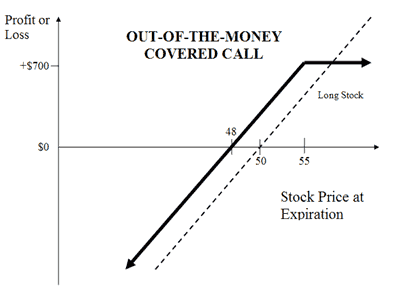
Writing out-of-the-money covered calls is fantastic because you will always have a capital gain. Setting strike prices above what you bought your shares guarantees you're selling them higher than their original cost. And if the stock never reaches its strike price, you're still profitable because of the option premium.
Compared to other covered call strategies, the only downside is that out-of-the-money covered calls don't make as much in option premiums. There's usually less demand for out-of-the-money call options because it caters to buyers who believe the underlying asset will go even higher than the strike price.
At-The-Money Covered Calls
For those seeking more cash flow and income from higher option premiums, consider looking at writing at-the-money covered calls.
Writing at-the-money covered calls is a strategy that involves selling call options at your asset's current market price.
For example, if stock A is at $60, instead of writing a covered call with a strike price above $60, you write it at $60. These calls are way more likely to be executed, which is why you'll get a higher option premium.
Many super high-yielding covered call ETFs use at-the-money covered calls. QYLD from Global X is a good example.
Funds that write at-the-money covered calls can generate significantly more in cash flow than out-of-the-money calls, but they, unfortunately, run a higher risk of capital erosion because they're way more likely to rebuy shares at a higher cost after being forced to sell.
This is why I generally avoid covered call funds that sell at-the-money covered calls. Even though they have higher dividend yields, their prices and NAV often trend down over the long term.
For retirees, however, at-the-money covered calls can make a lot of sense. Many people who are retiring will be selling their shares anyway and have already achieved a significant gain on their stocks, so why not get an additional bonus from selling options?
For example, if you have held an S&P 500 index fund like SPY for a long time and have already gotten a 60% unrealized gain from the last five years, it can make way more sense to collect the larger option premium from an at-the-money covered call if you planned to sell anyway.
In-The-Money Covered Calls
After hearing about out-of-the-money covered calls, you probably inferred that there was also an in-the-money covered call. Sometimes, at-the-money covered calls are considered a type of in-the-money covered call.
Having learned about out-of-the-money and at-the-money covered calls, you can also probably infer that in-the-money covered calls rely on selling call options with strike prices lower than your stock's current market value.
For example, if we take stock A again, whose value is $60, you might sell an in-the-money covered call with a strike price of $58.
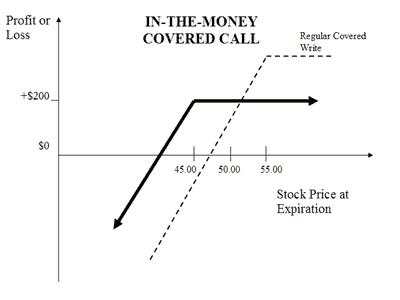
As you may have guessed, in-the-money call options are worth significantly more than out-of-the-money options because they are more likely to be exercised.
Since in-the-money covered calls have strike prices below your assets' current market price, this is a very uncommon strategy in covered call funds.
It's not very sustainable to sell in-the-money covered calls month after month because the options are almost guaranteed to be executed and lead to asset repurchasing at losses.
Like at-the-money covered calls, in-the-money covered calls are best suited for those already looking to sell their assets. The key difference is that an in-the-money covered call performs best in downward-trending markets.
If one thinks that their holdings will drop significantly over the next few months, selling with an in-the-money covered call option may be wise if the option premium makes you more profitable than selling the shares at market value.
Better Understanding Of Covered Call Funds
I hope this introduction to covered calls gives you a better understanding of the options strategy and how they are implemented to generate income. To recap, covered calls are a strategy that will generally cap your growth in exchange for cash flow.
By having this high-level overview, you should understand covered call funds more clearly and know what you're investing in if these ultra-high-yield funds interest you.
Disclaimer: The views in this article are the author’s personal views. This commentary is provided for general informational purposes only. It does not constitute financial, investment, tax, legal, or accounting advice, nor does it constitute an offer or solicitation to buy or sell any securities referred to. Individual circumstances and current events are critical to sound investment planning; anyone wishing to act on this article should consult with their advisor. The information provided in this article has been obtained from sources believed to be reliable and is believed to be accurate at the time of publishing, but we do not represent that it is accurate or complete, and it should not be relied upon as such. Investing in stocks, bonds, exchange-traded funds, mutual funds, and money market funds involves the risk of loss. Their values change frequently, and past performance may not be repeated.


