
An Inspiring, Life Trajectory-Altering Lesson From Ramana Maharshi’s Favorite Book
The Ribhu Gita has a simple but essential lesson for modernity
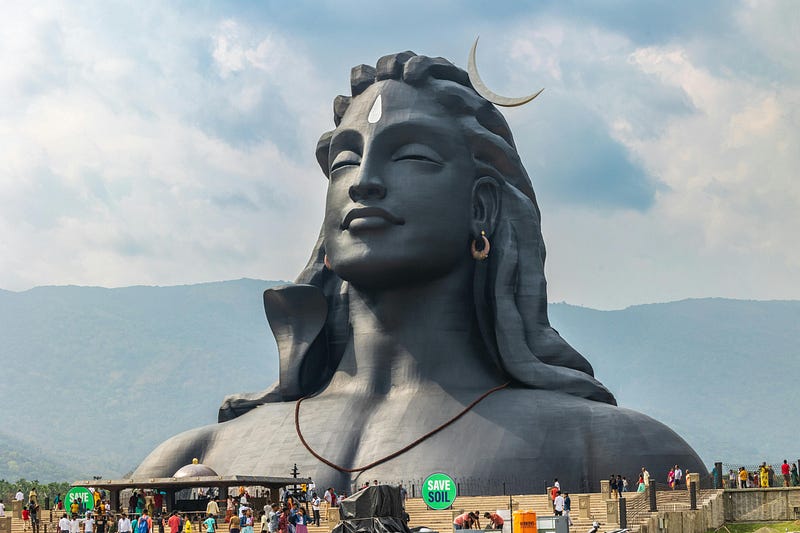
The mark of a sage is teaching successfully without even speaking. The word for sage in Sanskrit (muni) even comes from the word for silence (mauna).
So for someone like Ramana Maharshi (able to help awaken people with silent presence), the explicit recommendation of a written book is a really, really big deal.
The Ribhu Gita is a song in which the first yogi Shiva is teaching his disciple, the sage Ribhu.
Its final chapter, a beautiful description of true consciousness, had such an impact on Ramana Maharshi, he said to one disciple that just reciting it would be enough to place oneself within self-realization!
You can listen to a beautiful, guided meditation of it here, if curious.
But its (arguably) single most prominent lesson is this.
‘Be always happy.’
The Ribhu Gita negates every possible object or subject you could mistakenly attach to.
It seeks to identify you with what you are: sheer beingness. The unborn, undying, measureless consciousness that is already free, knowing, and invincible.
And this has a name: being-consciousness-bliss (sat-chit-ananda in Sanskrit). But this is not meant to be a ‘you’re already enlightened, so do nothing’ teaching.
- We can’t ever cease being. But we can forget.
- We can’t terminate our consciousness. But we can get it covered by thought.
- What we can lose is (unalloyed) bliss.
This is why even the other famous short Vedantic text, the Ashtavakra Gita, admonishes us not to struggle to accept suffering — but to be happy, for once!
If your consciousness is already free, you must tune in to its joy, in order to reach it. This is why the Ribhu Gita repeatedly ends its verses with the same instruction.
Be always happy.
Being is always a joyful state! Just the fact of being alive brings you a positive feeling. This is the gateway.
It’s so simple, but most of your life is lived while forgetting it.
Self-inquiry is a special kind of mindfulness.
Ramana Maharshi taught that wanting to know who you are — out of a burning desperation to leave behind the unsatisfying things you’re not — is what should be practiced day and night.
Self-inquiry doesn’t work if turned into a hobby or part time activity.
It must be continuous: make it your monkey mind’s job, during every spare and background moment of your life.
He says that eventually this one thought burns away all other thoughts, thus fully taming the mind.
When it itself dissolved through its own power, only realization is left.
But it must be active. Inquiring. ‘Who am I’ cannot become dead words. And to even inquire, you have to actually feel the alive-ness that you’re inquiring about.
Which means: stop being glued to your miserable worries and mind-created stresses! Be joyful, just from existing, for once in your adult life!
Then, you can ask the following:
- Who is alive in here?
- What exactly is alive?
- Where does this awareness come from?
- What’s this consciousness made of?
- What am I at my core?
Upon igniting this flame of inquiring wisdom (and seeing why it’s so important), instructions like the following may add some essential fuel.
There is nothing big or small or medium, No back, no front, nothing in between, Nothing difficult, nothing easy, nothing in between, Nothing belonging to others, nothing one’s own, nothing in between, Nothing singular, nothing dual — nothing in between, Nothing interior, nothing exterior, nothing indeed at all. What is completely perfectly full, the changeless consciousness itself, The peaceful, is the supreme Brahman [reality] alone.
(Source: David Godman’s translation of the Ribhu Gita)
May you realize how much you deserve the peace, strength, and unshakable bliss that is your nature.