avatarChristopher P Jones

Free AI web copilot to create summaries, insights and extended knowledge, download it at here

5314

Abstract

y, she becomes a metaphor for all of humankind’s creative and scientific endeavours: brilliant yet perpetually frustrated, always reaching for something higher but never fully satisfied with the result.</p><figure id="5118"><img src="https://cdn-images-1.readmedium.com/v2/resize:fit:800/1*UymhuH4TUHLUjgbvF8An9g.jpeg"><figcaption>Detail of ‘Melencolia I’ (1514) by Albrecht Dürer. Copper engraving. 23.8 × 18.5 cm. Image source <a href="https://commons.wikimedia.org/wiki/File%3AAlbrecht_D%C3%BCrer_-_Melencolia_I_-_Google_Art_Project_(_AGDdr3EHmNGyA).jpg">Wikimedia Commons</a></figcaption></figure><p id="21c4">Finally, in this portion of the image, notice a ladder to the far left propped up against the building. It may be a reference to the fact that Melancholy is winged but in fact cannot fly, alluding to her powerlessness to go beyond earthbound imagination into a higher realm of thought.</p><h1 id="5728">Measuring the World</h1><p id="b752">Exploring the rest of the image, the other pieces of the jigsaw begin to fall into place. The overarching theme of the print emerges as the quest for knowledge, with facets of science, art and civilisation shown alongside Melancholy, who represents an inevitable counterpart to the pursuit.</p><p id="97d1">There are so many objects to look at — from the carpenter’s tools at her feet, including a plane, a pair of pincers, a set-square, a ruler, and nails, to the <i>putto</i> cherub holding a slate tablet, sitting on a millstone.</p><p id="4ed6">For now, let’s consider the pair of compasses in her hand — an instrument commonly used to draw circles.</p><figure id="2e8f"><img src="https://cdn-images-1.readmedium.com/v2/resize:fit:800/1*mMc8WqBQnCfjtz9Odq4_ew.jpeg"><figcaption></figcaption></figure><figure id="f410"><img src="https://cdn-images-1.readmedium.com/v2/resize:fit:800/1*SiI0l_YJ-nyfNCJZUBu2Fw.jpeg"><figcaption>Details from ‘Melencolia I’ (1514) by Albrecht Dürer. Copper engraving. 23.8 × 18.5 cm. Image source <a href="https://commons.wikimedia.org/wiki/File%3AAlbrecht_D%C3%BCrer_-_Melencolia_I_-_Google_Art_Project_(_AGDdr3EHmNGyA).jpg">Wikimedia Commons</a></figcaption></figure><p id="ff50">Historians have noticed that the spacing between the points of the compass corresponds exactly with the radius of the circle (or rather, sphere) at her feet. The implication is that Melancholy has just inscribed or “created” this shape.</p><figure id="bec8"><img src="https://cdn-images-1.readmedium.com/v2/resize:fit:800/1*P4f_TpBIj3_SRFUldOx0Lg.jpeg"><figcaption>God the Geometer (c.1220–1230) by anonymous artist. 13th century illustrated manuscript. 34.4 × 26 cm. Austrian National Library, Vienna. Image source <a href="https://commons.wikimedia.org/wiki/File:God_the_Geometer.jpg">Wikimedia Commons</a></figcaption></figure><p id="6d01">Precedents in art history show how the compass tool has long been linked with the idea of God as the original mathematician — the divine geometer, measuring out the heavens and the Earth with exact precision.</p><p id="9981">It’s an idea that dates back to Plato. By the mid-1600s, the poet John Milton connected the story of creation with the compass in his epic <i>Paradise Lost (BOOK VII)</i>:</p><blockquote id="77ed"><p>“He took the golden compasses, prepared In God’s eternal store, to circumscribe This Universe, and all created things. One foot he centered, and the other turned Round through the vast profundity obscure, And said: — ‘Thus far extend, thus far thy bounds, This be thy just circumference, O World!’⁠”</p></blockquote><p id="00e0">In Dürer’s image, the circle is shaded to suggest a sphere — perhaps a symbol of the Earth. Is Dürer telling us that Melancholy has created the world?</p><p id="af49">Not quite. Rather, he seems to be suggesting the angel, in the hope of “moving the earth” — to paraphrase Archimedes — has carved a ball of stone. And now the compass sits inert in her hand. Compared to the heights of divine creation, Melancholy broods with despair at the bounds of human accomplishment.</p><h1 id="93d0">Saturn and Melancholy</h1><p id="7290">To underline this idea, Dürer has included what appears to be a rainbow in the distance behind. Next to it, a bat-like creature hovers (and howls?), spreading its wings to display the title of the print: <i>Melencolia I.</i></p><figure id="28f5"><img src="https://cdn-images-1.readmedium.com/v2/resize:fit:800/1*ist0dgo38Vc_8GJnsgh8eQ.jpeg"><figcaption>A dazzling light in the sky in the background. Detail of ‘Melencolia I’ (1514) by Albrecht Dürer. Copper engraving. 23.8 × 18.5 cm. Image source <a href="https://commons.wikimedia.org/wiki/File%3AAlbrecht_D%C3%BCrer_-_Melencolia_I_-_Google_Art_Project_(_AGDdr3EHmNGyA).jpg">Wikimedia Commons</a></figcaption></figure><p id="4f22">Yet the rainbow may not be all that it seems. It is not striped as rainbows are, and moreover, there appears to be a comet or a star glowing below it. Finally, the nocturnal habits of the bat would seem to discount the prospect of it being a sun-lit rainbow.</p><p id="b8c6">Instead, it might be a lunar rainbow we can see or else — I would suggest — an illustration of cosmic radiance.</p><p id="f039">What is the light beneath? Is it the sun setting? A comet? Or a bright star like Sirius?</p><p id="b35a">One likely possibility, is th

Options

at the light source is the planet Saturn, raining cosmic beams across the nocturnal water. The presence of Saturn might bring to mind the word <i>saturnine</i> — meaning gloomy — suggestive of the age-old link between the planet and the “temperament” of melancholy.</p><p id="5b18">It is this link that helps to unravel the full meaning of Dürer’s image.</p><h1 id="cd17">Temperaments</h1><p id="f494">All of these details are intended to come together to deepen and emphasise the figure’s saturnine qualities. In early medieval doctrine, melancholy was one of the four temperaments, an antiquated theory of four basic personality types: sanguine, choleric, melancholic, and phlegmatic.</p><figure id="458a"><img src="https://cdn-images-1.readmedium.com/v2/resize:fit:800/1*LIiPxpGF6pQ8bU8YSdP5Fw.jpeg"><figcaption>Lost in thought. Detail of ‘Melencolia I’ (1514) by Albrecht Dürer. Copper engraving. 23.8 × 18.5 cm. Image source <a href="https://commons.wikimedia.org/wiki/File%3AAlbrecht_D%C3%BCrer_-_Melencolia_I_-_Google_Art_Project_(_AGDdr3EHmNGyA).jpg">Wikimedia Commons</a></figcaption></figure><p id="d20e">Dating back at least as far as the Greek physician Hippocrates, the temperaments were believed to arise from an excess of one of the four “humours”, which were thought to constitute the basic ingredients of the human body: blood, black bile, yellow bile, and phlegm.</p><p id="a200">Medieval physicians considered melancholy a result of too much black bile in the body, seen as both a temperament and an illness.</p><p id="3e5a">Whilst melancholy has traditionally been viewed as the lowest of the four humours, Dürer’s print seems to raise it to a more noble level: the mark and burden of genius, a unique and divine gift, in line with this remark attributed to Aristotle:</p><blockquote id="6315"><p>“Why is it that all those who have become eminent in philosophy or politics or poetry or the arts are clearly melancholics, and some of them to such an extent as to be affected by diseases caused by black bile?” (<i>Problemata </i>XXX.1)</p></blockquote><p id="f3a0">And so the full meaning of the engraving reveals itself: the angel, armed with the instruments of art and science, is yet immersed in contemplative inaction, embodying the image of the creative being overwhelmed by a recognition of the impassable barriers that stop her fully realising her ambitions.</p><h1 id="941d">Contrast Between Religious and Secular Learning</h1><figure id="4637"><img src="https://cdn-images-1.readmedium.com/v2/resize:fit:800/1*LpNQ5VJRy3XJkNvh7m2o_Q.jpeg"><figcaption></figcaption></figure><figure id="d5fb"><img src="https://cdn-images-1.readmedium.com/v2/resize:fit:800/1*vEv6A30d2D-JYa7LArab6Q.jpeg"><figcaption>Right: <i>St. Jerome in His Study</i> (1514) by Albrecht Dürer. Copper engraving. 24.4 × 18.7 cm. Image source <a href="https://commons.wikimedia.org/wiki/File%3AD%C3%BCrer-Hieronymus-im-Geh%C3%A4us.jpg">Wikimedia Commons</a>. Left: Melencolia I (1514) by Albrecht Dürer. Copper engraving. 23.8 × 18.5 cm. Image source <a href="https://commons.wikimedia.org/wiki/File%3AAlbrecht_D%C3%BCrer_-_Melencolia_I_-_Google_Art_Project_(_AGDdr3EHmNGyA).jpg">Wikimedia Commons</a></figcaption></figure><p id="0503">Dürer is known to have distributed his <i>Melencolia I</i> print along with at least one other print, of <i>St. Jerome in His Study.</i></p><p id="5b02">It is generally understood that the engravings represent different forms of virtuous living: theological (<i>Jerome</i>) and intellectual (<i>Melencolia I</i>).</p><p id="4057">Both show intellectual endeavour, yet whilst Melancholy is clearly dispirited by her efforts, Jerome is glowing. Melancholy sits within a disordered scene, where everything seems half finished or abandoned. By contrast, Jerome’s abode is more ordered: light shines in through the glass windows, while the two sleeping animals — a dog and a lion — differ from the emaciated dog in <i>Melencolia</i>, which has grown thin from neglect.</p><p id="1d1c">For Dürer, the intellectual pursuit is one fraught with the dangers of frustration — although one that he perhaps romanticised.</p><p id="d927">The print is therefore a warning <i>and</i> an homage. In his surviving writings, Dürer is short and sweet on the topic: in a book written for young artists, he counsels that too much creative exertion may lead an artist to “fall under the hand of melancholy”.</p><p id="6e89">This image might be a counterpart to that advice.</p><figure id="f5e4"><img src="https://cdn-images-1.readmedium.com/v2/resize:fit:800/1*igQbKCOI4qGLg6JzYP7H9w.png"><figcaption></figcaption></figure><p id="582d">If you liked this, you may also be interested in my book <a href="https://www.chrisjoneswrites.co.uk/how-to-read-paintings/"><i>How to Read Paintings,</i></a><i> </i>an examination of fifteen of art’s most enthralling images.</p><h1 id="f9e4">Would you like to get…</h1><p id="5ed4">A free guide to the <i>Essential Styles in Western Art History</i>, plus updates and exclusive news about me and my writing? <a href="https://www.chrisjoneswrites.co.uk/sign-up-art/">Download for free here</a>.</p><h1 id="4506">Join me…</h1><p id="215e">On <a href="https://www.instagram.com/greatpaintingsexplained/">Instagram</a> for more great paintings on the go!</p></article></body>

Unpicking the Symbolism in Dürer’s Famous Image of Melancholy

A timeless engraving where art, science and allegory meet
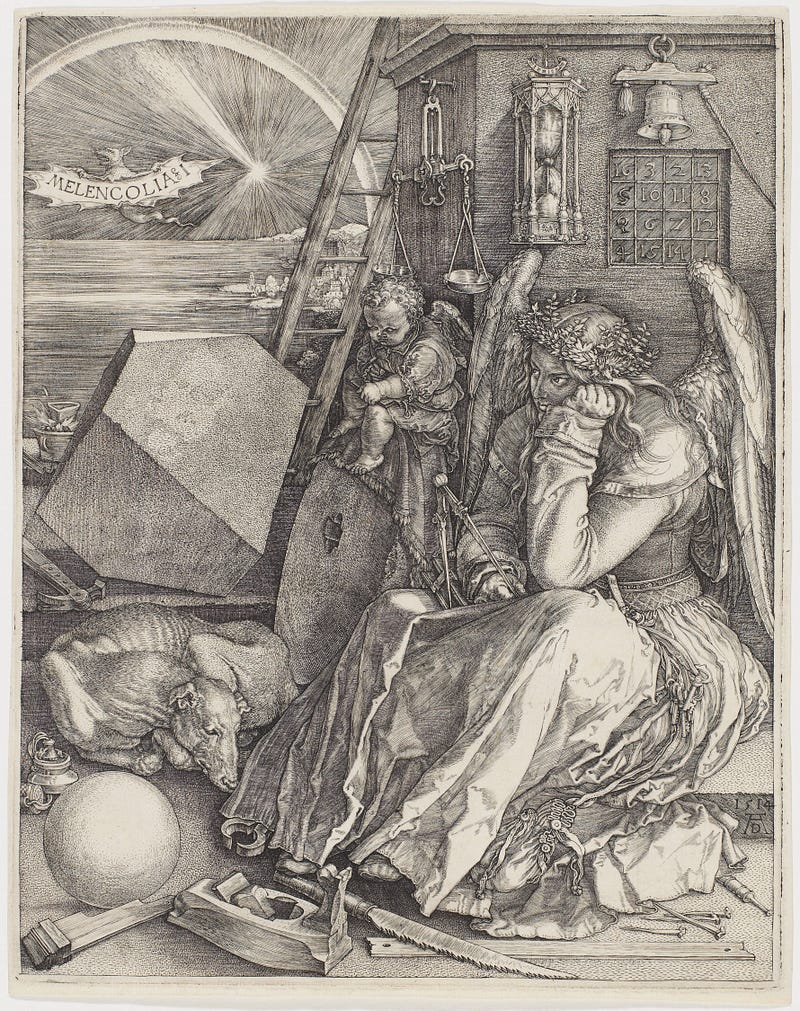
Melencolia I (1514) by Albrecht Dürer. Copper engraving. 23.8 × 18.5 cm. Image source Wikimedia Commons

This image is called Melencolia I and is one of Albrecht Dürer’s most superb engravings. Dürer was a German painter and printmaker, and one of the finest artists of his age. He made this enigmatic image in 1514 and it has since become one of the most debated artworks of all time.

Let me draw your attention to its foremost detail to start unravelling the full meaning.

We see the figure of Melancholy portrayed as an angel. She has a pair of wings — beautifully rendered with great technical virtuosity — and a wreath of leaves around her head. She rests her cheek on her hand, displaying an air of lethargy and brooding sorrow. Her dress is elaborately embroidered. In her lap she holds a pair of compasses and a closed book, apparently distracted from her intellectual pursuits by inner woes.

Surrounding her is a variety of puzzling objects, including a sleeping dog, an oil lamp, a set of keys, a syringe, a sphere and a large multi-faceted rock.

All these objects seem to be significant, but the detail I want to look at first is the quartet of objects on the wall behind her, hung across the side of a building.
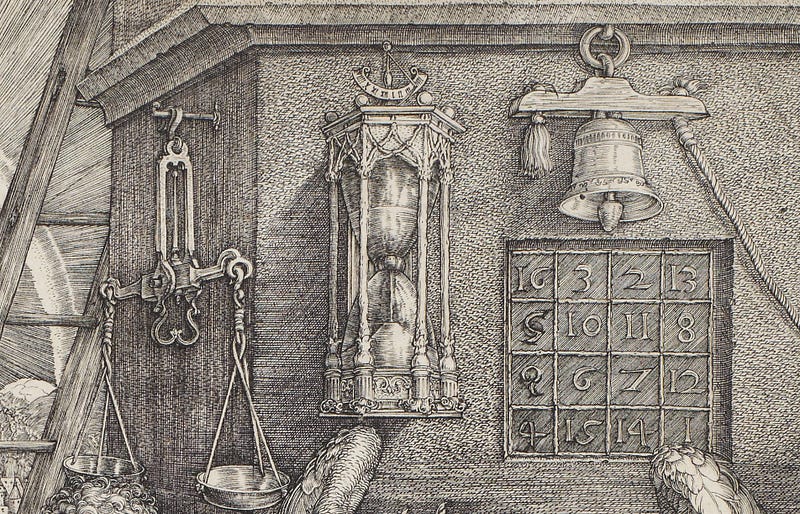
Detail of ‘Melencolia I’ (1514) by Albrecht Dürer. Copper engraving. 23.8 × 18.5 cm. Image source Wikimedia Commons

To the left, we see a pair of weighing scales, traditionally a symbol of justice (weighing the evidence to judge between right and wrong) and, in a Christian context, the weighing of souls at the Last Judgement.

We also see an hourglass, symbolic of the passage of time.

Then there is a bell with a rope attached to ring it — ready to sound for the advent of community news, a signal of a birth, a wedding or a funeral, or else as part of a liturgical act.

Lastly, beneath the bell there is a grid of numbers, a so-called “magic square” in which all the rows and columns add up to the same number: in this case 34 — as all grids of this size do. In fact, across each major diagonal line and each quadrant come to the same total. (Notice also that Dürer has cleverly included the date of the image, 1514, shown in the bottom row of the square.)

Time, Judgement and Mathematics

What do these objects mean?

Before delving further, it’s worth taking a moment to admire the brilliance of the engraving as a whole. It was made by Dürer by carving grooves onto a copper metal plate, after which the engraved plate would be covered with ink and wiped, leaving the ink inside the grooves, ready to be pressed against the paper surface.
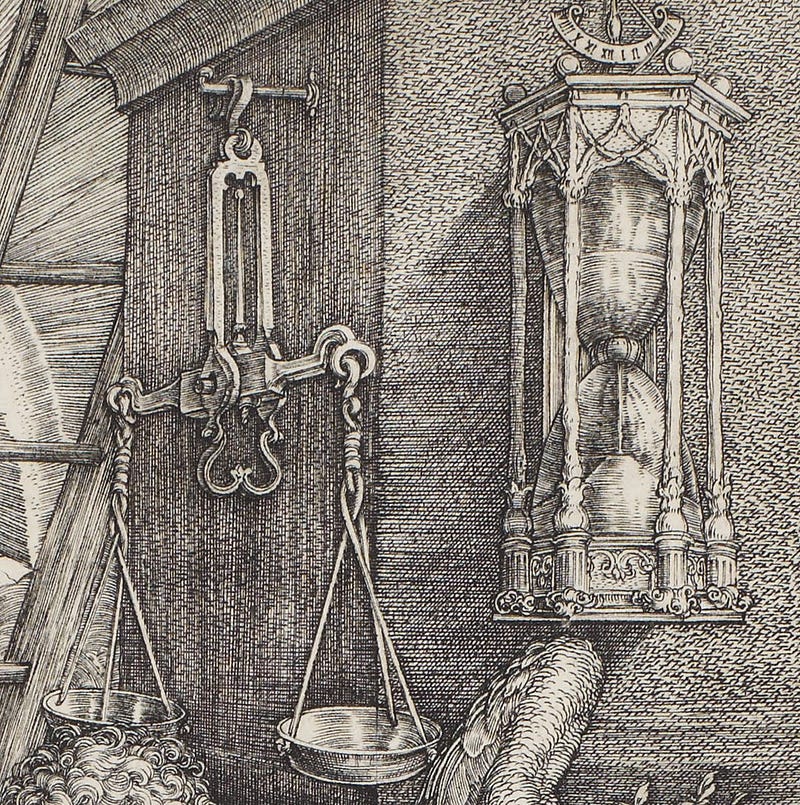
Detail of ‘Melencolia I’ (1514) by Albrecht Dürer. Copper engraving. 23.8 × 18.5 cm. Image source Wikimedia Commons

The array of textures rendered through the use of lines and hatchings is astounding, from the intricate mechanism of the scales to the glassy reflections on the hourglass.

So what about the quartet of objects? Together, the items point to the heart of Dürer’s enigmatic image. Whilst it has drawn many varied interpretations, for me one of the most compelling posits the idea that Melancholy is an idealised vision of genius, portrayed as a saturnine creature whose intellectual gifts predispose her to despondency.

The objects shown here are all associated with human knowledge and judgement. The scales are in equilibrium. The hourglass contains an equal amount of spent and unspent sand. The bell is silent, whilst the magic square is resolved with all of its rows and columns in balance.

What we see then is the harmonious balance of judgement, time and mathematics, yet Dürer’s winged angel is immobile and heavy.
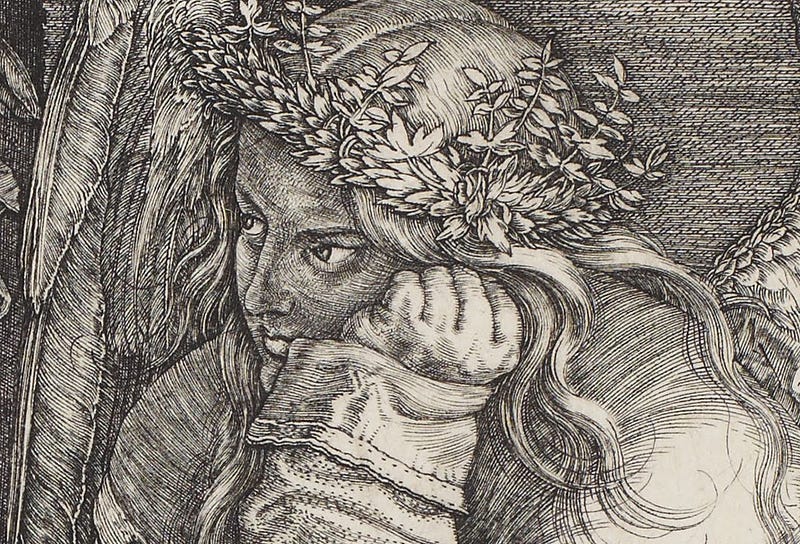
Lost in thought. Detail of ‘Melencolia I’ (1514) by Albrecht Dürer. Copper engraving. 23.8 × 18.5 cm. Image source Wikimedia Commons

Read in this way, she becomes a metaphor for all of humankind’s creative and scientific endeavours: brilliant yet perpetually frustrated, always reaching for something higher but never fully satisfied with the result.

Detail of ‘Melencolia I’ (1514) by Albrecht Dürer. Copper engraving. 23.8 × 18.5 cm. Image source Wikimedia Commons

Finally, in this portion of the image, notice a ladder to the far left propped up against the building. It may be a reference to the fact that Melancholy is winged but in fact cannot fly, alluding to her powerlessness to go beyond earthbound imagination into a higher realm of thought.

Measuring the World

Exploring the rest of the image, the other pieces of the jigsaw begin to fall into place. The overarching theme of the print emerges as the quest for knowledge, with facets of science, art and civilisation shown alongside Melancholy, who represents an inevitable counterpart to the pursuit.

There are so many objects to look at — from the carpenter’s tools at her feet, including a plane, a pair of pincers, a set-square, a ruler, and nails, to the putto cherub holding a slate tablet, sitting on a millstone.

For now, let’s consider the pair of compasses in her hand — an instrument commonly used to draw circles.
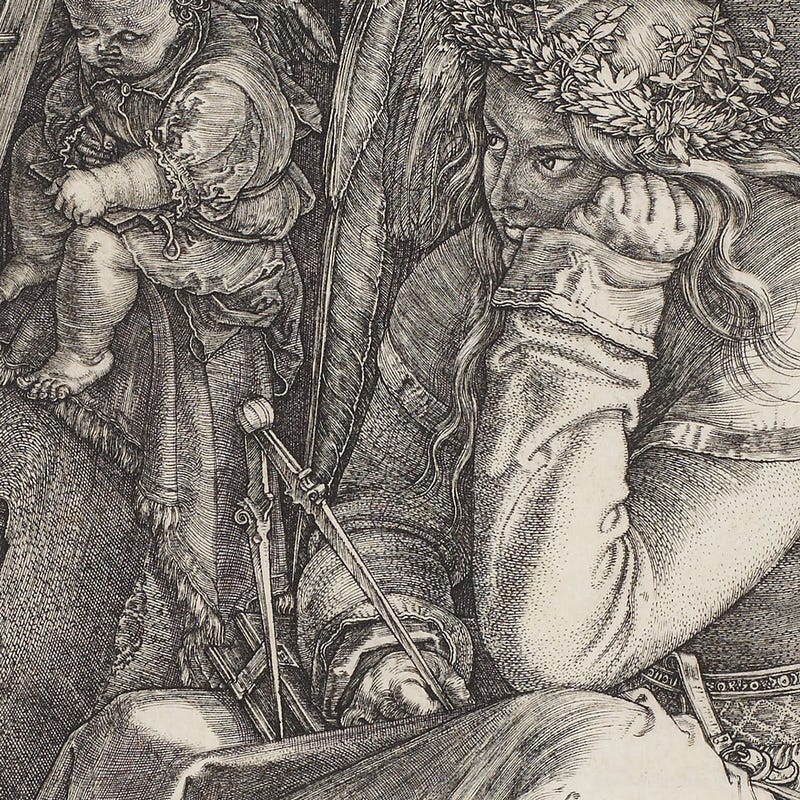
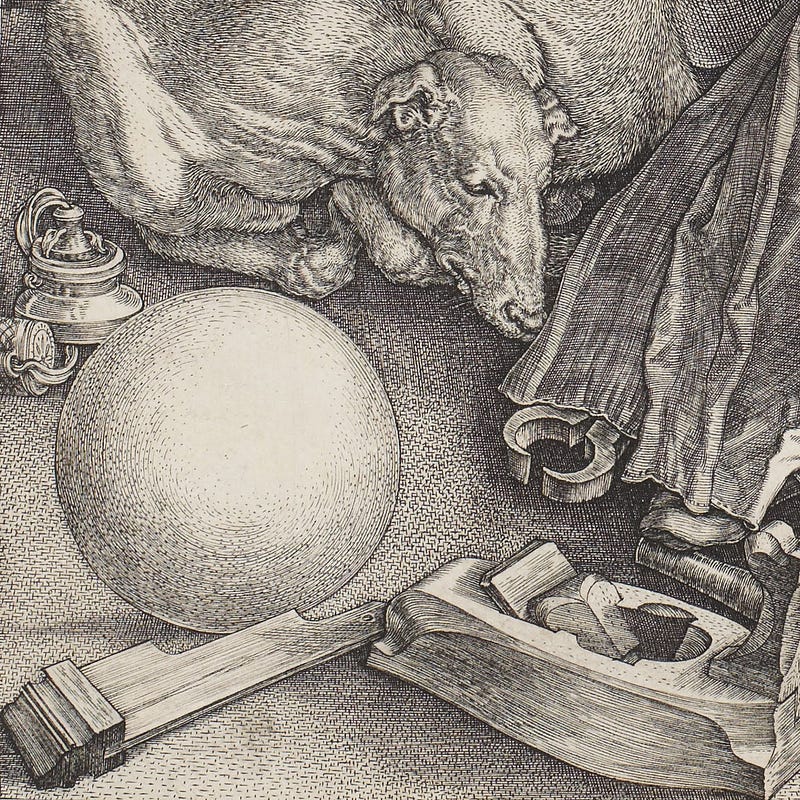
Details from ‘Melencolia I’ (1514) by Albrecht Dürer. Copper engraving. 23.8 × 18.5 cm. Image source Wikimedia Commons

Historians have noticed that the spacing between the points of the compass corresponds exactly with the radius of the circle (or rather, sphere) at her feet. The implication is that Melancholy has just inscribed or “created” this shape.
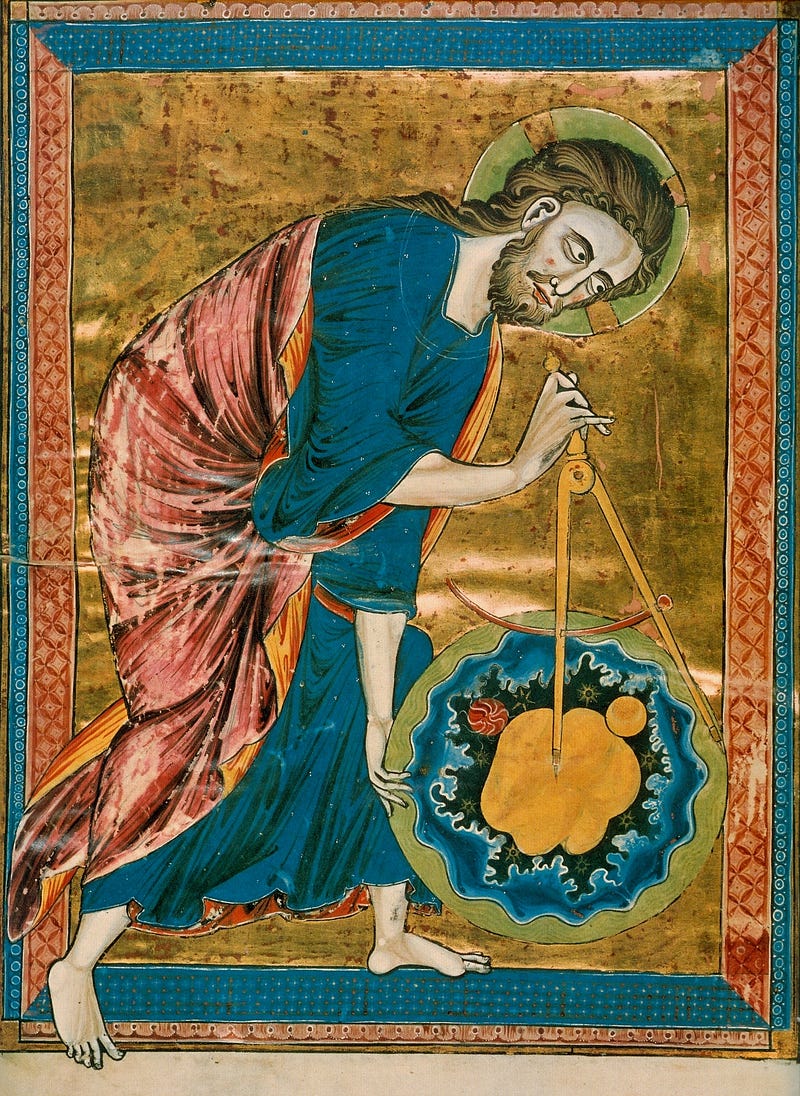
God the Geometer (c.1220–1230) by anonymous artist. 13th century illustrated manuscript. 34.4 × 26 cm. Austrian National Library, Vienna. Image source Wikimedia Commons

Precedents in art history show how the compass tool has long been linked with the idea of God as the original mathematician — the divine geometer, measuring out the heavens and the Earth with exact precision.

It’s an idea that dates back to Plato. By the mid-1600s, the poet John Milton connected the story of creation with the compass in his epic Paradise Lost (BOOK VII):

“He took the golden compasses, prepared In God’s eternal store, to circumscribe This Universe, and all created things. One foot he centered, and the other turned Round through the vast profundity obscure, And said: — ‘Thus far extend, thus far thy bounds, This be thy just circumference, O World!’⁠”

In Dürer’s image, the circle is shaded to suggest a sphere — perhaps a symbol of the Earth. Is Dürer telling us that Melancholy has created the world?

Not quite. Rather, he seems to be suggesting the angel, in the hope of “moving the earth” — to paraphrase Archimedes — has carved a ball of stone. And now the compass sits inert in her hand. Compared to the heights of divine creation, Melancholy broods with despair at the bounds of human accomplishment.

Saturn and Melancholy

To underline this idea, Dürer has included what appears to be a rainbow in the distance behind. Next to it, a bat-like creature hovers (and howls?), spreading its wings to display the title of the print: Melencolia I.
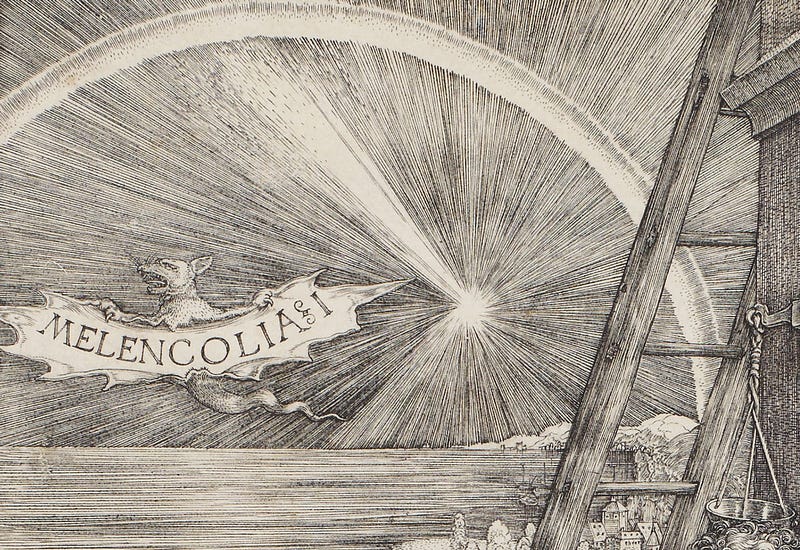
A dazzling light in the sky in the background. Detail of ‘Melencolia I’ (1514) by Albrecht Dürer. Copper engraving. 23.8 × 18.5 cm. Image source Wikimedia Commons

Yet the rainbow may not be all that it seems. It is not striped as rainbows are, and moreover, there appears to be a comet or a star glowing below it. Finally, the nocturnal habits of the bat would seem to discount the prospect of it being a sun-lit rainbow.

Instead, it might be a lunar rainbow we can see or else — I would suggest — an illustration of cosmic radiance.

What is the light beneath? Is it the sun setting? A comet? Or a bright star like Sirius?

One likely possibility, is that the light source is the planet Saturn, raining cosmic beams across the nocturnal water. The presence of Saturn might bring to mind the word saturnine — meaning gloomy — suggestive of the age-old link between the planet and the “temperament” of melancholy.

It is this link that helps to unravel the full meaning of Dürer’s image.

Temperaments

All of these details are intended to come together to deepen and emphasise the figure’s saturnine qualities. In early medieval doctrine, melancholy was one of the four temperaments, an antiquated theory of four basic personality types: sanguine, choleric, melancholic, and phlegmatic.

Lost in thought. Detail of ‘Melencolia I’ (1514) by Albrecht Dürer. Copper engraving. 23.8 × 18.5 cm. Image source Wikimedia Commons

Dating back at least as far as the Greek physician Hippocrates, the temperaments were believed to arise from an excess of one of the four “humours”, which were thought to constitute the basic ingredients of the human body: blood, black bile, yellow bile, and phlegm.

Medieval physicians considered melancholy a result of too much black bile in the body, seen as both a temperament and an illness.

Whilst melancholy has traditionally been viewed as the lowest of the four humours, Dürer’s print seems to raise it to a more noble level: the mark and burden of genius, a unique and divine gift, in line with this remark attributed to Aristotle:

“Why is it that all those who have become eminent in philosophy or politics or poetry or the arts are clearly melancholics, and some of them to such an extent as to be affected by diseases caused by black bile?” (Problemata XXX.1)

And so the full meaning of the engraving reveals itself: the angel, armed with the instruments of art and science, is yet immersed in contemplative inaction, embodying the image of the creative being overwhelmed by a recognition of the impassable barriers that stop her fully realising her ambitions.

Contrast Between Religious and Secular Learning
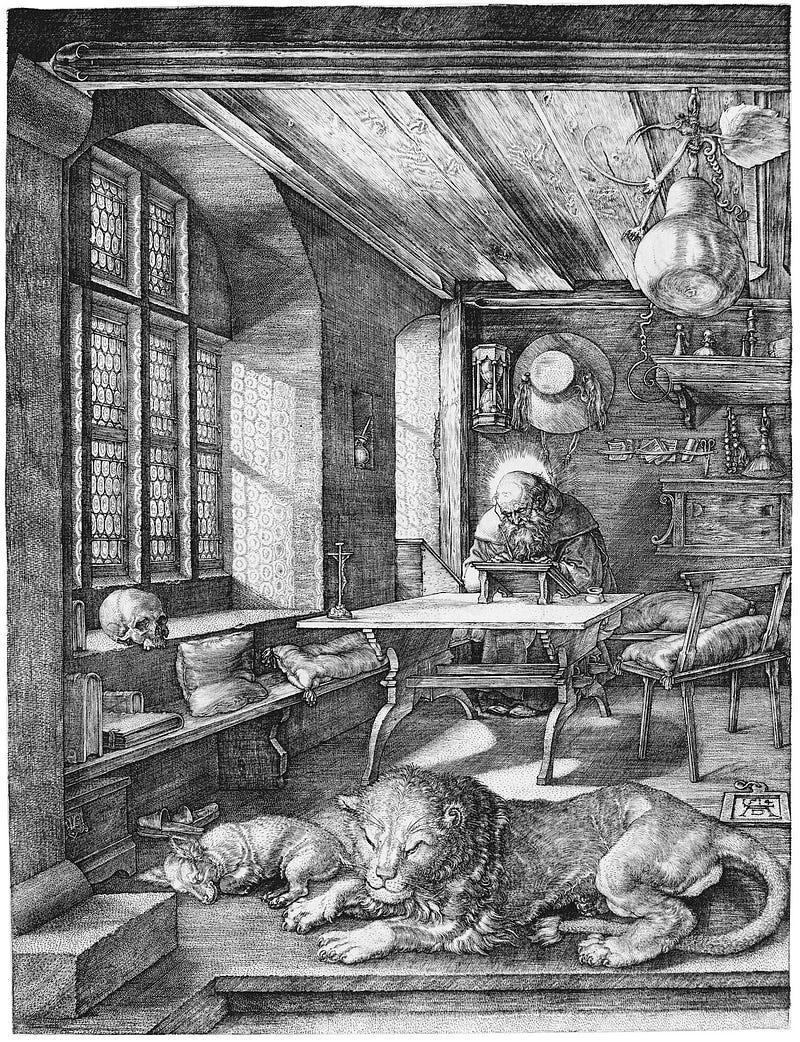
Right: St. Jerome in His Study (1514) by Albrecht Dürer. Copper engraving. 24.4 × 18.7 cm. Image source Wikimedia Commons. Left: Melencolia I (1514) by Albrecht Dürer. Copper engraving. 23.8 × 18.5 cm. Image source Wikimedia Commons

Dürer is known to have distributed his Melencolia I print along with at least one other print, of St. Jerome in His Study.

It is generally understood that the engravings represent different forms of virtuous living: theological (Jerome) and intellectual (Melencolia I).

Both show intellectual endeavour, yet whilst Melancholy is clearly dispirited by her efforts, Jerome is glowing. Melancholy sits within a disordered scene, where everything seems half finished or abandoned. By contrast, Jerome’s abode is more ordered: light shines in through the glass windows, while the two sleeping animals — a dog and a lion — differ from the emaciated dog in Melencolia, which has grown thin from neglect.

For Dürer, the intellectual pursuit is one fraught with the dangers of frustration — although one that he perhaps romanticised.

The print is therefore a warning and an homage. In his surviving writings, Dürer is short and sweet on the topic: in a book written for young artists, he counsels that too much creative exertion may lead an artist to “fall under the hand of melancholy”.

This image might be a counterpart to that advice.

If you liked this, you may also be interested in my book How to Read Paintings, an examination of fifteen of art’s most enthralling images.

Would you like to get…

A free guide to the Essential Styles in Western Art History, plus updates and exclusive news about me and my writing? Download for free here.

Join me…

On Instagram for more great paintings on the go!

Art
Inspiration
Creativity
History
Art History
Recommended from ReadMedium