
An Existentialist and a Christian Walk Into a Bar
The search for meaning in a meaningless world
Among millennials, losing one’s religion is something of a trope. Still, even a trope can’t escape reality, and I can attest to my generation’s reluctance to engage with a spiritual community. Although my parents weren’t regular churchgoers, I was baptized and went to catechism. I (infrequently) attended mass, recited the psalms, and read picture book versions of the Bible.
I also felt ashamed of myself for engaging in sinful acts, guilty for questioning Biblical truths, and afraid that I was going to Hell. I was happy to jettison the self-hatred Christianity wrought. Prayer, liturgy, and belief weren’t adding anything of value to my life.
And so I left, intent on never looking back.
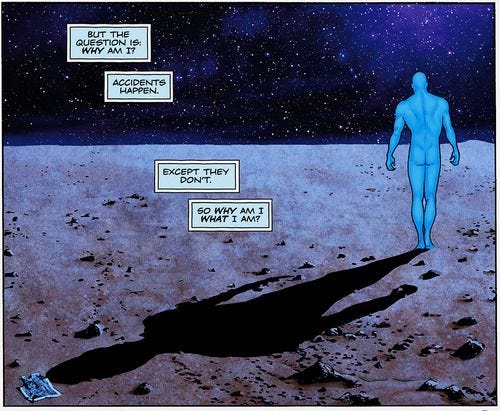
Funny thing about humans, though. We’re nothing if not restless. We crave purpose and meaning and to be a part of something bigger than ourselves.
One of my favorite books is Albert Camus’ The Stranger. The novel’s protagonist (if you can call him that), Meursault, becomes increasingly self-aware as the story progresses. By the end of it, he comes to the conclusion that “life isn’t worth living, anyhow.” Meursault believes our continuous search for meaning in a world utterly devoid of such is absurd. In the acknowledgment of life’s absurdity, he finds peace and accepts his fate (which, spoiler alert, is being executed).
I was (and remain) inspired by Camus’ philosophy. His thoughts on the human condition are as relevant as ever, particularly those articulated in The Plague.
I have Camus to thank for my interest in existentialism, not just as a philosophy but as a way of living. Even when I strongly identified as a Christian, I never believed my life has an innate purpose. That my existence is contingent on an unknowable, preordained essence makes me feel claustrophobic and profoundly uneasy. As an existentialist, though, I create my own meaning, not God or some other supernatural entity.
After devouring The Stranger, I started reading more existential philosophers — Sartre, Kierkegaard, Tillich. I find Kierkegaard’s Christian take on existentialism refreshing. Modern strains of Christianity are far too rosy and blithe for my tastes. They cloak suffering with platitudes meant to inspire, such as:
“As long as you keep Jesus in your heart, all will be well!”
“Just have faith that God has a plan for you!”
Groan.
Life is hard. Existence is pain. We shouldn’t cover it up.
So let’s talk about it.
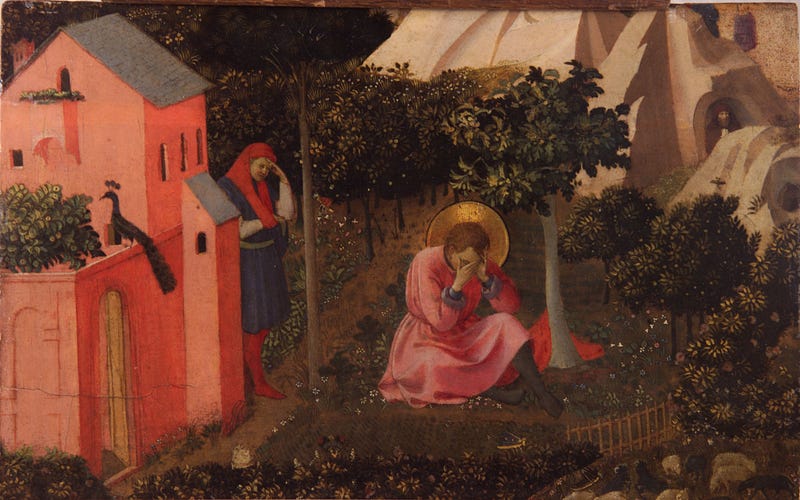
St. Augustine, one of humanity’s greatest thinkers, is arguably the forefather of Christian existentialism. His magnum opus, Confessions, reads like a primer on existential thought:
Still he desires to praise thee, this man who is only a small part of thy creation. Thou hast prompted him, that he should delight to praise thee, for thou hast made us for thyself and restless is our heart until it comes to rest in thee.
In Confessions, Augustine documents his search for truth. He seeks to understand who he actually is as a human being, his genuine self. To this end, Augustine confronts the absurdity of life. He contemplates the source of his being and flirts with pure, unrestrained freedom.
All this pontificating sends Augustine into a philosophical tailspin. He becomes acutely aware of his inability to decode the mystery of his own selfhood. With this comes uncomfortable feelings of inadequacy, shame, and anxiety. He writes:
The house of my soul is too narrow for thee to come in to me; let it be enlarged by thee. It is in ruins; do thou restore it. There is much about it which must offend thy eyes; I confess and know it.
Kierkegaard calls this sickness of the spirit despair. We experience despair when we fail to live authentically and when we misunderstand our true selves.
By the end of Confessions, Augustine attains some semblance of tranquility. Although he is reminded of his impermanence and imperfection, his quest for the self leads him to God. The journey for meaning, then, is also the search for God. Unfulfilled by earthly pleasures, Augustine turns inward, realizing that God is the source of all things, including the true self. For Augustine, to know the self is to know God.
Augustine’s panacea for existential dread has been repackaged throughout the intervening centuries. Its formula, however, remains unchanged: to rid ourselves of despair, we must “leap” into faith.

Confessions was written in the 4th century, so it’s pretty old. But it’s preceded by an even starker meditation on existence by nearly a millennia.
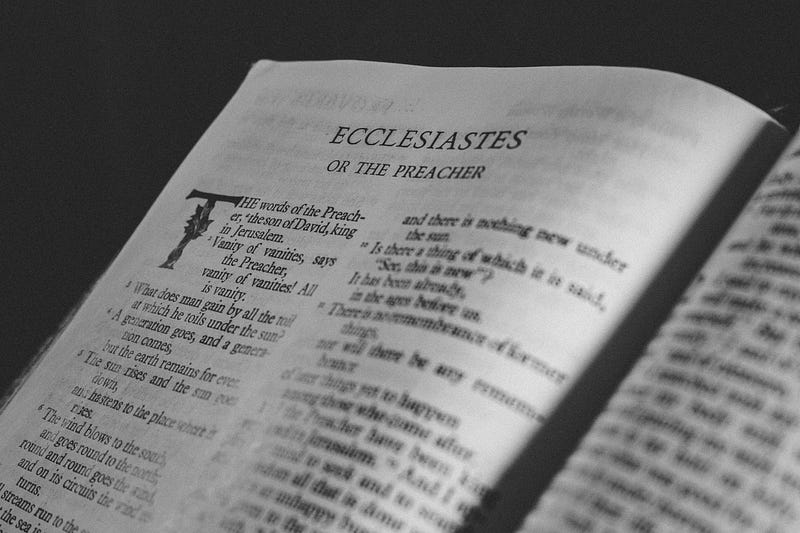
Which leads me to the most obtuse, perplexing, and misunderstood book of the Bible — Ecclesiastes. I must admit I never read Ecclesiastes in catechism nor do I recall any sermons inspired by it. After discovering it anew, I can see why. Ecclesiastes doesn’t shy away from darkness and isn’t afraid to question God.
Ecclesiastes is essential reading for the doubtful, among whom I count myself.
Written around 450 BCE, Ecclesiastes details the musings of Kohelet or the “Teacher” (I use both titles interchangeably). One gets the impression that Kohelet has a bone to pick with God. If you find Job too suppliant in his obsequiousness, Kohelet is the guy for you!
Kohelet rebukes the book of Proverbs, which advises us to pursue wisdom so that we may live a good, successful life, by emphasizing life’s randomness:
I again saw under the sun that the race is not to the swift and the battle is not to the warriors, and neither is bread to the wise nor wealth to the discerning nor favor to men of ability; for time and chance overtake them all (9:11).
Kohelet believes chance dictates our lives. Any attempt at obtaining wisdom and wealth is nothing more than folly. He laments as much in the opening of the book by exclaiming, “Vanity of vanities . . . ! All is vanity” (1:2).
Kohelet is dismayed by the gross unfairness of life. For example, a mother works hard to provide for her family only to have her entire life’s savings stolen. Meanwhile, a young man given to depravity inherits his family’s wealth. The book of Proverbs cannot explain this unkind fate; only the cruelty of chance can.
The Teacher has grown cynical, having looked on as the righteous are oppressed and the wicked prosper:
I have seen everything during my lifetime of futility; there is a righteous man who perishes in his righteousness and there is a wicked man who prolongs his life in his wickedness (7:15).
Kohelet acknowledges that he once believed the good were rewarded and the evil punished. But time has hardened him. The world simply doesn’t care how virtuous one is. Boethius, a Roman statesman and philosopher falsely accused of treason, echoes Kohelet’s cynicism, writing of his fate while imprisoned:
In this situation [prison] I am not made so dull by grief that I complain about wicked men contriving evil against virtue. What astounds me is that they have carried out their wishes . . . it is almost monstrous that every wicked man accomplishes his plots against the innocent, while God looks on.
The Teacher next turns his attention to the temporariness of existence. As the king of Jerusalem, he leads a life of indulgence — drink, women, power, riches. Yet these earthly diversions bring him little pleasure because they are fleeting:
Then the dust will return to the earth as it was, and the spirit will return to God who gave it (12:7).
The Teacher asks, “What advantage does man have in all his work which he does under the sun?” (1:3). The question is rhetorical because there is no advantage. Life is brief, and the Teacher chastises humans for their vain pursuit of fulfillment through labor and luxury. We cannot escape our destiny — death — so to what end are we toiling day and night?
My generation is buckling under the pressure of income inequality, poor job prospects, and debt. We are worse off than our parents, and subsequent generations will face unprecedented challenges. We will leave behind a dismal legacy, and our planet will inevitably become uninhabitable and continue to spin without us. Kohelet pondered as much more than two thousand years ago, saying that generations come and go but the earth remains forever (1:4).
This speaks to the grim mystery of life: we fill our world with monuments and testaments to our achievements, yet they perish all the same.
Kohelet ties his theses together with a final observation: the inescapability of death. While it may be that in life the righteous suffer and the evil thrive, it matters not, because death is the great equalizer. Kohelet doesn’t mince his words when describing the fate of humans: “Afterwards they go to the dead” (9:3).
Now that I’ve thoroughly bummed you out, let’s unpack Ecclesiastes.
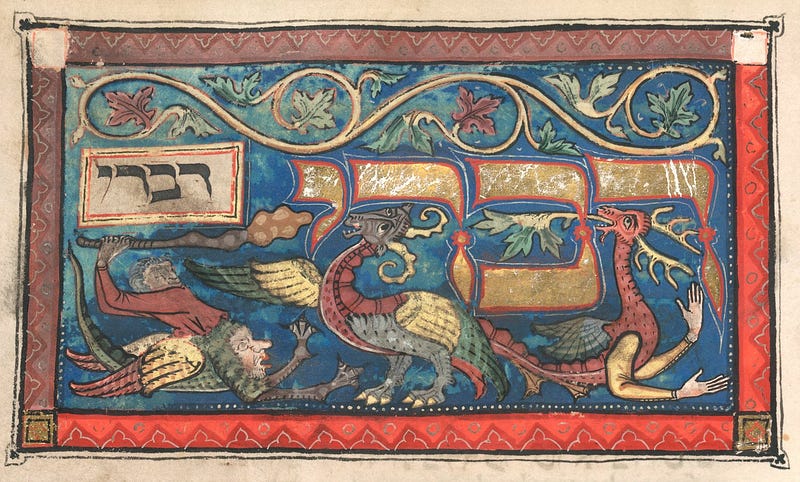
The Teacher refers to existence as hevel, a Hebrew word for smoke or vapor. He invokes hevel throughout the text to emphasize the transience and flimsiness of life. We are left with the impression that Kohelet is a nihilist.
But this couldn’t be further from the truth.
The world is uncertain, unfair, and inscrutable. We struggle to make sense of reality and bend it to our will. This, as Kohelet is all too happy to remind us, is vanity.
Life pulls us into painful directions and our impulse is to fight. But resistance is futile. Like swimming against a riptide, we inevitably wear ourselves out and drown. If, however, we relax and allow the tide to take us, we are safely guided back to shore.
Ecclesiastes encourages us to accept suffering as a prerequisite for living a pleasant, rewarding life. Instead of rebelling against what we cannot understand or change, we should focus on simple pleasures:
There is nothing better for a man than to eat and drink and tell himself that his labor is good (2:24).
The comfort of friendship, the satisfaction of a full belly, the warmth of the sun on our face. Sounds nice, right?
Ecclesiastes provides an honest assessment of life and how to best live it. The book does so without relying on language and imagery that I (and many other disillusioned Christians) find off-putting about the Bible, such as tribalism, ethnic violence, xenophobia, misogyny, and a jealous God.
Ecclesiastes invites us to enjoy life and not be sidetracked by its opaqueness. The Teacher challenges us to understand that there is no abstract concept of meaning that can be thrust upon our existence. We must embrace hevel to free ourselves from the yoke of despair.
Despite figuring less prominently in his philosophy, I’m confident Kierkegaard read the Old Testament and Ecclesiastes, exclaiming, “This is what I’ve been saying all along!”
Kierkegaard was a bit of an odd duck. He was frail and sickly, and he likely had kyphosis or hunchback, making him an easy target for mockery. A deeply unhappy man, he never married, and once called off the engagement to a lovely young woman named Regine Olsen because, well, reasons. Some scholars cite an unwillingness to burden Regine with his melancholy. Others claim he was celibate. Still others believe what Kierkegaard really wanted was a muse, not a wife because he considered domestic life incompatible with his philosophical calling. Most likely, it was a combination of all the above.
Kierkegaard was aloof and given to rubbing people the wrong way. He reportedly demurred to meet with the famous Swedish author and feminist Fredrika Bremer, responding to the invitation with, “Let no one invite me, for I do not dance” (and here I thought I was the one bumming y’all out).
What really makes Kierkegaard stand out from his contemporaries is his critique of rationality and reason. He argues that truth cannot be mediated by society and science. This puts him at odds with other titans of 19th-century philosophy who seek to reconcile religion with reason.
“The light is pleasant, and it is good for the eyes to see the sun.” — Ecclesiastes 11:7
This, according to Kierkegaard, is a Sisyphean task. Christianity and religion are riddled with paradoxes. The only way to overcome these paradoxes is to take a leap of faith, a leap beyond reason. In taking a leap of faith, one recognizes that there is no reasonable justification for the commitment religion requires. It is, as Camus would say, absurd. But existentialism argues life itself is absurd. Confronting the absurdity of life with the absurdity of faith makes a weird kind of absurd sense (still with me? Good).
Kierkegaard and Ecclesiastes provide solace to those of us who struggle with uncertainty yet still yearn for purpose. They validate our fears while showing us how doubt can enable faith. Indeed, Kierkegaard concludes that faith is conditional on doubt, writing in his journal, “Doubt is conquered by faith, just as it is faith which has brought doubt into the world.”
This approach to God is a radical departure from what I was taught in church. It doesn’t try to explain away the baseness of men or the crushing inequities of society. It doesn’t pretend to have all the answers. Instead, it says, “Yeah, the world kind of sucks, and there is no profound universal truth that can justify it.”
To me, this is much more satisfying than any attempt to rationalize something as absurd as faith. We can’t believe in God because we can only believe in that which we can prove. Faith is reserved for what lies beyond our understanding (i.e., God). We can’t objectively defend faith, but we don’t have to, because as Ecclesiastes tells us, we cannot straighten that which is made crooked (1:15).
I’m not quite ready to join Kierkegaard in taking a leap, but I am nearing the precipice.
Our world is coming apart at the seams: Authoritarianism is very much alive. We are being ravaged by an invisible enemy. The planet is warming, its coasts swallowed by the sea. How do we even begin to make sense of it all? Perhaps we can’t. Perhaps to understand 2020 and our tumultuous existence, we should be more like Kohelet.
“Hevel. All is hevel.”