
An excerpt from “The Tartar Steppe” by Dino Buzzati that defines life
But at a certain point we turn round, almost instinctively, and see that a gate has been bolted behind us, barring our way back.
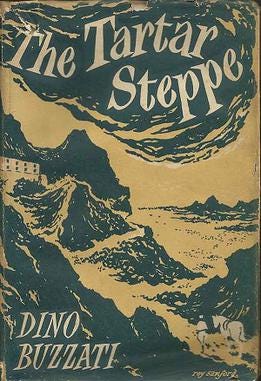
Dino Buzzati is a not-so-known amazing storyteller of Italian origin. He is known for his fantastical tales which touch the “real” in formidably amazing ways. His “Il deserto dei Tartari” (The Tartar Steppe) is a novel about Drogo’s endless search for some meaning, a glory while posted as an officer in a Fort. The following lines are from Chapter Six of the novel, translated by STUART C. HOOD (1940):
PLEASE READ AND TELL ME IF YOU DON’T GET THE CHILLS.
As he lay stretched out on his camp bed beyond the circle of the oil lamp daydreaming over his own life Drogo was suddenly overcome by sleep. Meantime, that very night (had he but known it he might perhaps not have been inclined to sleep) that very night time began to slip by him beyond recall.
Up to then he had gone forward through the heedless season of early youth — -along a road which to children seems infinite, where the years slip past slowly and with quiet pace so that no one notices them go. We walk along calmly, looking curiously around us; there is not the least need to hurry, no one pushes us on from behind and no one is waiting for us; our comrades, too, walk on thoughtlessly, and often stop to joke and play. From the houses, in the doorways, the grown-up people greet us kindly and point to the horizon with an understanding smile. And so the heart begins to beat with desires at once heroic and tender, we feel that we are on the threshold of the wonders awaiting us further on. As yet we do not see them, that is true — but it is certain, absolutely certain that one day we shall reach them.
Is it far yet? No, you have to cross that river down there, go over those green hills. Haven’t we perhaps arrived already? Aren’t these trees, these meadows, this white house perhaps what we were looking for? For a few seconds we feel that they are and we would like to halt there. Then someone says that it is better further on and we move off again unhurriedly.
So the journey continues; we wait trustfully and the days are long and peaceful. The sun shines high in the sky and it seems to have no wish to set. But at a certain point we turn round, almost instinctively, and see that a gate has been bolted behind us, barring our way back. Then we feel that something has changed; the sun no longer seems to be motionless but moves quickly across the sky; there is barely time to find it when it is already falling headlong towards the far horizon. We notice that the clouds no longer lie motionless in the blue gulfs of the sky but flee, piled one above the other, such is their haste. Then we understand that time is passing and that one day or another the road must come to an end.
At a certain point they shut a gate behind us, they lock it with lightning speed and it is too late to turn back. But at that moment Giovanni Drogo was sleeping, blissfully unconscious, and smiling in his sleep like a child.
Some days will pass before Drogo understands what has happened. Then it will be like an awakening. He will look around him incredulously; then he will hear a din of footsteps at his back, will see those who awoke before him running hard to pass him by, to get there first. He will feel the pulse of time greedily beat out the measure of life. There will be no more laughing faces at the windows but unmoved and indifferent ones. And if he asks how far there is still to go they will, it is true, still point to the horizon — but not good-naturedly, not joyfully.
Meanwhile his companions will disappear from view. One gets left behind, exhausted; another has outstripped the rest and is now no more than a tiny speck on the horizon.
Another ten miles — people will say — over that river and you will be there. Instead it never ends. The days grow shorter, the foot-travelers fewer; at the windows apathetic figures stand and shake their heads. At last Drogo will be all alone and there on the horizon stretches a measureless sea, motionless, leaden. Now he will be tired; nearly all the houses along the way will have their windows shut and the few persons he sees will answer him with a sad gesture.
The good things lay further back — far, far back and he has passed them by without knowing it. But it is too late to turn back; behind him swells the hum of the following multitude urged on by the same illusion but still invisible on the white road.
At this moment Giovanni Drogo is sleeping in the third redoubt. He is smiling in his dreams. For the last time there come to him by night the sweet sights of a completely happy world. It is as well that he cannot see himself as he will one day be — there at the end of the road, standing on the shores of the leaden sea under a grey, monotonous sky. And around him there is not a house, not one human being, not a tree, not even a blade of grass. And so it has been since time immemorial.