
COMMUNICATION
An Epitaph For The Loss Of Genuine Connection Via Online Channels
BBS and Message Boards created in-depth communication

In 1993 I was thirty-years old and a chance online conversation with a man in Chicago, U.S.A. saved my life. His name was Mark and he had similiar values and interests to me and was able to go online at a time when I, in Australia, was able to connect to him for more than five minutes at a time.
At that time I was ready to throw in the towel. Being the oldest intercountry adopted person in Australia with little support for this process and having run the gamut of abuse within and outside of my adoptive family, I was at a rock bottom low.
Online messaging services and message boards helped me navigate through life and gave me the support and interest to stay alive.
Back in those days, online chat rooms were the “buzz”, i.e. they were exciting ways of connecting online to people around the world. They were comforting, even if not very secure, because you joined with a friend or friends or quickly made friends or acquaintances whom you at least thought you could trust.
Little did a Chicago man called Mark know that his voluntary interaction with me was a spark that reignited my faith in myself as a human being.
We used an online chat room via a BBS or a Bulletin Board System. My communication and connection with Mark literally stopped me from deciding to “shuffle of this mortal coil.” Wait a minute, I sort of thought, maybe there’s something good in this world for me to stick around for. This Chicagoan man Mark respects and likes me. He thinks that I’m worthwhile.
The BBS was the first time in internet history where user-generated content became a fundamental aspect of an online service. A BBS is a computer running special communications software that acts as a kind of electronic bulletin board.
Anyone with a modem and a home computer could dial-in, often for free, and interact with other callers in their area code. Overseas calls were possible and incurred charges.
The first BBS, called Computerized Bulletin Board System, was developed by Ward Christensen and Randy Seuss. It went live in 1978 when I was fifteen years old. I used it on and off during the eighties and the early nineties.
BBS remained popular until the mid-1990s when other forms of online user interaction took over, for example different versions of IRC (Internet Relay Chat) and Messenger services.
In 1988, popularized real-time online communication became a reality with IRC. IRC has been described as a glorified chatroom system that started off as a way to have live chatting between multiple users, but eventually evolved into a powerful network for data transfers and file sharing.
I joined in some of the IRC channels and got some useful information and support from people whom I could trust, before I decided to move away from IRC. This was because I wanted more in-depth connection around specific topics, rather than instant or real-time messaging in short form.
Online Forums
After dabbling with AoL Online Messenger (AIM) and Yahoo Messenger, I soon found the wonderfully helpful world of online message boards or forums.
According to the makeuseof website, online Forums, also known as message boards or discussion boards, are one of the reasons why the Internet is so large.
They act as centralized locations for topical discussion, similar to BBS but on a much larger scale and in more specialized ways.
I met wonderful people with similiar interests to me on public E-blah forums (2003 to 2005). I joined public forums running on Ezboard (2006 onward) which metamorphosed into Yuku. I created my own Forum, “Peace in Practice” using the Ning platform around 2007.
I loved the Yuku platform which let administrators design aesthetic or appealing home pages and to create categories of specific forums.
The forums of some member areas even provided customized personal and private (locked) forum spaces for interested members. Anyone wanting her or his private space to write from the heart and to share with whoever they trusted and wanted to share with could use this administrator provided option.
This capitalized on the therapeutic and journal keeping aspects of writing, allowing deeper connections. Message boards or discussion boards along with long form instant messaging via a BBS kept me alive and well.
An example of a Yuku based discussion board that helped me stay grounded or kept me going follows.
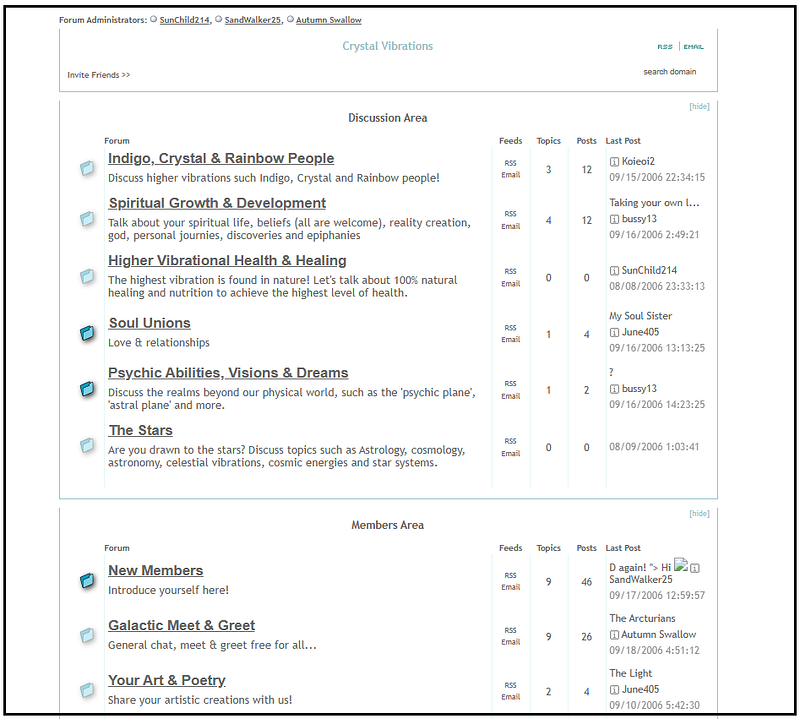
In 2005 I joined a forum called Crystal Vibrations on Yuku, where I made friends with people and forged deep and meaningful conversations about spirituality.
Those experiences had a major part in refining my perspective on our connection to something greater than us, which I call Source.
A beautiful and uplifting online forum, running on Yuku, called “Knowing Together” gave me a private posting space. It was within this safe haven that I first started sharing my personal journey.
This resulted in people openly honoring me, aware that I had been through many trials and got through them. Someone on that forum had the honesty and the perspective to write “I don’t see how there can be a shred of love left in you after what you’ve been through, but you are an amazing person full of forgiveness and love.”
Message boards or discussion boards still exist today for book reviews or for general social communication, rather than for spiritual discussion or for more specific purposes.
While social media platforms and online communication interfaces can place a veil or a distance between writer and reader, there is less of a veil when using message boards.
This is because they are structured with a number of categories or areas, each with a number of forums centred on a very specific topic.
Thus the user can focus on one topic and easily read all of the content related to one issue and engage meaningfully with it.
These forums were special to me because of their intent and the dynamics of the interaction that was possible by using them. Even today I miss the nurturing that my use of BBS and forums or message boards gave me.
The Blogs and Social Media Implosion
People began to move off message boards because of blogging platforms and social media, such as Facebook. My opinion is that people use instant online platforms, such as Facebook and Twitter, as toys or play-things often or sometimes, even if subconsciously.
I moved from MySpace (created in 2003), a social networking space popular with artists and musicians until 2008, to web logging or blogging with Blogger in the early 2000s and then onto WordPress in 2012.
Blogger, an American online content management system, founded in 1999, enables its users to write blog posts with time-stamped entries. I enjoyed using Blogger as a record of my personal experiences, including posting recipes for burgers for cats.
I started my first blog about “Fascinating Amazing Animals” with WordPress in 2012. This was not a date stamped chronicle of my adventures with animals, but rather my posting about our animal world as a mark of respect for the fact that there’s life on Earth other than human beings.
Blogs do not encourage in depth conversation. In the early days of this blog, I experienced negative feedback. I had started a page as a Dictionary of animals, with sub pages planned for an alphabetical listing. While this was in the making, people wanting instant gratification would comment complaints about the Dictionary not being magically complete. So I removed it and discarded that idea.
Someone bitterly complained about a picture of a chameleon that I had posted (but have removed now), saying that it was a manufactured image and that I had given the animal world a grave disservice. Never mind engaging with me as they might with a family member, asking me WHY I had posted it and HOW I had got the image.
I replied to him saying that I had got the image, with permission, from X Y Z source and had not suspected that it was a “doctored” image, and I apologized.
I was upset by the vitriol that was easy to dish out to a face-less and distanced person. A blog writer is often seen as a robot or someone without feelings and a personal life, in my experiences.
Some people, who aren’t using the internet for essential business transactions, are in the game of life, that game being where they look after themselves first.
I have witnessed extreme lack of genuine support in most of the Facebook Groups that I’m in. If you don’t know the answer to a question in a Facebook post, you won’t answer. But if asked for your opinion or for an analysis or specific help, you could reply in a polite way. This is what I do.
But the flip side doesn’t occur because when I ask a question in many Facebook groups, even a question with a simple yes or no answer, the silence is deafening. Some people won’t answer even if they know the answer. If they like you, i.e. if you’re popular or useful to them, they are more likely to respond to your posts and questions. Others ask a question then don’t even acknowledge your answer!

Examples of lack of genuine or in depth communication on social media abound. For example “spiritual” pages and groups on social media proclaim to help others, but readers aren’t allowed to share relevant information as links in comments; information that could be a life changer for some people.
This must be because the page owner is also selling products and/or services and doesn’t want business to be taken from them. Some say that the links may be malicious or spam, but couldn’t technology and software help overcome this?
Tweeting on Twitter is bizarre now, taken over by Elon Musk. Hidden powers by those behind Twitter and the micro-blogging power afforded to irresponsible flame-throwers with pious comments and prejudiced posts were and are a very scary vista to me. This ushered me out off the revolving doors of Twitter soon after it began.
Forbes warns that online marketers and technology platforms routinely exploit your behavioral biases and, by doing so, convince you to reveal more information than you should.
Facebook Messenger is used for instant gratification, where the sender may expect a reply the same day or send you a message when they mean something else.
A Facebook message of “how are you” may actually mean “what have you been doing today, how can I help you because I’ve got this great product/service you could buy.”
Public message boards or discussion boards still exist today for book reviews or for general social communication, rather than for spiritual discussion or for more specific purposes.
In summary, blogs and social media platforms tend to be superficial and restrictive, even upsetting or damaging or divisive and lacking in genuine or deep connections. Someone can like a Facebook post or a Twitter or a WordPress post without even reading a word of the content.
And the completely linear format and the insufficient moderation ratios of social media spaces usually don’t allow for meaningful and helpful categorized, layered and webbed dialogue as did the online message boards of old.
Loss of online message boards and fun website elements
Even though today people can still use ICQ and even though Yuku is still available after being bought out by Tapatalk, I claim that some people of today don’t know what it’s like to use forums with “rooms” and “areas” where moderated genuine communication takes place.
In 2020 I became a volunteer climate activist and recently suggested that we run a moderated online forum for discussion. But the facilitator said that had been tried before and nobody used online message boards any longer. This makes me sad.
I reminisce over the lost free online applications of the past, such as Photobucket, aquarium widgets, and message boards.
Widgets refer to either any GUI (graphical user interface) element or a tiny application that can display information and/or interact with the user. They are used to personalise a home page or a computer desktop with fun or functional visual objects.
But the free fun and entertaining “widgets” for personal websites have disappeared. Instead we have sterile clock widgets and other business widgets and YouTube content to embed, which are not the same as the widgets of old.
They are not for fun but for profit making.
The tried and true, simple and free web components of old have given way to applications which all cost money to run effectively and which are business oriented.
Along with the widgets of old and BBS disappearing, the burgeoning, unbridled and propped up culture of the quick fix and of profits before people resulted in migration and facilitation from IRC and online message boards to Twitter and Facebook and other social media outlets.
Instant messaging became our world anthem. And deep and genuine online public conversation (with options for private discussions) took a rain-check.
Today, message boards or forums are used for games discussion or for community discussions, like those related to retail or business, such as eBay.
Other boards are run for select and private groups of people. Reddit and Quora qualify as forums, but even with nesting, they don’t easily and aesthetically facilitate linked reading and discussion as do message boards, like ProBoards and phpbb boards, etc.
An epitaph for the death of in depth connection via online means
I am well entrenched in the online world. Today I have 8 email addresses, accounts for most social media platforms, and I have founded 7 WordPress blogs. I run a Substack Newsletter and post on Medium under a pen name, Grace Mary Power.
Yet as I dispense information or knowledge which can be turned into wisdom by the reader applying the information, I still experience a “hole” or a void in my spiritual and 3-D being.
The previous online communication channels that I used from the seventies to the nineties, even though commercialized versions of them exist today, were life-lines for me to enter into nuanced and in-depth topics or discussions related to happenings and systems of thinking and ways of life.
Today we have social media outlets where leading voices are those who often are looking after themselves foremost. Maybe most people these days don’t want to engage in depth with others.
Facebook and Twitter don’t let you structure long form posts in specific categories within an overall site, as do message or discussion boards.
A fitting epitaph for the tombstones of the dying message boards or forums of the heydays of the 90s and early 2000s is:
“Herein lies the willingness and the effort to explore and to negotiate the syzygy (union of opposites) among the infinite potential, buried under a mountain of self-interest and the lava of instant communication.”
“To the casualties of the war on words, reading comprehension, understanding and genuine support, I salute you. I pledge to revive you through mindful content online, leading by example, and resuscitating long form discussion online through all peaceful useful means possible. Thank you for your tour of duty.”