
An entrepreneurial EU

The thinking behind Europe’s leading innovation fund
Under the Horizon 2020 scheme, the EU’s SME Instrument (SMEI) provided a total of €3 billion in funding to highly innovative small and medium enterprises, focusing on groundbreaking but high-risk technologies that were considered too high risk by most investors. The aim here was to provide a bridge across the ‘valley of death’ that stops so many start-ups in their tracks as they struggle to make the journey from innovation to market. Horizon Europe is the successor to Horizon 2020. It will run from 2021 to 2027, with a total budget of €95.5 billion and aims to strengthen the EU’s scientific and technological bases, boost Europe’s innovation capacity and competitiveness, and deliver on citizen’s priorities.
Within this framework, the SMEI transitioned into the European Innovation Council (EIC) Accelerator, with a total budget of €10 billion over the Horizon Europe period. The scheme ran as a pilot in the years 2018–2020 that also brought together other funding schemes from Horizon 2020 under the EIC umbrella (such as the FET Open becoming the new EIC Pathfinder) in an attempt to streamline and consolidate innovation funding in Europe. The central tenants of the funding program are in line with its predecessor — to promote and fund innovation in Europe and to increase competitiveness within the EU. This stems from a core issue in Europe of translating excellent science to innovative businesses.
There was one major change in the thinking behind the new EIC Accelerator however, and that is the addition of an equity component to the funding scheme. Under the EIC Accelerator, companies could apply for up to €2.5 million in grant funding as before, but also opt for up to €15million in equity from the EIC. In this step, the EIC positioned itself to become one of Europe’s biggest venture capital investors by pledging to initially invest up to €178 million of shares in emerging science and technology companies, with the potential to increase to €3 billion over the following seven years. This would see the EU becoming a direct investor in promising, early-stage companies, typically acquiring a 10–25% stake.
The practical reason behind this is to de-risk the companies for additional VC investment and the EIC in most cases requires the investment to be led by a VC or other private investment firm. However, there is broader philosophy behind this thinking that helped to structure the new program — the concept of the entrepreneurial state.
The Entrepreneurial State
In 2013, Marianna Mazzucato published The Entrepreneurial State, which challenged the notion that for innovation to success, the state should get out of the way and let private enterprise do their thing. Mazzuccato argues that in fact, most innovation successes today are a direct result of state involvement, for which the state, and the taxpayers, rarely see a fair return. The major points are:
- The state has historically funded ground-breaking innovation
Mazzucato gives the example of Apple Inc. Well known for having avoided taxes in Ireland, but she makes the case that it is also the US taxpayer who footed the bill for the company’s success. How so? Because the technology that makes the smartphone smart was publicly financed — GPS, internet, battery, voice recognition, touchscreen — was all engineered by individuals on a government payroll, but this is never mentioned by Apple, who moved their base of operations to avoid paying $2.5 billion in taxes to the state of California.
2. The socialisation of risks has not been matched by the socialisation of rewards. The state is punished for the failures, yet never acknowledged for the successes.
Two green-tech companies — Tesla and Solyndra. One you’ve definitely heard of, the other perhaps not. Solyndra were once the biggest name in solar power. Then President Obama, trying to create green jobs while pulling the country out of the financial crisis, gave the company a $535 million loan guarantee from the Department of Energy. Within two years, Solyndra was bankrupt, out-competed by cheaper solar panels coming from China. The state was accused of interventionism, playing outside of its role, interfering with public business and wasting taxpayer’s money. The company was investigated, and Obama was slated for the error by Republicans.
Under the same green loans scheme, Obama gave Tesla $465 million guaranteed loan (just under what Solyndra got) on the condition that if the loan was not paid back, the government would get 3 million shares. Well, the share price rose from $9 in 2009 to $90 in 2013. The loan was paid back, but the share increase could have more than covered the Solyndra loss.
The first story is given as a case study of why the state should never get involved in private innovation and just get out of the way. The second story is conveniently forgotten.
3. The private sector only finds the courage to invest after an entrepreneurial state has made the high-risk investments.
Not just the early-stage research, but also development and innovation are funded very often by the state. Risk-averse VC investment tends to come later, once the innovation and company has become “de-risked”.
Is it the role therefore of the state to take the risks and support early stage and high-risk innovations? If so, is it not also fair that the successes, funded by tax-payer money, should somehow payback to the state? In the case of Tesla, the condition should not have been that the government received shares only if the loan was not paid back, but it should have been given in return for shares. The return could have gone on to fund further high-risk innovations. Instead, the US government just got stuck with the bill for the Solyndra failure.
The thinking behind The Entrepreneurial State heavily influenced the new EIC Accelerator scheme. In 2017, Mazzucato was appointed Special Advisor to the European Commissioner for Research, Science and Innovation. During that tenure, she outlined a “mission-oriented innovation” thesis which became engrained into Horizon Europe. The EIC Accelerator, and the SMEI before it, has always been about ‘de-risking’ innovative technology, but now it is also about providing a suitable return for the risks taken with state funds. Giving the EIC the chance to invest directly in these companies ensures that the success as well as the risk is shared across taxpayers. But not everyone agrees.
Criticisms of the Entrepreneurial State
In a recent article Sinead O’Sullivan decries Mazzucato’s “bullshit” thesis.
“The government didn’t create the iPhone! It’s all a very easily debunked crock of nonsense!”
This is something of a strawman, since Mazzucato never claims that the government created the iPhone, only that it had a critical role in developing the technology, for which it never saw a fair return. O’Sullivan directs you to the Nintil blog that provides a similar assessment and assumptions while misrepresenting some of the sources used:
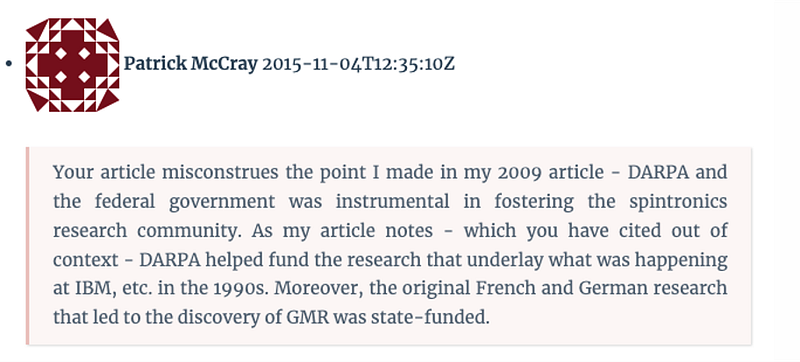
O’Sullivan’s direct criticisms of Mazzucato stem from a philosophical difference in the role of the state in innovation. To summarize a series of scathing attacks on Mazzucato and anyone who O’Sullivan thinks is weak minded enough to believe them (“a lot of people read what she wrote and nodded along to themselves thinking: “Yes, I am rather good at my job, and no, I don’t get enough credit for what I do.” Overnight, Mazzucato was a populist star within government and public sector circles.”), she concludes that:
“Mazzucato, an academic who has never worked in the private sector, has to be the first person alive to have a €10 billion fund raised on the back of a bullshit thesis with no evidence.”
This relies on the conceit that Mazzucato was singularly responsible for Horizon Europe with no other input involved, whilst also downplaying Mazzucato’s role as a researcher. This is the more academic perspective however, O’Sullivan has a more practical objection to the EIC Accelerator and that is in the way the funds have been managed:
“The problem with this fund? One big issue is that the government, it turns out, can not deploy money very efficiently or quickly enough to keep up with the needs of start-ups. Good VCs can write a cheque to a start-up in 24 hours if they want to. The EIC? Some start-ups have had to wait years.”
This is where even the most ardent supporter of Mazzucato is forced to nod along; the EIC Accelerator has been plagued by a host of issues since it’s full release, the most pressing of which is the ability of the EIC to invest directly in early-stage companies.
State of the EIC Accelerator
After a successful Pilot launch, the EIC Accelerator was, rather bizarrely, completely changed for its full launch in 2021. An AI platform was introduced that made the application process so difficult for companies that enlisting the help of a dedicated grant writer now seems to be a basic requirement (something that increases the likelihood of wealthier EU member states getting funding as they are in a position to subsidise such services).
Much more damning however, is the handling of the payouts to companies who have elected for equity funding. Companies who were selected for a blend of grant and equity financing under the new EIC Accelerator scheme were forced to wait over a year for the grant agreements to finally be signed and the money awarded; a year can be a lifetime in start-up world, so this was potentially devastating for the companies involved. As stated by O’Sullivan, the EIC did not have the expertise to manage a big pool of equity investments, and so the Commission handed over management to the European Investment Bank (EIB). However, internal disputes at the Commission still led to a hold up in the funds.
MEP Christian Ehler brought the motion to the EU Parliament to suspend funding for the EIC Accelerator for up to a year stating that:
“The Commission is running it into ground due to budgetary infights. Even worse, it’s trying to kill the idea behind the EIC by making it a bureaucratic and static instrument run by the European Investment Bank,”
In a move Ehler describes as “hilarious”, all decisions regarding funding and equity are now passed up to the College of Commissioners for final decisions, creating a bottleneck that would, if left unchecked, take years to work through.
“We promised, but we didn’t deliver. We had a pilot project which was working and running, and which was all of a sudden stopped by internal fights.”
Ehler and others are still passionate about the idea behind the EIC Accelerator as a flagship fund for stimulating deep-tech investment in Europe. In that sense, Mazzucato’s thesis behind the program still has support — the State should be helping to de-risk strategic technologies for investors while still being properly rewarded as being the risk taker. However, O’Sullivan’s second criticism on the painfully slow investment process of the Commissions seems to be completely validated by the evidence to date. The question is, can the program be saved, or is it a failed program built upon a “bullshit” thesis?
Saving deep-tech investment in the EU
Later this year, the EU Parliament will vote on whether to suspend the EIC Accelerator funding for a year. The EIC has until the Autumn to present its plan to fix the inherent problems in how it pays out funding. The question is, can the EIC prove the critics wrong; can it in fact move fast enough to invest in such dynamic industries?
In an op-ed for Research Europe, Ehler states:
“Outsourcing equity funding to the EIB would divide the accelerator’s two funding streams and undermine its unique selling point of truly blended finance.
Instead, we need an independent body that can manage both grants and equity. This should have a clear political mission, a presence in the venture capital market and the agility to meet the needs of deep tech startups. No such body exists at present, so we need a tailor-made solution.”
It remains to be seen now if such a tailor-made solution is possible. The issues behind the EIC Accelerator are not philosophical (although many objections to it are) but structural. The mistakes in the last two years are potentially solvable if an independent investment body can be created. If so, then it can be shown that Europe can drive deep-tech investment in a ‘European way’ without having to copy-paste an American VC model.


