
An Empty Browser History Says More Than a Full One, You Say?
Reblogging my greatest hits so you don’t have to.
It’s important to remember that, in a context where trust and ethics are paramount, the actions of individuals should be interpreted with consideration and without jumping to negative conclusions. The emphasis should always be on respecting privacy and avoiding assumptions that could lead to unwarranted suspicion or unethical actions.
If a user has deleted their browser history, there are a few deductions that could be made about the user:
- Privacy Concerns The most common reason for deleting browser history is to maintain privacy. Users might not want others who have access to their computers to see their browsing activities.
- Security Reasons Users aware of cybersecurity threats might delete their history to reduce the risk of personal data being accessed through browser history in case of malware or hacking attempts.
- Space Clearing Browser history can take up a significant amount of disk space over time, especially with heavy internet usage. Deleting it can free up space.
- Troubleshooting Sometimes, clearing browser history, along with cache and cookies, is recommended as a troubleshooting step to resolve issues with browser performance or when accessing certain websites.
- Sensitive Information Users might delete their history if they have been visiting websites they consider sensitive or personal — this could range from adult content to confidential business sites.
- Habitual Action For some, regularly clearing browser history is just a habitual action for maintaining general digital hygiene.
It’s important to note that deleting browser history is a fairly common and normal practice, and doesn’t necessarily imply any nefarious intent. However, in certain contexts, like in forensic investigations or monitoring for inappropriate use, it might be seen as an attempt to hide one’s activities or cover up evidence.

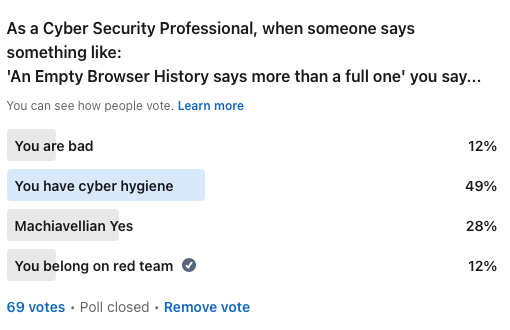
%49 — CYBER HYGIENE
There is no harm In keeping your browser history present, if you just clear your cache and cookies. If you did the latter, that would be cyber hygiene. But clearing your browser history alone would really not be not okay.
%28 — MACHIAVELLIAN YES
I like the thought process here, friends. It’s always good to think like the adversary. But this answer would not be correct, because it indicates you are going to forensically examine their browser history, and you did so without permission which would be a felony in most sane locales also we don’t do that to our friends. If you get arrested over a LinkedIn quiz answer, was it worth it? We are supposed to be the good guys here, not the villains with power.
%12 — RED TEAM
That was put there as a joke because the red team is usually not as aware as the blue side of things… which would be funny… It would still be wrong because we know that's just a tech stereotype, just like that we must blame everything on networking (but as time went on we realized we could blame DevOps instead, so true). DEMERIT.
The correct answer is…
%12 — YOU ARE BAD — That would likely be the right answer because only a loser does something like generate browser history to begin with. So it would be.. YOU ARE BAD, AT TECH — I mean that is only the real answer, and of course, it could imply BAD AS A PERSON because psychology 101!
What are you thoughts? Got any to add? Feel free to debate.
Original Post here.
Citations

Like this story? Check out a list of all articles. Don’t forget to clap, subscribe, or become a member! If you’re feeling generous, leave me a tip! If you’re curious about sources, on a separate page because long citations tank my stats! Be sure to also check out my other publications at history.internetarchaeology.io.
The opinions and thoughts expressed on this platform reflect only the author’s views alone. Images/passages within this publication may contain certain elements of artificial intelligence; but unless specified, have been edited for this article. This image originates from OpenAI/ChatGPT (2024).


