
Mathematics
An Elegant Proof That 1 + 1 = 2
And 2 + 2 = 4 and so on
1 + 1 = 2. 2 + 2 = 4. 2000 + 24 = 2024. At first glance, they are just simple additions that even a 6 year-old kid would be able to compute. Now what if I told you that mathematicians in the past have developed concrete axioms to rigorously prove that 1 + 1 is indeed equal to 2. Keep reading and you will be able to impress your friends and family!
Mathematics is about rigor and elegance, and we are going to see just that in this article.
Peano Axioms

Presented by the 19th-century mathematician Giuseppe Peano, the Peano axioms are a set of axioms for the natural numbers in mathematical logic. Generally, axioms are statements taken to be true, upon which further reasoning nd arguments are built. Think of them as the bedrock for all of mathematics.
Before we can fully appreciate the rigor behind why 1 + 1 = 2, we first have to understand what the equality sign really means. We don’t want to have any room for confusion or contradiction.
As in this ‘=’
After all ‘=’ is merely a symbol until we clearly state its properties.
What is ‘=’ exactly?
I have hand-written the 4 axioms below. We will now look at each one carefully.
= is the equality sign.
∈ means belongs to/ an element of.
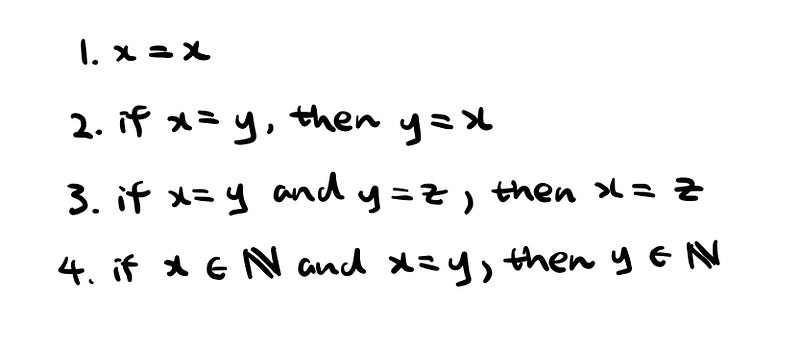
Axiom 1
For every x in the natural numbers, that natural number is equal to itself.
The numbers we deal with here are natural numbers, and they are called ‘natural’ because these numbers are originally used for counting. This first axiom shouldn’t be too confusing. Equality simply means the variable is equal to itself.
Axiom 2
For every x and y in the natural numbers, if x is equal to y, then y is equal to x.
It doesn’t matter whether the rule is from the right to left or from the left to right. What matters is whatever is on one side is equal to what’s on another. This is also know as the symmetry axiom because it’s a mirror image of itself.
Axiom 3
For every x, y, z in the natural numbers, if x is equal to y and y is equal to z, then x is equal to z.
This is called the transitive axiom.
Axiom 4
For all x and y, if x belongs to the natural numbers and x is equal to y, then y also belongs to the natural numbers.
In other words, the only way for something to be equal to a natural number is for it to be a natural number itself.
The 4 axioms we have looked at so far are like ‘baby’ Peano axioms because they lay the foundation for main Peano axioms, which will tell us exactly what a ‘number’ is.
What is a ‘natural number’?
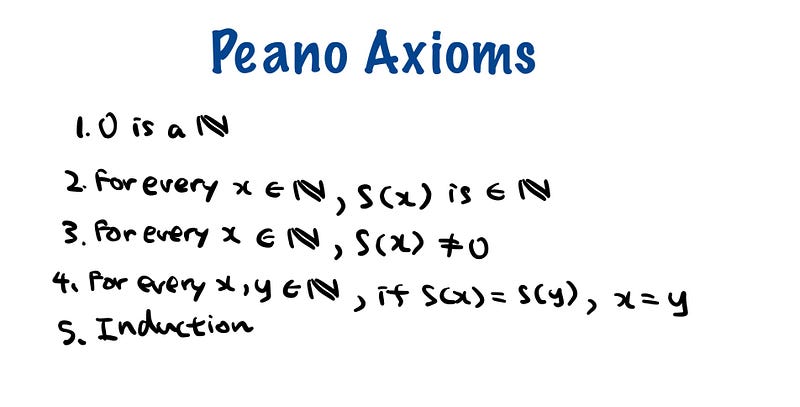
Axiom 1
0 is a natural number.
Some mathematicians don’t include zero as a member of the natural numbers, but we will use the convention that it is.
Axiom 2
For every x in the natural numbers, S(x) is a natural number.
S(x) is the successor of x. Intuitively, we can think of S(x) as x + 1. The problem is that we cannot define it this way because we do not yet know what the addition sign (+) really means. What we are really doing through these axioms is to define clearly the natural numbers themselves.
Axiom 3
For every natural number x in the natural numbers, S(x) cannnot be 0.
S(0) cannot be zero. But it must equal some other natural number. We can denote that natural number as 1.
So, we can define the following: S(0) = 1
At this point, we know that there are at least two two natural numbers, namely 0 and 1. To make sure that the rest of the natural numbers (as we know it) exist, we have the following axiom.
Axiom 4
For every x, y in the natural numbers, if S(x) = S(y), then x = y.
The principle outlined here fundamentally impacts the structure of the natural numbers, ruling out the option of it being merely {0, 1}. This is evident when we consider that S(0) = 1 and, from axiom 4, S(1) cannot also be 1.
Axiom 2 prevents S(1) from being 0, so there must be a different natural number for S(1), which we label as 2. Consequently, we establish that 2 = S(1).
Using the same line of reasoning, S(2) cannot equal 0, 1, or 2, so it must be a different natural number, which we call 3. Continuing this pattern, we have guaranteed the existence of the rest of the natural numbers.
Axiom 5: Induction
The mathematical rigor of axiom 5 is beyond my aim here. In simple terms, the 4 axioms above can be applied on top of each other.
S(0) = 1, so S(S(0)) = S(1) = 2 so on and so forth
This process is known as induction and we ca define the whole set of natural numbers by continuously applying the successor function.

This is the whole set of natural numbers we have defined from all out axioms above.
Now that we have done all the groundwork, there’s one more thing to do. And that is to define what ‘addition’ really is.
What does + mean?
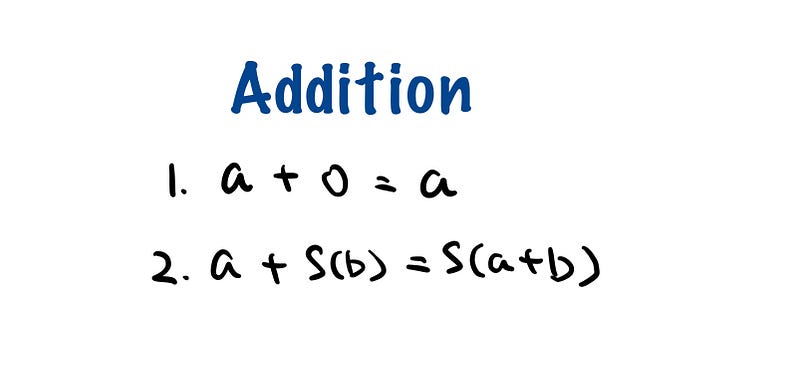
Rule 1 should be obvious.
An arbitrary number + 0 results in itself.
Rule 2 states that if we have a and we add the successor of b, the result is the successor of (a + b).
1 + 1 = 2
To compute 1 + 1, we first note that 1 is the successor of 0.
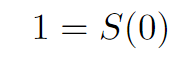
Now, using rule 2 from addition, we get

Rule 1 tells us that 1 + 0 = 1, so the successor of 1 + 0 is simply the successor of 1. And the successor of 1 is defined as 2.
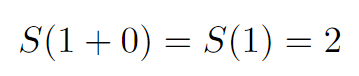
And we have proved that 1 + 1 is indeed equal to 2.
2 + 2 = 4
Try and apply the same principle to prove that 2 + 2 = 4.
The first step would be to apply rule 2.

With S(2 + 1), we once again apply rule 2 for (2 + 1).

2 + 0 = 2 according to rule 1. So we are left with the successor of the successor of 2.

The successor of 2 is defined as 3. And the successor of 3 is defined as 4.
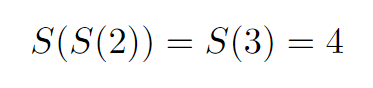
And we are finally done.
This has been a long writing session for me, and perhaps a long reading session for you. Now go outside and take a break before coming back for more hidden gems in math.
Thank you for coming along this journey with me.
Thank you for reading. Don’t forget to clap the article if you find it insightful.
I put a lot of effort into writing every article for you, so please support me with ko-fi ☕ if you are feeling generous.
Love, Bella ❤️


