
An Election Victory That’s Larger Than Politics
The amazing story and triumph of Yusef Salaam
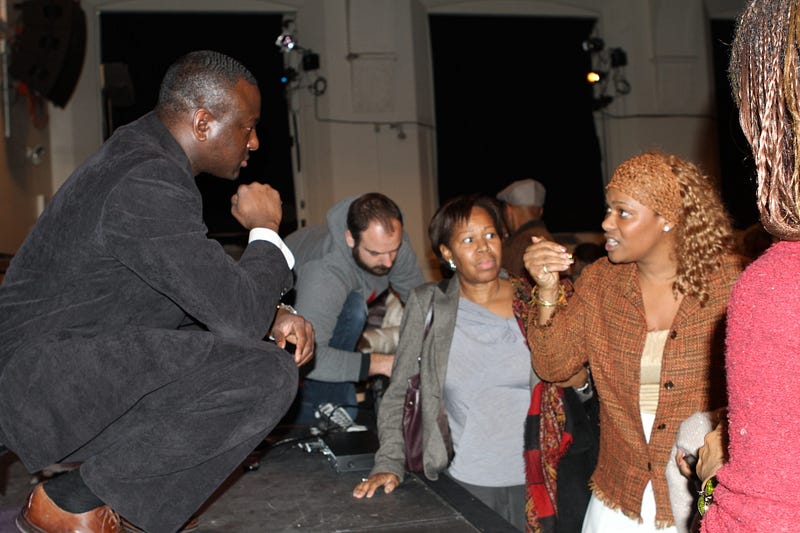
On November 7, 2023, I watched television from my home in rural Iowa, awaiting the official declaration that Yusef Salaam had won a seat representing Harlem on the New York City Council. There was no doubt Salaam would win the seat since he ran unopposed. My excitement, therefore, had nothing to do with it being a close race nor with my confidence that Salaam would make a good city councilman. My excitement was witnessing Salaam’s triumph over a history of adversity that makes his political victory all the more significant.
Who is Yusef Salaam?
In 1989, Yusef Salaam and four other Black and Latino men were convicted of the rape and beating of a white jogger in Central Park. Salaam was arrested at age 15 and imprisoned for almost seven years for a crime he never committed. A serial rapist and murderer was eventually linked to the crime through DNA evidence and a confession. Salaam was released from prison in 1997, and the convictions of the so-called “Central Park Five” were vacated in 2002.
While Mr. Salaam ran unopposed in his November 7 victory, he won a commanding victory in a contested Democratic primary in June when he defeated two sitting members of the New York State Assembly. The Democratic incumbent who currently holds the Council seat, Kristin Richardson Jordan, a democratic socialist and among the most left-leaning members of the Council, dropped out of the race before the primary.
On April 4, 2023, two months before Salaam’s primary victory, I watched Joy Reid from MSNBC interview Yusef Salaam. It was the day Donald Trump was arrested, arraigned, and pleaded not guilty to 34 felony counts of falsifying business records related to his alleged role in hush money payments toward the end of his 2016 presidential campaign.
In 1989, Trump spent $85,000 to take out a full-page ad in four major New York City newspapers demanding the state bring back the death penalty and execute Salaam and four other Black and Latino teenagers for a crime they never committed. Reid talked with Salaam about his decision to turn the ad that Donald Trump created calling for the death of the Central Park Five into a campaign ad for his run for New York City Council.
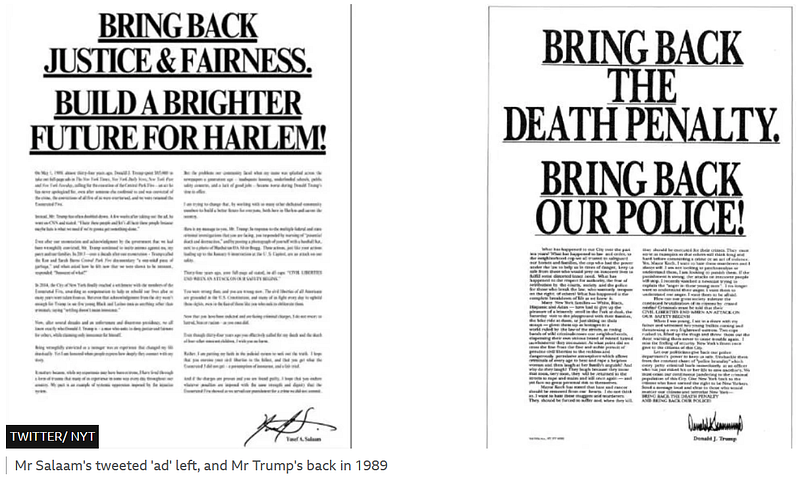
When asked about being bitter, Salaam made a statement that amazed me. He said, “Rather than just going through it, I grow through it.” I’m not quite sure what was said after that because that statement occupied my thoughts and imagination for the next few moments:
What does it mean to “grow through” rather than “go through”?
In 2021, Yusef Salaam wrote a memoir, Better not Bitter: The Power of Hope and Living on Purpose. The book was named a “Best Book of 2021” by NPR.
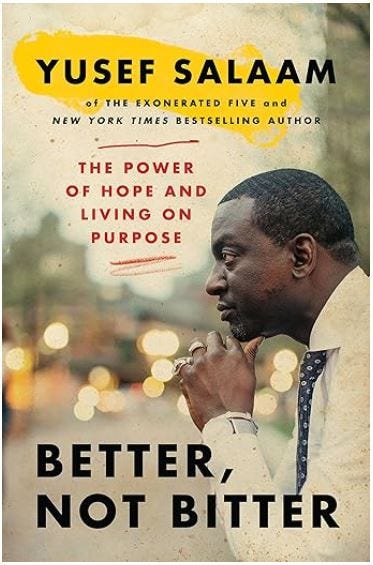
Despite the horrific miscarriage of justice experienced by Salaam, his compelling memoir is a book of fantastic hope and compassion. One reviewer writes:
Despite having confronted the racist heart of America while being “run over by the spiked wheels of injustice,” Yusef channeled his energy and pain into something positive, not just for himself but for other marginalized people and communities.
Salaam recounts stories of growing up Black in central Harlem in the ’80s, his years of incarceration, his reentry, and exoneration. He connects these stories to lessons and principles he learned that gave him the power to go through and grow through the worst of life’s experiences.
He tells a story of how when he was moved into an adult facility, Muslim members of the Black Panther Party and the Black Liberation Army told him, “You are a political prisoner. You are safe.” Salaam says these experiences have helped him grow into the person he has become.
“When They See Us”: Fear, hatred, and dehumanization of Black men
Immediately after the rape of Patricia Ellen Meili in Central Park, Donald Trump said to a room full of reporters at a news conference,
You better believe that I hate the people who took this girl and raped her brutally. You better believe it. And it’s more than anger. It’s hatred, and I want society to hate them.
In an interview with CNN at the time, Trump said: “Maybe hate is what we need if we’re gonna get something done.”
In his full-page ad, Trump wrote,
Mayor Koch has stated that hate and rancor should be removed from our hearts. I do not think so. I want to hate these muggers and murderers. They should be forced to suffer, and when they kill, they should be executed for their crimes…. Yes, Mayor Koch, I want to hate these murderers, and I always will. I am not looking to psychoanalyze or understand them. I am looking to punish them.
While much attention has been focused on Trump’s words, Trump was not alone in his sentiment. In a New York Post op-ed column titled “The Barbarians Are Winning,” Republican ideologue Pat Buchanan wrote:
How does a civilized, self-confident people deal with enemies who gang-rape their women? Armies stand them up against a wall and shoot them; or we hang them.
Echoing the long tradition of lynch mob “justice” in America, Buchanan continued,
If the eldest of that wolf pack were tried, convicted and hanged in Central Park, by June 1, and the 13- and 14-year-olds were stripped, horsewhipped, and sent to prison, the park might soon be safe again for women.
In a Washington Post op-ed, readers were told,
If New Yorkers want to be able to reclaim their city from the murderers and the thugs, they must restore the criminal justice system’s capacity to intimidate would-be criminals.
In a New York Times editorial, “The Jogger and the Wolf Pack,” an author wrote:
The news inspires horror and outrage: A pack of teenagers rampages through Central Park, harassing and assaulting several people, ultimately brutalizing and raping an innocent young woman who had been jogging on a lonely path, leaving her for dead in the April mud. New Yorkers respond with unanimous fury: Those guilty of the atrocity deserve swift, stern punishment.
The editorial speculated whether “drugs,” “greed,” or the African-American youths’ alleged hatred of white people was the cause of their savagery. The editorial never raised the possibility that the suspected perpetrators may not have committed the crime they were accused of.
These newspaper articles were reflective of the racial bias and hatred of New Yorkers (and possibly Americans) at the time. Alexandra Bell, an interdisciplinary artist, created a series of photolithographs, “No Humans Involved — After Sylvia Wynter,” that critiqued the media’s coverage of the Central Park jogger case — especially the New York Daily News and its racist headlines like “Park marauders call it ‘Wilding’” and “Wolf Pack’s Prey.” According to Bell,
I was really attracted to this moment where all the rules of journalism had been abandoned. This is the way violence in reporting operates, and there was a lot of egregious, awful reporting about the Central Park Five.
What I found extremely difficult about looking at the headlines and reading the stories in the exhibit is knowing that very little of the reporting was accurate.
The title of the series, “No Humans Involved — After Sylvia Wynter,” is a disturbing reference to the Los Angeles Police Department’s use, in the early nineteen-nineties, of the acronym N.H.I. — “no humans involved” — for criminal cases involving Black men. (The poet and scholar Sylvia Wynter interrogated the phrase in an essay titled “No Humans Involved” in 1994.)
It is this sort of hatred, fear, and dehumanization of Black men that is revealed in the Netflix mini-series that tells the story of the Central Park Five: “When They See Us.” The mini-series is a four-part series by Ava DuVernay that depicts the horrifying events surrounding the case and the excruciating toll the public persecution and swift conviction had on these teenage boys and their families.
Reflecting upon the hatred, fear, and dehumanization of Black men exhibited by newspaper articles at that time and the toll all of it had on the teenagers and their families, Salaam told the Guardian newspaper,
We were all afraid. Our families were afraid. Our loved ones were afraid. For us to walk around as if we had a target on our backs. Had this been the 1950s, that sick type of justice that they wanted — somebody from that darker place of society would have most certainly came to our homes, dragged us from our beds and hung us from trees in Central Park.
Identifying this sort of fear and hatred as an illness of American society, Salaam has said:
I look at Donald Trump, and I understand him as a representation of a symptom of America. We were convicted because of the color of our skin. People thought the worst of us. And this is all because of prominent New Yorkers — especially Donald Trump.
In his ad imitating Trump’s ad, Salaam wrote,
Now that you have been indicted and are facing criminal charges, I do not resort to hatred, bias or racism — as you once did… I hope that you exercise your civil liberties to the fullest, and that you get what the Exonerated Five did not get — a presumption of innocence and a fair trial.
Trump’s ongoing arrogance and feigned victimhood
Throughout his fraud trial proceedings, Trump has complained about how unfairly he’s been treated by the American justice system. He has repeatedly claimed that efforts to hold him accountable are evidence of political persecution. His followers have rallied to his defense.
When he was initially arraigned, he said it was a “very sad day for America” and claimed the charges amounted to “persecution of a political opponent.” I’m not sure WHY Trump considered his arraignment a “very sad day for America.” At the same time, he believes the wrongful arrest, persecution, and incarceration of innocent American teenagers is an acceptable practice.
Trump has made claims at rallies that,
This was never supposed to happen in America…. This is the persecution of the person that’s leading by very, very substantial numbers in the Republican primary and leading Biden by a lot. So if you can’t beat ’em you persecute ’em or you prosecute ’em. We can’t let this happen in America.
Trump, however, expresses no outrage about the black teenage boys being wrongly persecuted, prosecuted, incarcerated, and threatened with public lynchings, nor does he apologize for his demand that they be executed. Does Trump believe the treatment of the Central Park Five “was never supposed to happen in America,” or is this sort of fear, hatred, and dehumanization of Black men acceptable in America?
In 2021, when prosecutors were beginning the process of bringing indictments against Trump and the Trump organization, Trump told supporters, “Remember, if they can do this to me, they can do it to anyone!” This is the same message that Trump has been trying to convey since his arraignment.
What is it precisely about Trump’s arraignment that supporters should remember? What is it they should fear? The so-called criminal justice system has wrongly charged, convicted, punished, and even executed innocent Black and Brown people since its inception.
Shouldn’t the fact that five innocent teenagers could be treated the way the Central Park Five were treated by the so-called “legal justice system” cause Americans to fear that this could be done to anyone? Or is it only certain people this could be done to?
Nearly 35 years after their wrongful conviction and 20 years after their exoneration, Trump still refuses to apologize for demanding their execution, even after DNA evidence has linked someone else to the crime.
The city of New York has “honored” the now “Exonerated Five” by renaming a gate to Central Park the “Gate of the Exonerated.”
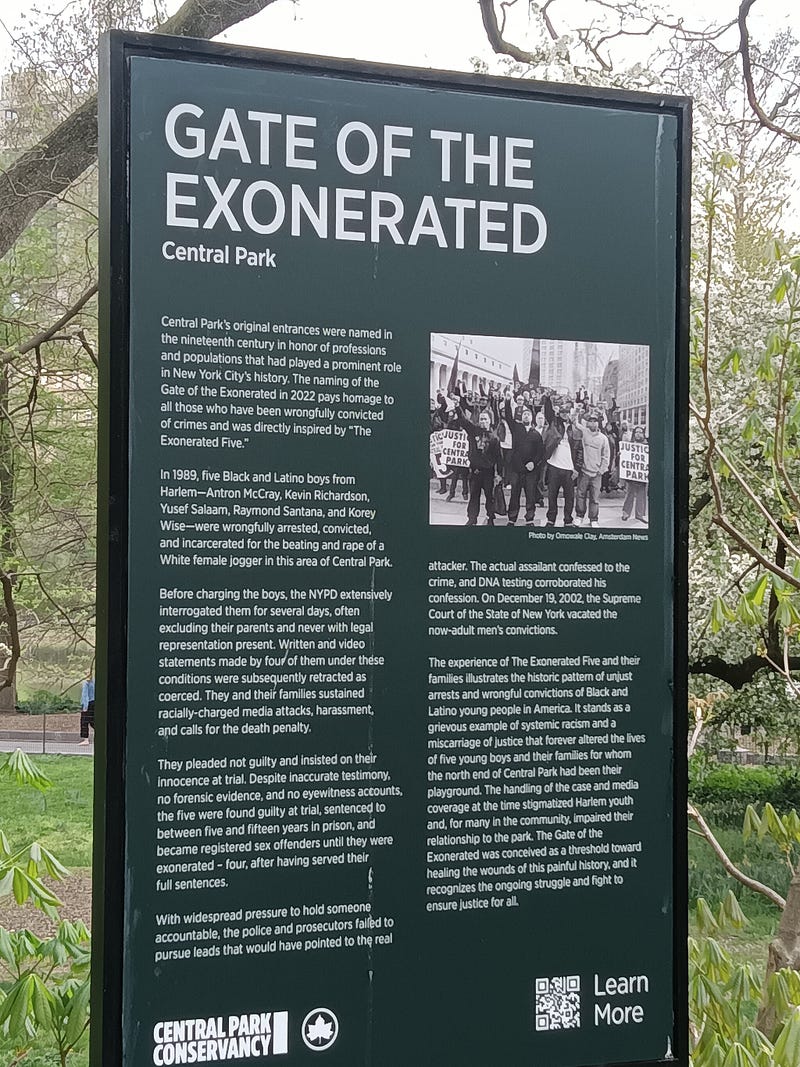
According to the Central Park Conservancy, the gate is the first entrance to be named since 1862, and it “commemorates the experience of the Exonerated Five and honors all of those wrongly convicted of crimes.”
Despite the exoneration, Trump, on at least five occasions, has expressed that he continues to believe the original verdict that the men are guilty. Trump even criticized the city for settling their civil case in 2014, calling the deal “a disgrace” in a New York Daily News op-ed. Trump maintained that stance during his 2016 Presidential campaign. “They admitted they were guilty,” Trump told CNN in a statement.
While the five teenagers confessed to the crime, they immediately retracted their statements. The five said police had coerced them into giving false confessions.
In a 2016 interview with the Guardian, Salaam said:
I would hear them beating up Korey Wise in the next room.
They would come and look at me and say: “You realize you’re next.”
The fear made me feel really like I was not going to be able to make it out.
False confessions have played a role in nearly 30 percent of wrongful convictions later overturned by DNA evidence. As of 2021, in New York State alone, 43 people who have been exonerated were wrongly convicted based on false confessions.
Even three years after being elected president, Trump continued to assert the guilt of the Exonerated Five, saying, “The police doing the original investigation say they were guilty… The fact that that case was settled with so much evidence against them is outrageous. And the woman, so badly injured, will never be the same.”
In typical Trump fashion, even though all of the evidence proves the innocence of the Exonerated Five, Trump continues to argue that his personal beliefs are more important than the evidence. Despite his prominent role in demanding the American legal system execute the Central Park Five and his refusal to acknowledge their innocence now, when he was President, Trump posted on Twitter in response to Robert Mueller’s findings: “There was insufficient evidence and therefore, in our Country, a person is innocent.” If, in America, a person is innocent when there is insufficient evidence, why does Trump refuse to acknowledge the innocence of the Exonerated Five?
Despite his support of the unfair treatment of the Central Park Five, Trump now dares to repeatedly complain about being mistreated by the American legal system. His complaints are a joke.
Salaam Yusef said it best in his recent response to and mimicking of Trump’s 1989 ad,
Now, after several decades and an unfortunate and disastrous presidency, we all know exactly who Donald J. Trump is — a man who seeks to deny justice and fairness to others while claiming only innocence for himself… Thirty-four years ago, your full-page ad stated, in all caps: “CIVIL LIBERTIES END WHEN AN ATTACK ON OUR SAFETY BEGINS.”
You were wrong then, and you are wrong now. The civil liberties of all Americans are grounded in the U.S. Constitution, and many of us fight every day to uphold those rights, even in the face of those like you who seek to obliterate them.
I don't know what kind of politician Salaam will be
I have no idea whether or not Yusef Salaam will make a good city councilman. Only the future will tell. According to supporters, Mr. Salaam is a moderate Democrat, unlike his predecessor, Ms. Jordan, a democratic socialist and among the most left-leaning members of the Council.
Mr. Salaam supports constructing a housing development on 145th Street, which Ms. Jordan opposed because she feared it would cause more gentrification. He also has said that he does not want to reduce funding for the police despite his experiences with the criminal justice system as a teenager.
While he did not win the support of local progressives during the primary, Cornel West, the professor and activist running for president, and Keith Ellison, Minnesota’s progressive attorney general, endorsed him.
Harlem is struggling with the effects of gentrification, including the loss of Black residents, the proliferation of drug treatment facilities, and a lack of affordable housing. Asked about his lack of political experience, which his opponents have made an issue of, Mr. Salaam says it means he has no “hidden agendas.”
My celebration of the election of Yusef Salaam to represent Harlem on the New York City Council is not necessarily a celebration of the election of the best candidate for the job. I don’t live in Harlem and don’t claim to know which candidate might be best for the job. My celebration of the election of Yusef Salaam is a celebration of the resiliency of oppressed people.
While Maya Angelou’s poem, “Still I Rise,” is specifically about the resiliency of Black women living in a racist and sexist America, I find the words inspiring for all people facing and triumphing over oppression. It is the triumph of Yusef Salaam and the Exonerated Five over racial hatred and oppression that I celebrate today.
You may write me down in history With your bitter, twisted lies, You may trod me in the very dirt But still, like dust, I’ll rise….
You may shoot me with your words, You may cut me with your eyes, You may kill me with your hatefulness, But still, like air, I’ll rise….
Leaving behind nights of terror and fear I rise Into a daybreak that’s wondrously clear I rise Bringing the gifts that my ancestors gave, I am the dream and the hope of the slave. I rise I rise I rise.
Thanks for reading. If you’d like to get my articles emailed to you directly, you can subscribe here.
Learn more about Guy Nave here.
See ALL of my Medium articles here.
Follow me on Twitter: @guynave2.


