
‘An Education’ Is A Journey into the Dark Academia World of Innocence versus Pleasure
An examination of the 2009 movie, as a battle between human desire and morality
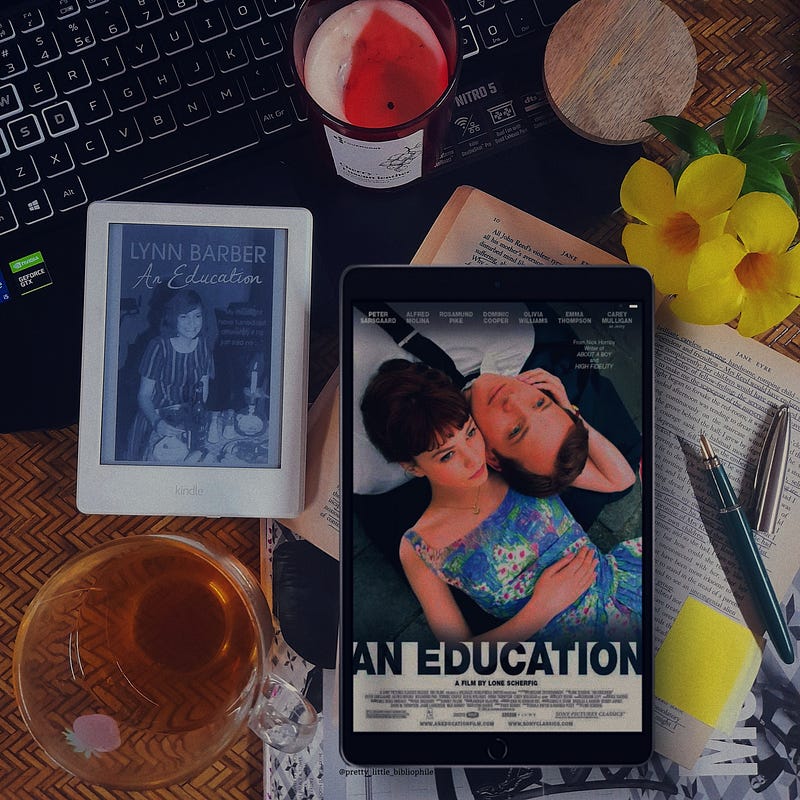
An Education, released in 2009, directed by Lone Scherfig and featuring Carey Mulligan, is a coming-of-age story of a young sixteen-year-old schoolgirl and her relationship with a charismatic thirty-four-year-old man. The memoir of the same name, by Lynn Barber, is a powerful execution of a tale that explores the dynamics of a relationship between two very different people and how the hedonistic and pleasure-seeking pursuit almost ruins the naivete of naivete of an impressionable young soul.
This examination is a personal one, based on the experiences I have lived with and went through. As such, it may not adhere to your understanding of this movie. However, I hope that the reader respects the subjectivity of this writer and the original writer of the memoir.
How It Began
The movie begins with a scene where girls are made to walk with a book atop their heads — an exercise in balance. An exercise in poise and therefore towards the social epitome of a ‘graceful woman’. With dancing lessons, followed by cooking classes with self-raising flour, and lacrosse, the movie sets the premise in an environment that strives to impart an all-around (but patriarchal, if we wear a contemporary lens) education to the girls.
Carey Mulligans’s Jenny and her walk in a snowing street was simply one shot in a montage series, and I was mesmerised by the way it was placed. I, therefore, situated her character amidst this process of identity formation. It is as if she is still in a cocoon — the Spring (birth) of her life is not yet here, but rather, just around the corner.
Jenny is bright and witty, as her first interaction with her parents (mostly her father) shows. She is also a diligent student — eager and willing to interact in class and interested in her cello lessons. From the very beginning, we see Jenny as one who participates — as the consummate student. But then we are compelled to ask — is this because she wants to get into Oxford herself, or is it because she is simply following her parents’ (father, really) desire?
The Desire to Learn and Grow
What is the point of the beginning for change in Jenny is her meeting with the charismatic David. From the first moment that she gets to see/know him, he is portrayed as a kind and charismatic man. We as viewers are charmed by him, and therefore it is not surprising that an impressionable 16-year-old Jenny too is. He is wise and also funny, and they hit it right off. Inside the “tres chic” interiors of the Bristol car, she cannot take her eyes off of him.
“If I go to university, I’m going to read what I want and listen to what I want, and I’m going to look at paintings and watch French films and I’m going to talk to people who know lots about lots.” (Jenny)
This dialogue complicated the whole issue for me — Jenny yearns for artistic freedom, growing and learning, and seeing the world. But, one wonders, is this where David’s psyche is intrigued? Is this where his ego decides that it is for him to show this young girl the ways of the world?
“Isn’t it wonderful to find a young person who wants to know things?” (David)
Immediately after, we see her lying on the ground, humming to a song that is a tribute to Paris, with rain falling outside. This is a visual romanticisation of her desires, which is also affected by her meeting with David. I wondered, is this rain a thawing of her frozen cocoon? Is this an unwrapping of that which will now birth her into the spring of her life? Does this mean that David was a catalyst to her coming of age? I found that the answer was a resounding yes.
Her parents are already unimpressed by Graham, a boy her age whom she has chosen as her social partner, and so it is no wonder that they will take a liking to David. And so, David enters her parents’ life with an excuse to expose her to culture (Ravel) — it is to be a cultural education, and the innocent (and ignorant) Mellors are only very grateful. After a short round of questioning, they slowly let their daughter enter David’s world.
The Seductive Power of Art and A Pursuit of Pleasure
And then, we see the transformative (and seductive) power of art. It is a beautiful rendering that the movie portrays — slowly, Jenny grows more confident and wiser regarding the ways of the world. She lets herself be touched by the art she comes across, and Carey Mulligan’s acting is beyond comparison.
From classical to Jazz, Jenny falls in love with the world, and seeing her transform and coming out of her cocoon is a vision in art itself. Although intimacy intrigues her (we see her wonder at observing Helen and Danny's closeness), art transforms her, and desire adds it all up as the last most potent ingredient. And so, Jenny’s “best night of [her] life” stretches out to an entire season of her life with David.
The Jane-Eyre Question: Passion and Practicality
From the beginning of the educational atmosphere of Miss Stubbs’ class, we get to see Jane Eyre as a significant presence. Jenny’s essay is titled “Passion and Practicality in Jane Eyre”, which seems to become more meaningful as the movie goes on.
Does this also signify how Jenny’s life will turn out, now that a man nearly twice her age is on the scene? And like Mr Rochester, could he, too, perhaps have a wife all hidden away? Will Jenny’s infatuation be at the cost of practicality — her education? That which it all started out as — seeking a cultural education — be the ultimate trap for Jenny?
Lover or Predator?
Despite his seemingly mild ways, as a viewer, my interaction with this movie (and my own past experiences) made me view David as a predator. Why does he need to see her body? To have just a tiny little peek? Why does a man his age take this strange interest in a sixteen-year-old schoolgirl? Does it make him feel good because he could ‘control’ himself? Does it make him feel powerful that he can steer her education?
The First Fall
Jenny’s realisation comes too late. As she sits teary-eyed, looking out of the window on the fast-moving Oxford (as well as her innocence) that she leaves behind, it is already too late. The cost of her education was too high, and it has taken away her innocence (both sexual and ethical).
This movie sequence is quite interesting. The object and reason of the realisation (the stolen Speed map) is positioned between Jenny and Helen, thus portraying two different aspects of being — one that is Helen, ditzy and ignorant, and the other of Jenny. She finally faces the truth and is shocked by it. But David, with his charming ways that only make us realise the conman he is, convinces her with his take on liberation and moving away from the bourgeoisie. In this, her ultimate alliance with David and his friends, and her letting go of her ethics, comes the first fall of Jenny.
Jenny justifies it all by saying, “You have no idea how boring everything was before I met you… I never did anything before I met you”. She has paid the price of her innocence while pursuing pleasure and art.
The Final Fall
Well-meant warnings (and subsequent encouragements) from Miss Stubbs and the Headmistress fall onto deaf ears, as Jenny ends up going to Paris, having sex with David, and ultimately dropping out from school and giving up on her originally-planned Oxford career. It is, therefore interesting, how a person on the outside sees and hence understands the nuances of such a relationship.
“You’re clever, and you’re pretty. Is your boyfriend interested in clever, Jenny?… I’m telling you to go to Oxford, no matter what.”
I felt like this question puts this whole relationship into perspective. Miss Stubbs understands what this relationship will mean for a girl with so much potential, like Jenny. And through this, we also finally get to understand, as it is put into words, how this relationship is not right, in more ways than one. Jenny, however, is unable to understand any of that.
“…these last few months, I’ve eaten in wonderful restaurants and been to jazz clubs and watched wonderful films, heard beautiful music.”
Because in Jenny’s mind, a duality has already built up, and she has chosen her side.
“Maybe all our lives are going to end up with… essays, or housework.”
The Mellors
“Please don’t make me tell them on my own. You owe me that much. You owe them that much.” (Jenny)
But the ones I felt the most for were her parents. Yes, they were ignorant and too trusting, but maybe I have reached an age where I am past all my rebellion and can understand the things parents do and say for their children are really what they think are for their benefit. The Mellors are unable to protect their daughter and it is unfortunate, but I cried more tears when I saw Jenny’s father, standing with a cup of tea for her, outside her door, apologizing.
Maybe I have reached the age I can empathize with the species that are the parents and understand them as humans, prone to error. Though his whole speech, as he delivers it outside her door, he also reveals how much he had trusted his daughter and how she had broken that trust too. It is a sad moment, one that acknowledged the foibles of both sides, perhaps the greater sins of the daughter lost in the pursuit of fun. It is also when Jenny visibly breaks down, realizing the lengths she had gone to trick her parents, under the seductive influence of David and morality (or lack thereof).
Jenny’s Redemption
In this whole chaos that inches towards doom, Danny is perhaps the only one on the other side, who questions David as to what he is doing with a girl like Jenny. He ends his small speech regarding his concern for her, by telling David, “I just don’t want to see her hurt.”
But in the end, Jenny’s realization comes too late (once again), and her enraged and tearful “I have nothing” broke my heart. David is revealed to be a coward, who is unable to face the situation and tell the truth to her parents. Jenny’s sorrowful plea falls on deaf ears and David simply walks away. In the end, David (albeit emotional and sorrowful, with his wobbling chin) is unable to face Jenny, who is panicky as she beats against her heart to calm herself down.
But in the end, Jenny starts re-working on her education, this time without the influence of David, and makes it to Oxford. We finally see her reclaiming her identity, her present, and therefore her future. It is heartwarming and a note of courage — one I hope will be both a warning as well as encouragement for impressionable young girls of sixteen.
Overall, I think this is a glorious movie, one that you need to watch! Carey Mulligan is brilliant, as is Peter Sarsgaard, and Rosamund Pike. It is also a superlative film in terms of the themes it explores.
Nayanika Saikia graduated summa cum laude with a Bachelor’s degree in English Literature and was also a Dean’s List student. She is currently pursuing her Master’s degree and is also a Booktuber and Bookstagrammer. She can often be found on her Instagram account Pretty Little Bibliophile. You can support her by Buying Her a Coffee.