
An Awe of Nature Could Save Our Lives
Traditional Hawaiian values could help us avert climate disaster if we take them to heart
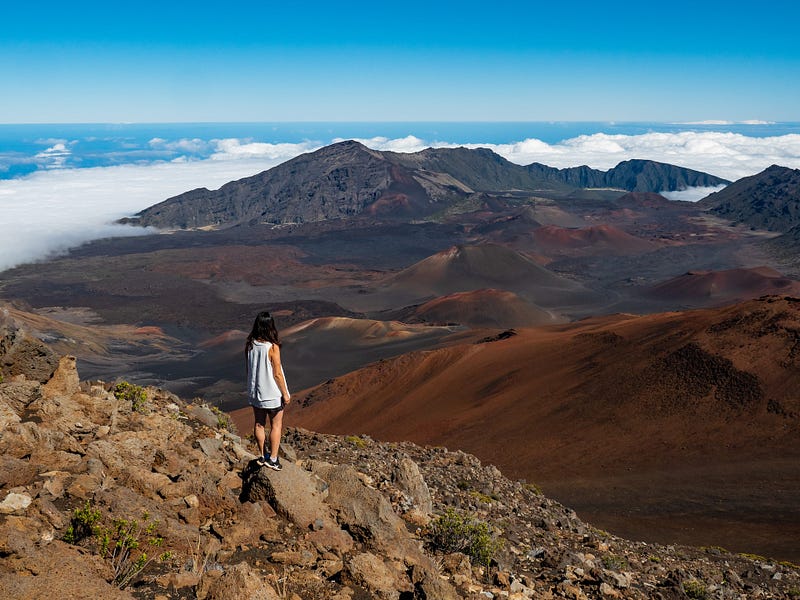
Can you imagine yourself in full-stop traffic and glimpsing a mountainous wall of fire approaching with the momentum of a high-speed train in your rear view mirror?
What would go through your mind? What would you feel in that moment?”
I know you don’t want to hear this. But you could be you next. No one in Lahaina went to bed thinking their life would end the next day.
Your end may not come from a wildfire. Unless you’re extremely lucky, it might be due to flood waters, intense heat, or hurricane winds.
This is the reality we live in now. This is the reality of climate change.
You probably don’t want to read this. I understand. Climate change is not your individual fault. Who wants to think about it? It’s easy to slip into delusion and keep dreaming your dream.
But the regular flow of disaster headlines constantly interrupt our future fantasies and instead lock us into nightmares occurring left and right.
We need to change. Right now.
Traditional Hawaiian values can show us how to avert disaster and live a kinder, more harmonious life. Let me suggest just two of an array of traditional Hawaiian values that center around the interconnectedness of all living beings.
Aloha
As I write this Hurricane Hilary just made its destructive path through California, while wildfires pummeled Washington State. Those catastrophic events are just a small part of the bigger global picture.
All this destruction reminds me to cherish the gift of my own life and to act with aloha towards others. With all the uncertainty that climate change brings, we never know who will still be with us tomorrow. Don’t miss a single chance to express your love now.
Aloha means more than “hello” and “good-bye.” Its deeper meaning includes love, peace, and compassion—not just towards friends and family but toward everyone.
So, I ask myself:
- Am I taking life for granted or am I seeing it as a miracle each morning I have the good fortune to wake up?
- Am I expressing aloha to everyone I see on a daily basis from those closest to me to casual acquaintances to strangers I pass on the streets?
- Am I living in my head, churning out thought after thought, or am I mindfully present, centered in my heart, and appreciative of the vibrant life that thankfully still surrounds me?
Aloha. We need it now more than ever—not just in Hawaii but everywhere.
“Do things for people not because of who they are or what they can do for you in return, but because of who you are. That’s aloha. ”—The Ku Project
Aloha “Aina” (Love of the Land)
The mile-a-minute wildfires that took out the entire town of Lahaina, Maui and killed more than 100 people (to date) weren’t due to downed power lines or the fierce winds of a distant hurricane alone—the stories you hear on the national news.
The destruction of Lahaina began decades ago.
In an article entitled “Here Are the Deeper Truths About Maui,” Naka Nathaniel explains that the Hawaiian Islands have been “disrespected for centuries.”
“Hawaii’s lands and waters have been devastated by extractive agriculture, overdevelopment and militarization.
The consequences of raising non-native crops and livestock in Hawaii have ravaged our lands and made us the planet’s extinction capital.”
Lahaina was once a lush area that became a tinderbox due to greedy corporate agriculture. Nathaniel says luxury homeowners and wealthy individuals also arrived in Hawaii and decided to change the land according to their preferences rather than respecting it as it is.
I’ve seen smaller versions of this on my side of the Big Island, where I’ve lived for more than a decade.
During the recent real estate boom, contractors frantically threw up new homes at break-neck speed. One contractor built three homes on my street simultaneously, making judicious use of his crews. Other homes were going up at the same time under different directors.
With each new build, contractors invariably clear cut the property — one acre lots in my division. The new homeowners weren’t the wealthy elite, but upper middle class. They had ample funds to plant one-acre lawns with just a few ornamentals here and there.
What happened to the birds, insects, and rodents that lived on that land when it’s cleared? Does anyone care about their lives?
I chose a different route.
Two-thirds of my one-acre remains wild. It will never be touched aside from maintenance while I’m here. Native Ohia trees dot the natural landscape, affording many spots for birds to perch and sing. As to the insects and rodents, I can assure you, they live on.
When I lived on five-acres, prior to this, about one-fifth hosted my small home and larger fruit tree orchard. Wild pigs roamed the rest, ‘Io (Hawaiian hawks) circled in the sky, and occasionally I’d catch a glance of a majestic Pueo (Hawaiian owl) perched quietly on a tree branch. In fact, the gravel road I lived on was called “Halepueo,” which means “home of the owl.”
There’s no need to clear cut land. Replacement lawns spell ecosystem disaster.
“Simple ecosystems, like monoculture lawns, support very few other species. In fact, lawns have been called biological deserts because of the paucity of other species they support. They are prone to disease, insect outbreaks, and invasive species. Nutrients are lost when clippings are removed, requiring large amounts of chemical inputs to sustain them. This type of system cannot sustain itself, but requires constant attention.” — EcoSystem Gardening
They require ginormous amounts of water, which can contribute to dangerous water shortages in our over-heated times. Lawns overuse other limited resources like gas too.
“According to the Natural Resource Defense Council, grass lawns consume nearly 3 trillion gallons of water a year, 200 million gallons of gas (for all that mowing), and 70 million pounds of pesticides. A challenge to maintain in some areas considering that some rivers out west are facing historically low levels — it means water shortages for residents out in Western states. The U.S. has experienced a “megadrought” this year, and hot dry conditions are also worsening the incidence of forest fires in various states across the West Coast.” — Popular Science
The individuals who seed lawns on completely cleared lots in Hawaii aren’t bad people. They’ve just lived on mainland U.S. so long most have lost their connection to the land in a world that values plastic more than nature.
If you want to help the world, let your lawn grow wild.
Traditionally, Hawaiians had a sacred connection with the land and the sea, which they collectively call the “aina.”
“Land is not a commodity to be exploited, it is a relative that is respected and cared for and, who, in turn, cares for us. Mālama ʻāina expresses our kuleana to care for the land and to properly manage the resources and gifts it provides. Aloha ʻāina expresses our love for this land and beyond that, our love of country — the sovereign nation stolen away but ever in our hearts.”—Office for Hawaiian Affairs.
Most people have lost this deep sense of connection with and respect for the aina or if younger, never learned it in the first place.
As a result, climate change speeds up, seemingly beyond our control. Catastrophic events occur more and more all around the world, destroying homes, ruining lives, and taking our loved ones.
Concluding Thoughts
We’ve not innocent victims.
Our actions, the overuse of resources like oil and its various products including disposable plastics and disregard for the environment initiated the destruction. The catastrophic disasters are simply mirrors showing us the damage we have foolishly enacted upon the land, the sea, and the sky.
But if we adopt traditional Hawaiian values like aloha (love) and aloha aina (love of the land), we may be able to avert disaster.
We need to recognize the interconnectedness of all living beings. What impacts you ultimately impacts me—it’s a natural fact.
We need to go deep and rekindle an awe of and respect for nature just like the Hawaiians who maintained a sacred connection to the land. We must reject politicians and corporate leaders who choose profit over the environment and your health and well-being.
Or we will die. If not this year, soon enough.
For more inspiration, sign up for my bi-monthly Wild Arisings newsletter and receive access to free self-discovery resources.
Come and write with us at Spread the Ripple.
This story was brought to you by Spread the Ripple. We are a publication dedicated to kindness. Kindness is our superpower. Read more stories and come and write with us here: