
An Autistic Family
When Dad, Mom, and Kiddo are autistic
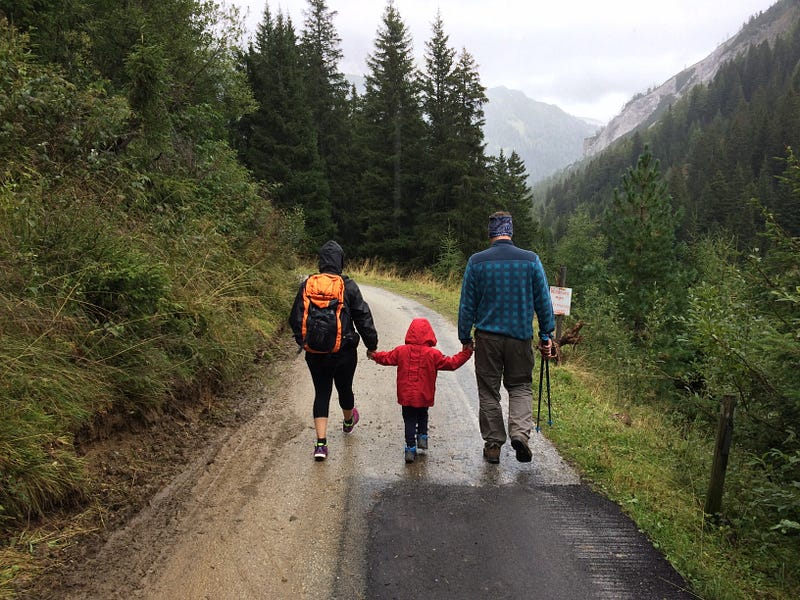
NOTE: in this piece, I will use identity-first language, since it is my personal choice to do so.
I was 27 years old when I got pregnant. We had been talking about it for a while, and finally decided to get busy.
My pregnancy was quite ordinary. No big issues. In fact, I found myself eating healthier than I had ever before.
It was about 11:00 pm when I started having contractions. Just 12 hours later, my son was in my arms.
If you go to any parenting advice website, you’ll find checklists on developmental milestones. You know, stuff a kid is supposed to be able to do at a certain age: sitting up, handling objects, shaking his head…
My son was doing ok…until he turned 18 months old. At this age, toddlers are supposed to say several single words. He wasn’t. Not only that, the two words he used to say, “ma” and “mira” (Spanish for “look”), went away. Most of the time, he would just hum.
We went to the pediatrician. He told us that we shouldn’t worry. “Not all babies develop the same. Don’t put too much pressure on him.” Maybe he was right.
But he wasn’t. By the time he was 2 years old, a neurologist told us: your child is autistic.
No, we weren’t shocked.
We kind of knew. You see, we had watched those Autism Speaks ads in which they tell you it is important to diagnose early so you can help your kid. We had heard the gloomy music and read the alarming statistics.
Then came the suggestions. “You really should take him to therapy. Now.”
The neurologist recommended a specialist. “She has a lot of experience with kids like yours. You’ll see a difference.”
I should point out now that, in Mexico, we don’t really have many of the services that are available in other countries. And I don’t mean that they are prohibitively expensive, I mean that they don’t even exist. We didn’t have many options, so we followed his advice.
We went to this therapist. When we arrived, we noticed she had conditioned an entire room with all sorts of sensory toys (I learned that term that day) and lots of cushions (I would later find out why they were necessary).
When we first met, she took a long look at my husband and I. As we talked, she kept throwing at us these odd looks. Finally, she couldn’t resist it anymore: “I’m sorry. The two of you…you do know that you are…autistic?”
We stared at her.
“What?”
“I mean…you would need to go to someone who specialized in grown-ups. And you are so different from one another. But there’s something…”
She then proceeded to work with our son. She made him use different toys, experiment with different textures; she evaluated the way he moved, made him do some somersaulting, and many more things.
We visited her several times, but our budget couldn’t resist many more sessions. So we looked for other options.
Then we found a small private center that specialized in autistic kids. It was still quite expensive for us, but way more affordable than our previous therapist. Besides, since the place was basically run as a school, we thought it would help our son even more.
And we were right.
Socializing with kids his age brought tremendous benefits for him. He really seemed to have found new ways to express himself. Also, since the groups were tiny (2 to 3 kids), the therapists managed to really tend to each kid.
And what did they do there?
Mostly, they would work on social skills, although they would also work on some basic academic abilities (numbers, colors, the alphabet…stuff kindergarteners work with).
Those few months felt amazing. Pretty soon, my son was speaking, expressing his needs and desires. We were even able to enroll him in a regular kindergarten. Their only request? He would still have to go to his “special” lessons 3 times a week, so he could “appropriately” interact with his peers and teachers.
We felt so happy we didn’t care.
And then my husband got his official diagnosis.
If you were to ask my husband about his childhood, you would quickly notice one thing: he didn’t have many friends. Scratch that: he didn’t have any.
When we first met, he would talk to me about how sometimes he would wander around the school grounds, all alone, not really wanting to talk to anybody.
Nowadays, he still doesn’t have any friends. Nor does he want to. And yet, if you talk to him about a topic he likes, he will tell you everything there is to know about it. And I do mean everything.
The therapists at the center were curious about my husband’s behavior, so they asked him to allow them to evaluate him.
Sure enough, the diagnosis came: Asperger’s Syndrome. Although, “today, Asperger’s syndrome is technically no longer a diagnosis on its own. It is now part of a broader category called autism spectrum disorder (ASD)”.
To him, it made all the sense in the world. Finally, lots of things he didn’t understand about himself became crystal clear.
There’s something you need to know about me: when I get interested in something, I tend to obsess. I usually gather lots of information on the topic and read everything I can (spoiler alert: this should have been a huge clue).
I treated autism the same way.
I visited every blog I could think of, watched interviews, learned the lingo.
It was at this time that I kept finding articles that pointed out at the large number of autistic boys, especially when compared vs. girls. However, some publications suggested that this gap could be due to misdiagnosis and to the fact that autism is considered “a boy thing.”
Also, autism tends to show different signs in girls. For example, girls tend to be better at copying other’s reactions in certain social situations. Furthermore, they usually follow scripts when engaging in play.
I read lots of stories about women who had found out late in life they were autistic. They described the signs.
It was like reading about me.
This would explain why, whenever I have to face a social situation I have never experienced before, I like to find a person who I deem an expert and request some coaching. I have literally done this before weddings, funerals, and even birthday parties. I just don’t know what to do, so I have taught myself to ask for help to avoid embarrassing situations.
As I was growing up, teachers would refer to me as “peculiar,” “shy,” “quiet.” Some of them would constantly ask me to look them in the eye, something I found slightly annoying, so I learned to look at people’s eyebrows and ears to get them to stop pestering me.
Luckily for me, I was an excellent reader. And I do mean great, as in “wow, this girl learned to read really fast. And she has an amazing memory! She must be super smart.” That got them off my back.
So here we were.
Autistic Kid.
Autistic Dad.
Autistic Mom.
We didn’t plan it this way.
You might think that this made things easier for us…but that wasn’t the case at the beginning.
For example, there were some staff changes at the therapy center where we took our kid. The new therapist apparently thought that my husband and I were not capable of making the best decisions when it came to our son’s education. They insisted on our child having to learn to read before allowing him to get into first-grade.
“I’m sorry?” I asked.
“If he finishes kindergarten without knowing how to read, he won’t make it in first-grade.”
“Isn’t that what first-grade is for? I have read the curriculum. Kids only need a basic understanding, they don’t have to fully…”
“My professional opinion is that he has to be able to read. It’s important for a kid like him. I won’t recommend him being accepted in first-grade if he can’t read.”
Oh.
Her professional opinion…A kid like him…
What the hell?
Worst of all? We were having trouble finding a school that would admit him.
“We can’t handle students like him.”
“We are not prepared.”
“We don’t have the proper staff.”
My son’s constitutional right to a proper education? Yeah, right. They didn’t care about that. “It’s for his own good.”
Finally, we found a private school that would accept him even if he couldn’t read yet…provided he kept on taking his “special” lessons. This really put a financial burden on us.
In the end, he did great in first grade. Turns out, the other kids, the “normal” kids, didn’t know how to read either. They all learned together.
At the beginning of second grade, something amazing happened. The private school went broke! That’s right, they were going out of business!
At first, we were worried. How were we going to find another school that would take him in?
We went to a pair of public schools. No luck. “He won’t do well here with us. He needs special attention…”
A social worker at one of those schools caught up with us at the parking lot. “Here, try this school. They will accept your son. And it’s public, so you won’t have to pay a penny.”
And she was right.
This new school didn’t care about my son’s so-called “special” situation. In fact, they had several students just like him. He fitted right in. We felt so encouraged that we decided to kiss the therapy center goodbye. My son is now in fifth grade…and he hasn’t missed his therapy lessons a single day. Turns out, being around other kids and being given a chance to learn like everybody else was the best thing that could have happened to him.
We don’t tell just everybody about our situation. We have found that people don’t know what to do when you disclose that you are autistic. They look at you and start saying stuff like, “Oh, yeah, I have watched Rain Man.” So we have decided not to reveal it unless we absolutely have to.
Many things have changed about our lives, but it’s not because of these autism diagnoses. They have changed simply because that is life… continually evolving.
I feel that knowing we are autistic has mostly helped us understand why other people react to us the way they do. They don’t know what to do, so they do stupid things. But that’s ok. I get it. They are not used to dealing with autistic adults: in their minds, autism equals children.
But…here’s this little thing about life: children grow up. Every little autistic kid you see now will eventually be a full-on grown-up. And he/she will still be autistic.
And there are, of course, people like my husband and me, who were born before diagnostic tools became the hype. After everything we went through with my son, I can’t help the feeling that perhaps we were lucky. Yeah, we were called “odd.” Yeah, we were teased. But no pathological labels were attached to us, and no one dared condition our education to taking some sort of expensive therapy.
As with many other aspects of life, only time will tell, only time will decide.
In the meantime, we keep on living this life of us. After all, isn’t that what we all are here for, autistic or not?