
4 Secrets To Living A Happy Life (According to An Astronaut)
How Chris Hadfield’s ‘An Astronaut’s Guide to Life on Earth’ changed my life

When I picked up the audiobook for An Astronaut’s Guide to Life on Earth by Chris Hadfield, I was feeling overwhelmed.
After countless hours researching opportunities, writing cover letters, and sending out resumes, I had yet to secure an internship or job for the summer. Scrolling through Linkedin (never a good idea when you’re feeling low), I saw most of my friends had their summers seemingly planned perfectly.
I felt like I had missed something obvious that everyone else had already figured out. I was beginning to suspect that I had failed in some way.
Deciding I need a break after hours on my laptop, I took a walk outside and started listening to Chris Hadfield’s memoir.
It completely changed my outlook on everything.
It was the right book, at the right time. But, it’s also just a brilliant memoir filled with wisdom and antidotes of life as an astronaut. His book gave me life-changing advice and taught me how to bring my Anxiety Brain back down to Earth (pun intended). I’ve already reread it since I first picked it up a few months ago.
Here are four key takeaways from An Astronaut’s Guide to Life on Earth that taught me the secret to happiness, even when you’re still reaching for the stars.
1. Enjoy Every Step of the Process
When 9-year-old Chris Hadfield watched Neil Armstrong take the first step on the moon, he decided what he wanted to do with his life. He was going to be an astronaut. But, at that time, Canada didn’t have a space agency. NASA only accepted applicants from the U.S.
This didn’t persuade Hadfield to give up on his dream. Hadfield writes, “Just the day before, it had been impossible to walk on the Moon. Neil Armstrong hadn’t let that stop him. Maybe someday it would be possible for me to go too, and if that day ever came, I wanted to be ready.”
There wasn’t a clear path to becoming an astronaut, so Hadfield carved his own. “I had to do what an astronaut might do if he was nine years old, then do the exact same thing,” he says.
He worked hard in school, joined the Air Cadets, and became a test pilot. He attended military college and then majored in mechanical engineering. Hadfield had other hobbies and activities not related to his dream of becoming an astronaut. But, he always focused on being ready, in case the opportunity ever presented itself.
What I found most important about learning of Hadfield’s journey to becoming an astronaut was the fact that he focused on his happiness. If he had never become an astronaut, he wouldn’t have felt disappointed in himself. He didn’t hang his self-worth on it.
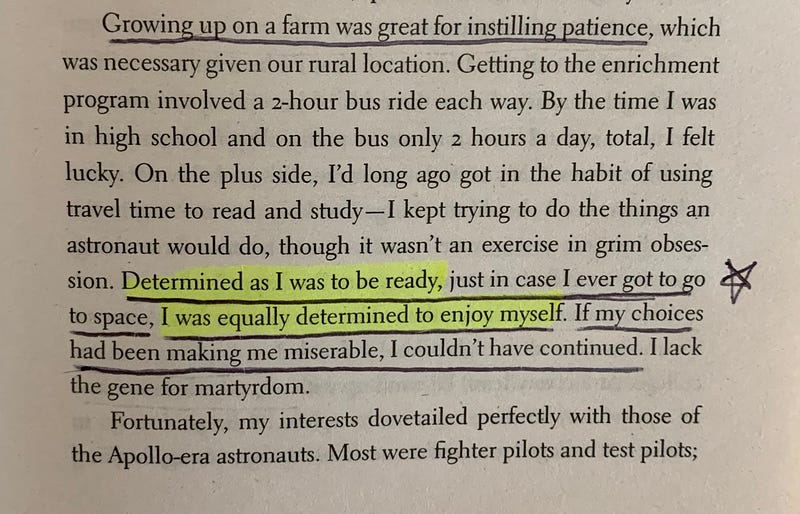
“Determined as I was to be ready, just in case I ever got to space, I was equally determined to enjoy myself. If my choices had been making me miserable, I couldn’t have continued.” — Chris Hadfield
Takeaway:
Hadfield’s advice was key for me to take a step back and think about the direction I want my life to go in. I learned to be kind to myself by taking small steps towards a life I want. It also inspired me to understand that the traditional path to a career or goal is not the only way to get there.
2. Be a Zero
Chris Hadfield has a philosophy about life. In any situation, you can be viewed in three ways: a plus one (someone who adds value, a minus one (someone who harms or creates problems), and a zero (someone who is neutral, and does not actively add or subtract).
Most people would aim to be a plus one. But Hadfield cautions against this.
He shares that as an astronaut, a profession built around teamwork and collaboration, it’s actually better to be a zero. He writes, “Anyone who views him or herself as more important than the ‘little people’ is not cut out for the job (and would probably hate doing it). No astronaut, no matter how brilliant or brave, is a solo act.”
The same thinking can be applied to any career path, especially when it comes to a new situation or environment.
“When you have some skills but don’t fully understand your environment, there is no way you can be a plus one. At best, you can be a zero. But a zero isn’t a bad thing to be. You’re competent enough not to create problems or make more work for everyone else. And you have to be competent, and prove to others that you are, before you can be extraordinary.” — Chis Hadfield
Takeaways:
Hadfield’s idea of being a zero was eye-opening to me. It helped me understand how important humility is in earning the respect of those around you. Don’t act as though you are above other people, or above doing certain tasks. Help other people succeed. Understand the power of listening and learning from others.
3. Plan For The Worst Case Scenario
One of the most common questions Chris Hadfield gets asked is how he deals with fear. After all, being an astronaut can be dangerous. His answer?
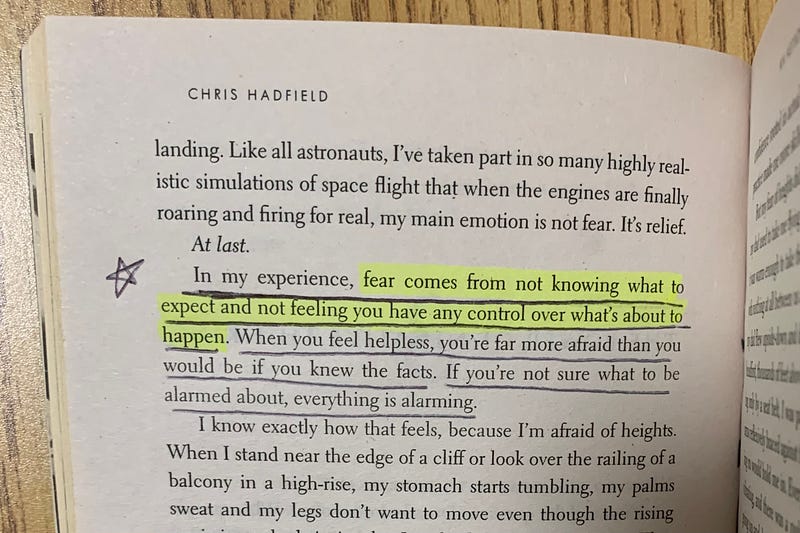
“In my experience, fear comes from not knowing what to expect and not feeling you have any control over what’s about to happen. When you feel helpless, you’re more afraid than you would be if you knew the facts. If you’re not sure what to be alarmed about, then everything is alarming.” — Chis Hadfield
Hadfield recommends when you are afraid of something, to really dig into why. Learn what you don’t like about a theoretical situation and figure out what you would do if it were to ever happen. Then, if it ever does come true, you will know what to do.
I was shocked to discover when I read this book that astronauts go through training called “contingency sims” or death sims. A “sim” is a simulation that the crew will practice on the ground in order to face a potential issue that could happen in space.
These death sims essentially force the crew to think about how they would want their potential death to be handled. They go over questions like how the astronaut would want their family to be told, when would it be appropriate to submit a statement to the press, etc.
Hadfield says, “When the stakes are high, preparation is everything.” As an astronaut, a split-second decision can save a person’s life. So, it’s vital they plan for multiple worst-case scenarios, even if they don’t happen. This makes the whole process a lot less stressful and seamless.
Takeaways:
Hadfield helped me understand that planning for a worst-case scenario can actually help me feel calm about a situation. When I plan for multiple outcomes, I know what to do, no matter what happens.
4. Critique The Problem, Not The Person
One main aspect of NASA’s organizational culture is its focus on education rather than achievement.
At the end of a space flight, the crew will debrief for weeks about all aspects of the mission, from experiments, successes, and even blunders from the crew.
Hadfield writes, “At NASA, we’re not just expected to respond positively to criticism, but to go one step further and draw attention to our own missteps and miscalculations.”
Why? Because knowing about a potential problem can save an astronaut’s life in the future. Talking about what can go wrong is a learning moment not just for the individual, but for everyone involved in the mission.
Hadfield says that these discussions are only effective when individuals become humble. Oftentimes, at NASA, you can be critiqued in real-time. That’s why Hadfield says it is important to “view criticism as potentially helpful advice rather than a personal attack.”
Takeaways:
People often say, “don’t take criticism personally,” but hearing about Hadfield’s experience helped me internalize this idea. Instead of ignoring criticism (which can be easy), it’s best to pick it apart, so you understand how to improve.
Reading Chris Hadfield’s memoir was life-changing and completely altered my perspective. I learned the importance of:
- enjoying every step of the process
- being a zero
- planning for the worst-case scenario
- and critiquing the problem, not the person
If you want to read an entertaining and informative book filled with valuable wisdom, pick up An Astronaut’s Guide to Life on Earth.
If you liked this article and want to support my writing, you can sign up for my email list to get my articles directly in your inbox.