
An Astounding Truth About Confidence I Wish I Had Known Years Ago
Confidence isn’t a state, inborn trait, or mindset

Being bullied in middle school morphed me into a college bully.
It was my form of redemption. In my head, my bullies had been the confident “alphas” so I gloated every time I picked on someone weaker.
Trying to act macho, I’d shit-talk, trigger senseless fights, and stir up drama.
Not to mention strutting around with my chest and head flared.
But weirdly, I felt way worse as a bully than I ever had while being bullied.
A string of experiences made me realize putting others down wasn’t the hallmark of confidence. What was it then?
Trying “Act confident and you’ll be” didn’t work. Nor did “Observe and mimic confident people”.
Don’t even bring up “Just be yourself” — that’s the most wishful, least helpful bit of advice out there.
Only now, years of experiences and introspection later, have I cracked the enigma of true confidence.
What Confidence Really Is
Competence.
Confidence is competence — the deep-seated knowledge that you’re capable of something.
It’s the difference between “I know I can” and “I think I can try”.
You can’t just wake up one day and assume competence. Doing so doesn’t signal confidence.
It implies arrogance.
As the Dunning Kruger effect explains, the lesser your competence in something, the better you think you are — and vice versa.
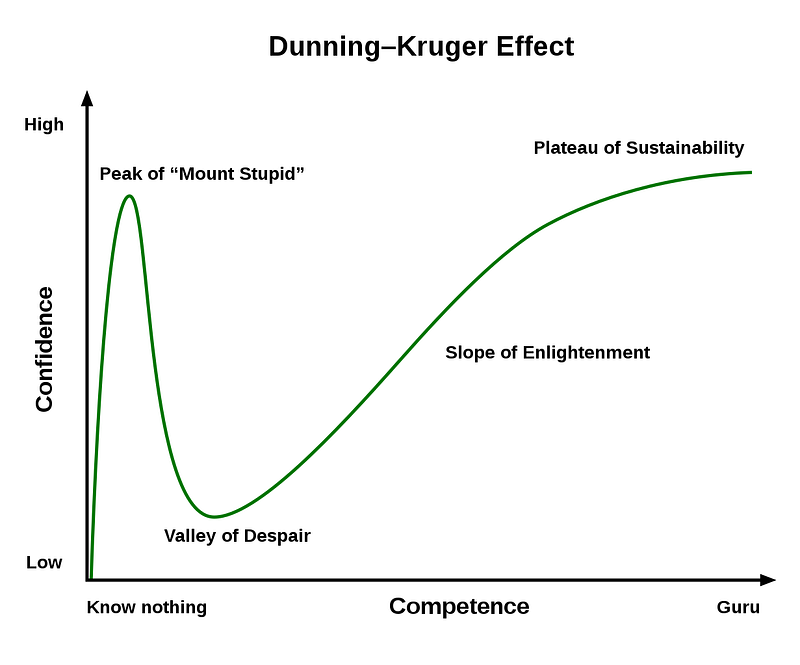

Until the peak of “Mount Stupid”, the high “confidence” is actually delusional arrogance. Only during the climb of the Enlightenment slope do you gain true confidence.
So true competence is built on the bedrock of experiences and sheer practice.
Want to become a better writer? Rip through 100 articles. Painfully shy around the alien species called women? Go talk to 100 of them.
Ashamed to take your shirt off? Shed the kilos. Baggy clothes to “pad” your twig arms? Build those guns.
Socially anxious? Throw yourself into gatherings.
Confidence isn’t an elusive state some are “magically” born with. It’s a skill — that anyone can master with enough practice.
Confidence Is Context-Specific
A business tycoon that can dominate the boardroom would be a clown in a frat party.
A professional bodybuilder can pose with a pair of tiny undies but piss his pants for public speaking.
A nerdy physicist could drone for hours about the hadron collider, but blush and stutter on a first date.
You can be extremely confident in one thing and be paralyzed with even at the thought of another.
Life Is a Game of Giving and Taking
An entrepreneur building a six-figure business can’t go out and pick up women on a daily.
An athlete on contest prep can’t get drunk with “the boys”. A social media influencer basking in the public eye can’t focus much on solitude and inner growth.
When you prioritize something in life, you also de-prioritize something else.
“Every time we say yes to a request, we are also saying no to anything else we might accomplish with the time.”
But There Is a Way to Build All-Encompassing Confidence
When you get straight A’s, you’re “academically” confident. Straight hoops? An amazing basketball player.
Mastering story-telling? You’ll dominate conversations. But when you get good at all of them?
You become good at “becoming good” — confident of “becoming confident”
Every achievement tilts the “evidence-scales” of your brain — rack up enough of them and you’ll internalize the phrase, “I know I can”.
You’ll still fumble and feel your heart hammering with nervousness when trying something new.
But you’ll know at a soul-level that you can and will get better with enough practice — given that you’ve already proven it in so many things.
The Element that Ties It All Together
The pent-up negativity of my middle-school bullying fueled the first leg of my fitness journey.
But the confidence I got from gaining muscle made me more vocal — which killed my stutter.
This double bonanza made me a chatterbox. Paired with reading and deep thinking, I became an excellent conversationalist—and bagging friends became effortless.
The vivid life experiences fueled my writing. And writing turbo-fueled my self-improvement — thanks to the clearer thinking process and heightened accountability.
Every single thing you get better at bleeds into every other thing.
It’s synergy — the sum of the whole is greater than its parts. So start improving your life.
One aspect at a time. Start now.