
An Anti-Beauty Drug — How Society Changes When Pretty Faces Don’t Matter
The path to a fairer community
Our looks are one of the biggest social issues nobody talks about.
We might talk about racism and sexism, but we don’t talk about the widespread prejudice towards unattractive people. Instead of fighting against it, our society reinforces the damn thing.
Yes, we’ve educated people on how appearances are deceiving and that we shouldn’t judge a book by its cover, but is it working?
We need technology to do what we can’t achieve naturally.
We can rapidly mature with a high-tech upgrade that allows us to ignore the surface. Here’s what happens when we cut the link between aesthetic judgments and our visual perception.
When looks don’t matter
There’s a neurological condition called associative agnosia that affects a person’s ability to connect emotions, feelings, or aesthetic judgments to the visual perception of human faces.
You can still recognize faces, but you can’t form an emotional or aesthetic response to what you see. You might look at a face in a picture but are unable to find it beautiful or ugly.
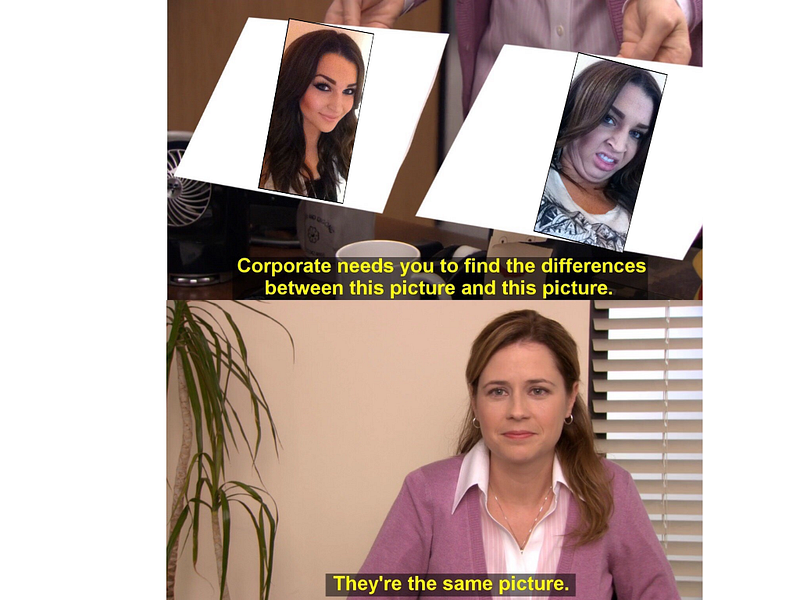
You can still see if they have a straight or crooked nose or a pointed or receding chin, but you won’t react to those differences.
So what if we could temporarily disable our ability to process the attractiveness (or unattractiveness) in a person’s face?
The miracle drug
Let’s say there’s a drug that can inhibit certain neural pathways linked to aesthetic criteria (i.e. pretty faces).
Animals have evolved to assess the reproductive potential of suitable mates by assessing their looks. They might find it attractive when they see potential patterns bigger than their counterparts, have more symmetrical features, have bigger hips, and so on.
In humans, these things matter too, but when we interact with others, we mostly pay attention to their faces. So, what if we could turn off the brain connections that make us care about how attractive a face is? These might include not caring about skin issues (e.g. acne, sun spots) or someone’s facial symmetry.
Using this drug, we’d essentially turn off our reactions to these features. It’s similar to numbing a specific part of the brain and keeping those impulses below a certain level. And the interesting part is, you could use this drug to either turn this beauty perception pathway on or off, depending on your choice.
You might notice the difference between people, but you wouldn’t care.
The device would eliminate our natural predisposition and level the plainfield.
Congrats! You’ve now become unable to distinguish between a pretty face and an ugly one.
What’s next?
Once you have the procedure.
Think about all the people you are surrounded by.
People with facial injuries like bone cancer, burns, scars, or facial mutations wouldn’t experience rejection from others.
Those young people who believe that being good-looking is the key to an easy life would shift their focus to developing their skills, valuing what they can achieve with their bodies and minds rather than their looks.
Teenagers who often feel uncomfortable in their skin would finally find relief from their constant worries about their physical appearance.
Wouldn’t the world look much better without the tyranny of good looks?
So there’s no more falling in love?
Physical beauty is just one part of what makes someone attractive.
The things people say, how they say it, their behavior, and even their body language are a big part of making them attractive.
The way they respond to you, also influences how you perceive them. If they look at you with desire, cuteness, and love, you will feel something whether it's rejection or attraction.
The drug doesn’t take those things away from the experience.
Physical appearance influences our society more than we think

Don’t you react differently when you’re with someone good-looking compared to someone who’s not as appealing?
Looks help you advance in life.
We think of attractive people as being more competent, more reliable, and deserving than those who are less attractive. This bias is often based solely on their appearance.
According to a study at Harvard, attractive people are more likely to get hired, get better performance reviews, and get paid more (10% to 15%).
Being good-looking pays off.
The alarming trend in pursuit of perfection
The promotion of beauty has become as addictive as turning plain coca leaves into cocaine.
Like any drug, it’s becoming a major issue.
In this case, it disrupts our self-perception, especially “thanks” to social media and its (beauty-boosted) filters.
Filters allow us to see ourselves in a better light and even hint at post-surgery transformations. Filters are quite fun until you start using them so much that others rarely get to see you without them.
Here’s a trend that’s been raising eyebrows (quite literally).
People are requesting plastic surgeries inspired by social media filters. These platforms offer us the means to digitally enhance our appearance, but why stop at digital changes when you can make them a reality? The most requested procedures focus on the eyes, dealing with dark circles and eyebrow tweaks.
For instance, Dr. Lara Devgan in NYC says half of her patients walk in with photos of their faces, only they’re retouched with filters. Essentially, they want an edited version of themselves.
What will happen when other filters hit the market?
More Insta surgeries!
Think about it. With this drug, plastic surgeries, cosmetic products, and model agencies would all run out of business.
We are bewitched by physical appearance
Why do we use so many magical words to describe an attractive person?
- Bewitching: She had a bewitching smile that captured everyone’s attention.
- Enchanting: His enchanting eyes seemed to cast a spell on those who gazed into them.
- Mesmerizing: Her dance moves were so mesmerizing that the whole room couldn’t look away.
- Spellbinding: The actor’s performance was spellbinding; he held the audience in rapt attention.
- Alluring: He possessed an alluring charm that made it hard to resist his company.
- Mystical: There was something mystical about her that left people intrigued.
Isn’t it weird?
Seeing an attractive person is like we’ve been put under a spell.
And why would we use magic in the first place?
To make people desire us or fall in love.
How many times have you fallen in love just by looking at an attractive being in front of you?
Oh man, we can be so off the mark. We get so caught up in their looks, that we miss all the warning signs or let things slide. It’s like our hormones are running the whole show.
It’s addictive and it’s harmful.
Takeaway
The drug doesn’t exist yet, sorry folks.
However, this theoretical approach helps us think about the societal obsession with beauty.
We need to raise awareness of the bias towards attractive faces, a bias that often transcends merit. We need to be able to look beyond appearances to achieve a fairer and more equitable society.
Any drug or tech that can change us to avoid dealing with this issue isn’t the answer.
Quick fixes don’t lead to the lasting solutions we seek.
Restricting people’s range of experiences doesn’t lead to their freedom or their personal growth.
True freedom and personal development often come from having a broad and diverse range of experiences to learn from.
It’s time beauty found a place among all other human qualities, not above everything else.