
Chinese Proverbs for Self-Improvement
An Ancient Chinese Proverb for Finding your Niche
On the Saying: “A Well-Bottom Frog” (Jǐng Dǐ Zhī Wā)
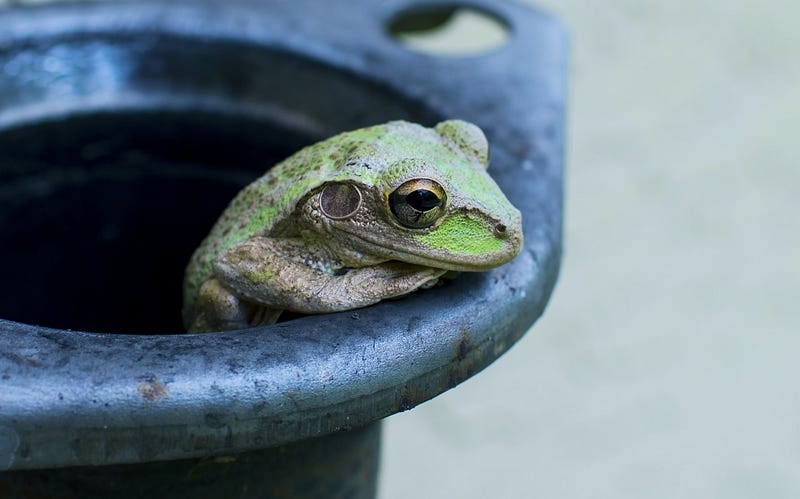
“You look as happy as a flea on a bluetick hound.”
I blinked at my great-uncle in confusion.
It was the summer after my first year of graduate school and I’d just finished complaining about the year’s challenges. Although I grew up around such folksy Southernisms, I was still a “city-boy” to my relatives on the family farm, just outside Vidalia, Georgia.
So, minor details occasionally got lost in translation.
I mean, I didn’t FEEL particularly happy — or even all that content — so, I thought, “Maybe he just wasn’t listening?”
But, “Pa” was listening, and he understood better than I did that I’d finally found my niche, a place where I might fit in, a place where I could rise to life’s challenges and grow in the ways I needed.
It wasn’t some fleeting emotion Pa heard in my voice, but something much deeper and longer-lasting.
It was BELONGING…
I’ve always been amazed at how a good proverb can pick out the nuances of our life experiences.
In my job as a professor of comparative philosophy, I’ve had a chance to discover idioms from other cultures, as well, and the ones that resonate the most with me tend to come from a class of Chinese sayings known as chéngyǔ [成語].
These expressions of “ready-made speech” consist of 4 to 6 Chinese characters. What makes chéngyǔ so unique is that they’re usually derived from some classic philosophical text or great work of literature. By contrast, Chinese folk-sayings handed down through the spoken language are called yànyǔ [諺語].
I think more people should know about these terrific sources of self-expression! That’s why I’ve created this series — “Chinese Proverbs for Self-Improvement.”
Each post will be devoted to another chéngyǔ, including its historical background, philosophical import, and some context for using it properly.
It turns out that there’s a chéngyǔ that offers a terrific illustration of the sort of happiness Pa heard in my voice that summer day, so many years ago… and it comes from one of my all-time favorite Chinese works— a philosophical text known as the Zhuangzi.
A Well-Bottom Frog — Jǐng Dǐ Zhī Wā [井底之蛙]
The Zhuangzi is a Daoist text from the Warring States period (476–221 BCE).
Experts, like Steve Coutinho, agree that, “Its style is complex — mythical, poetic, narrative, humorous, indirect, and polysemic.”
Indeed, I’d wager the Zhuangzi is one of the most humorous philosophy books of all time. Zhuang Zhou — for whom the text is named — had the charm and wit of a trickster and his writing tends to pull the rug out from under the sober theorizing found in other philosophies.
That’s exactly how this chéngyǔ — “A Well-Bottom Frog” — came about.
As the story goes, a logician named Gongsun Long — who was famous for twisting the ideas of others with his petty logical paradoxes — came to visit Prince Mou of Wei, who was fond of traveling about with Daoist philosophers.
Gongsun Long had just overheard Zhuang Zhou speaking and was shaken by his words:
“now I have heard the words of Zhuangzi [Master Zhuang] and I am bewildered by their strangeness. I don’t know whether my arguments are not as good as his, or whether I am no match for him in understanding. I find now that I can’t even open my beak. May I ask what you advise?” — Ch. 17 (tr. by B. Watson)
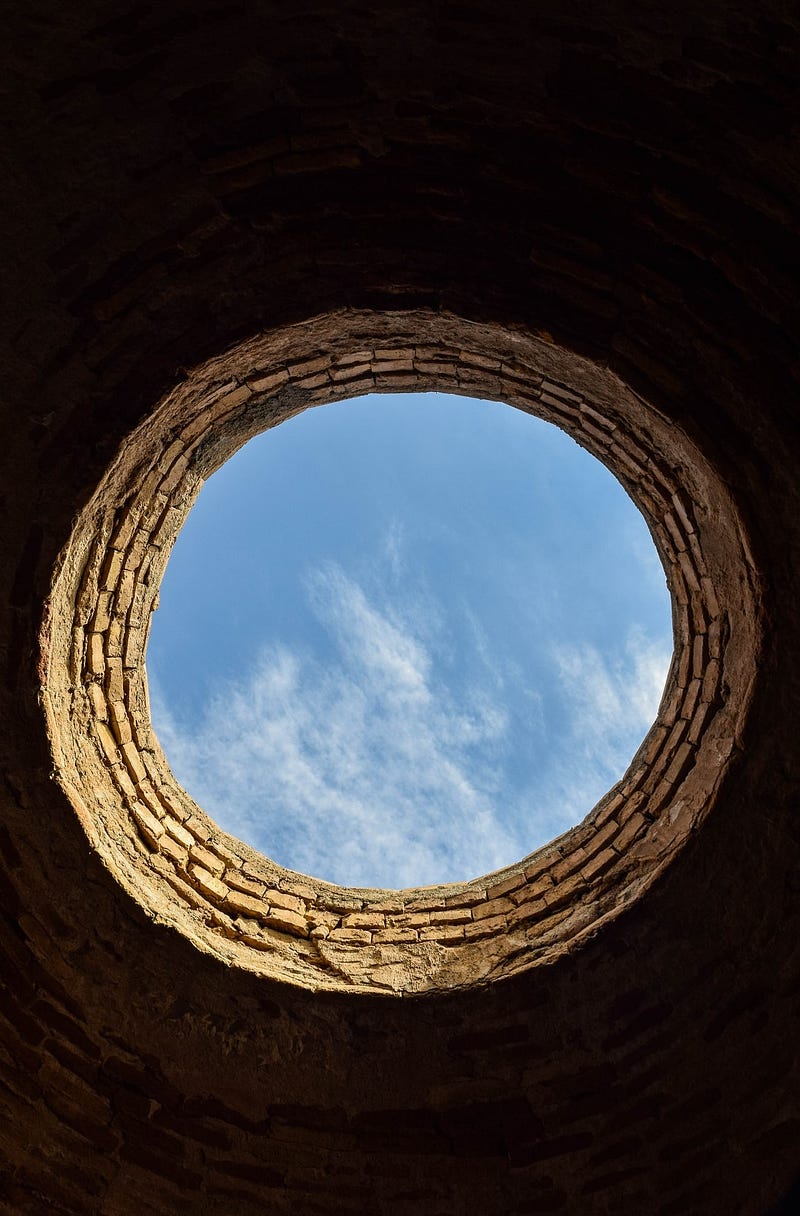
Prince Mou chuckled at Gongsun Long’s narrow-mindedness and recounted a story about a frog who lived at the bottom of an abandoned well.
As a giant sea turtle passed above, the frog shouted up to him, inviting him down for a visit:
“What fun I have! I come out and hop around the railing of the well, or I go back in and take a rest in the wall where a tile has fallen out… I look around at the mosquito larvae and the crabs and polliwogs and I see that none of them can match me. To have complete command of the water of one whole valley and to monopolize all the joys of a caved-in well-this is the best there is! Why don’t you come some time and see for yourself?” — Ibid.
But, when the turtle tried to enter the mouth of the well, he got stuck and had to back out. He explained how the little frog’s well couldn’t compare to the magnificence and endless depths of his home in the Eastern Sea.
Just like Gongsun Long felt after listening to Zhuang Zhou, the frog was both dumbfounded and crestfallen after hearing the turtle’s words.
Prince Mou tells Gongsun Long that trying to use his clever little tricks to understand someone like Zhuang Zhou — who’s comfortable swimming in unfathomable philosophical depths — was like a mosquito trying to carry a mountain on its back or trying to to use an awl to measure the depth of the Earth.
As long as he was stuck at the bottom of his tiny well, he’d never be up to the task… and even worse, if he went on trying he might get lost and forget his own petty understanding.
As Prince Mou finished, Gongsun Long’s mouth fell agape, he broke into a run and fled.
Gaining a Little Perspective — Big Frog, Small Pond
As the Zhuangzi story implies, being a well-bottom frog isn’t exactly an ideal existence — and that’s reflected in the way the chéngyǔ is used today.
If someone is a “well-bottom frog,” it typically means that they have had a pretty limited life experience, or — like Gongsun Long — they think themselves wise when they really aren’t.
But, in typical Zhuangzi fashion, other passages pull the rug out from under this interpretation. Throughout the text’s 33 chapters, there are plenty of stories of little creatures meeting large ones — a cicada poking fun at a giant phoenix, an ancient oak rebuking a small-minded carpenter, a jittery magpie conversing with a tall dyandra tree, etc. — and the implication is that EVERY character, whether big or small, is locked into SOME perspective.
Zhuangzi’s advice is that we learn how to care-freely wander in and around MULTIPLE perspectives.
But how does one start on THAT kind of philosophical project?
This is where I think something deeper might be hidden in that chéngyǔ, “A well-bottom frog.”
If you want to dive into the philosophical abyss, you have to have a leaping off point from which to start your journey. If you want to come back to the minutiae of concrete life, you’ll always need a safe place to resurface.
That’s what finding your niche — finding a sense of belonging — is really all about. We all need a place in which we can grow and develop new perspectives just as much as we all need something to keep us grounded, once we’re adrift.
So, whether you’re more comfortable starting out as a big frog in a small pond, or swimming in the depths of the great Eastern Sea, take comfort there — but don’t get SO COMFORTABLE that your niche becomes your whole world.


