
An Analysis of My First $1,500+ Article on Medium
Do not do this for the money — you’ve been warned
About a month ago I published my most successful article to date. Like with a lot of my most popular articles, I didn’t really see it coming. I did think it was going to do well, but not that well.
I remember posting this article. I published it mid-week and didn’t really get any traction from it. A bit disappointed, I ended up submitting it to a publication (Mind Cafe) on Friday night, in the hope of getting more exposure. Right after doing that, I went on a three-day weekend getaway that had been planned for a while. It came at the right time because I needed to unplug a little bit. I decided to not check any numbers (views, followers, earnings…) and not do any work for those three days. I needed to let go and not worry about it.
When I came back, the article had raked in thousands of views. Over the week, it went on to become my most popular article to date, and to make more money than I ever had on Medium.
I’m not writing about this to talk money. I’m writing about this because on Medium, the amount of money you make on an article is a good indication of how good that article is. Medium only pays you if you contribute to the platform, make people stay on the website to read longer, and make them react to your content. If they pay you good money, it probably means you’re doing a great job at writing good content. So I thought I would dissect my most popular article to date for educational purposes, because it is a good case study.
Choose a Hot Topic
Here is the secret formula to find a hot topic:
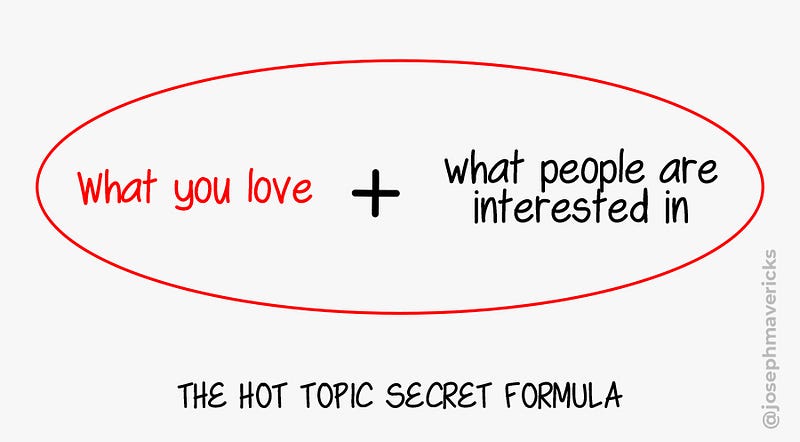
First, you have to be passionate about what you write, otherwise, your article will be hollow. It needs to stand out to get on top. It needs to have a personality, a style — and you only get that if you care about what you write.
Second, people have to be interested in what you’re saying, otherwise, nobody will read your work. There are always people interested in a specific topic, but some topics are more popular than others. The most popular ones are the ones with the easiest audience to find. If you can find the sweet spot between a big audience and your passion, you have your hot topic.
For me, this lay at the intersection between productivity and technology. I saw a lot of my favourite authors were posting about how they were using technology to optimise their productivity, and I love doing that myself. I very often get inspired by the work of my favorite authors.
Next, I thought of an angle I could use to bring my own expertise to this hot topic. And that’s where it got personal.
Be Personal
Another crucial factor in writing a popular story is to write a personal story. I thought of what made my use of technology for my productivity special. I focused on what made it my own way of doing and nobody else’s.
That’s how I got the idea of focusing on a small number of apps, but doing an exhaustive review for each. Plus, the article would be about phone apps, but I would talk about their use on the laptop.
People who know me know I barely ever use my phone. I use very few apps, and all the ones I use for productivity are synced with my laptop, which is where I use them 95% of the time. I thought it was a nice twist. It was personal, and phone apps are trendy, but it would come as a surprise to readers that I use most of them on my laptop.
I only chose apps I actually use in my everyday life. Again, it makes it more real, and it makes the review more tangible. If I really use those, I will have real things to say.
Lastly, I explained how I use those apps. People love to get sneak peeks into other people’s lives, what they do, and how they do it. Especially in the productivity spheres, it inspires and motivates people to see how others get things done.
Animated Images
One of the best ways to stand out on Medium is to design your own images. This works, because it builds an identity for your work. Darius Foroux, More To That and Cynthia Marinakos are only a few examples of people who are really good at this. Your fans can spot your content right away when scrolling in their feed, because they recognise your style. That’s assuming you also use a custom preview image, which I didn’t for this specific article. But I did go with something very noticeable, too: animated images.
I sometimes spend a lot of time designing my own images for my articles, especially graphs. For this article, I wanted to use screenshots of the apps. But it was a bit too cold and lifeless. So instead, I decided to showcase animated gifs of the different apps. It’s a lot more dynamic than static images. I’ve definitely seen these in graphic design and UX publications, but not really in the productivity content on Medium. I thought of trying to bring that process into a productivity article, and it worked great.
Just Images
In the case of my most popular article, a lot of the images are animated explainer visuals. Whatever you use visuals for though, posts with images tend to attract more visitors.
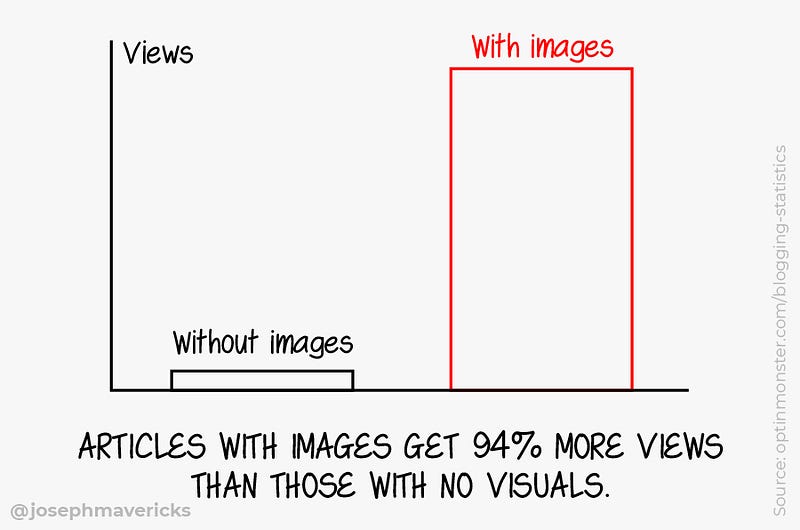
The human brain processes visual content a lot faster than text-based content. Adding images helps boost engagement too. People share images very easily. My article contains 18 images, almost all custom-made. That’s value-added content because people can’t find those anywhere else. They either have to share the image and hopefully credit me, or link straight to my content.
Use All of Medium’s Formatting Tools
I read this in a great article I can’t find anymore. I was never able to prove it, but it does seem that the Medium algorithm loves when you use all the formatting tools available in your content.
Those are:
- Heading 1
- Heading 2
- Bold
- Italic
- Links
- Quotes
I guess for Medium, that’s the criteria for quality, structured content. Using all the formatting tools makes it easier for the reader to understand your piece and not get lost in it. Structure is key. My article uses almost all the tools available except quotes and italic.
Quick tip: I recently learned how to add a grey text block like this one on Medium: ⌘ + Opt + 6 for Mac, Ctrl + Alt + 6 for Windows. Those are designed for code snippets, but you can use them for anything you want, as long as it helps you structure your content better.The Publication, the Exposure
Everyone is a fan of publications on Medium. Readers love them because they can read curated content about a specific subject that interests them. Writers love them because they can get exposure and share their content with people who are looking for what they’re writing about.
With that in mind, I cannot recommend enough submitting your content to publications. A lot of top publications don’t allow for call to actions to leave the platform to your website, or your landing page. It makes it harder to build an audience outside of Medium, at least for now. But the exposure and the credibility publications give you as a writer are invaluable.
With a publication, you get your work automatically catered to people who are interested in what you have to say. You get featured in email digests and land in people’s inboxes. People share your content more easily because it is from an accredited source.
I’m pretty sure my article wouldn’t have done nearly as well if it hadn’t been pushed by a publication. I know this because for the first few days I posted it outside of a publication, it didn’t get much traction. But that’s not necessarily because it’s not good enough.
As I always say, people will find your content if it’s good. The thing is, we live in a time where the sea of information is so vast, so deep, and so dense that you need an anchor. Unless you ask for permission to come aboard a sailing ship full of passionate fellow authors, you’ll most likely remain a drop in the ocean.
This piece is not about making the money. It’s about doing the work that leads to money. I’m in it for the long run, and you can’t be in this for the long run if your sole goal is to make money. It took me six months to write a $1,500 article. It would have never happened if I hadn’t planted all the seeds leading up to that harvest.
You have to love writing, interacting with your audience, providing value to other people. You have to get your head down, get to work, and keep going. As long as you work on improving your craft and focus on putting content out there, the numbers will come, and good things will happen.
Money is not the end game, believe me. It’s merely a side-effect of successful hard work. If you make money the priority, your chances of success in this game will be close to zero. If you don’t love it, you’ll get sick of putting in the work. And if you don’t put in the work, you won’t learn to love it more.
Don’t do it for the money.
Don’t do it for the numbers.
Do it because you love it. Otherwise, find something else. I mean that.