
An American Warship In The Red Sea Engaged Its Last Layer of Defense.
Close Call Has Been Taken. Houthies Are Being Provided With Top-End Weapons.
Houthis have once again began firing at American ships that try to take the route through the Red Sea, which is becoming nearly impossible to do, as most transport ships today are completely avoiding the Red Sea all together. They have frequently targeted all kinds of transport ships, not just the ones that are headed to Israel, I will explain as to why later. Which led not just the American navy to arrive in the Red Sea, but also foreign navies around the world, such as French and British.
The main reason, as to why Houthi group began targeting ships was because of the war that is raging in Israel, they themselves openly admitted this, saying that they will target everything that is heading toward Israel. While my opinion might not be the most popular out there, I believe Houthis and other terror organizations share the very same worldview with each other. Which is why, certain US officials have begun speculating that Iran is behind it all.
As it is, its very own proxies operating across the region. Why did Hamas attacked Israel on October 7th? Well, that’s because Iran and its close neighbors were arming Hamas militia group for many years, and many Western countries were sending these people money, through UNRWA. Several countries, including US, and others, have stopped their operations with Middle Eastern countries through UNRWA.
Which is a relief agency, dedicated to help the people of Gaza, not the Hamas. However, today, Hamas has bigger tunnels underground of Gaza than Britain has in total. And there has been Iranian weapons found in these tunnels.
The point being, Iran is controlling its assets in the Middle East, even as far as to Yemen, itself. Iran has been arming these groups with expensive weapons that these terror groups couldn’t afford by themselves, such as anti-ship missiles, and drones. What I think made everything clear was the documented use of Shahed drones by Houthi fighters, all of which shows that Iran is clearly behind the attacks in the Red Sea. Today, Iran has its assets in Lebanon, Gaza, Syria, and also Yemen, and in many more areas.
An American destroyer, USS Gravely, has taken an extremely risky decision when it came to shooting down a Houthi missile that was on route to hit their ship. If that kind of missile had hit the ship, it is likely that the damage would have been perhaps lethal, as these were no ordinary grad rockets, these were missiles dedicated to destroying the Navy vessels, also called anti-ship missiles.
Houthi group on themselves cannot afford to buy such missiles, especially when they are of ballistic origin, capable of quickly flying and evading air defense systems. Iran, on the other hand, makes such missiles, and their price is widely recognized to be around 150,000,000 million range. Houthis do not manufacture weapons of this type, they don’t have access to such technology, neither do they have the resources to do so.
Here is what the United Nations had to say about Iranian help provided to the Houthies:
Current military Iranian support to Houthis in Yemen is consistent with patterns of arms transfers going back to more than five years to date
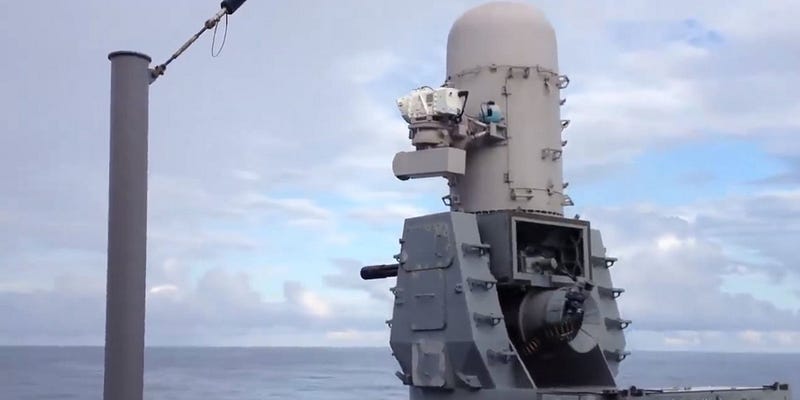
This is not a recent event, this has been going on for many years. However, it is now that Houthies began launching their attacks. And began causing problems. As American ship was about to being hit, it engaged its anti missile defense system (CIWS), which can also target airplanes, helicopters, even fighter jets. Yet, it only has a maximum range of 9 kilometers, which is 5 miles.

According to American military, this weapon system has shot down the missile. CIWS can fire up to 4500 bullets every minute, their effectiveness is so great that they have even mounted these systems on large vehicles, which were stationed in the Middle East during May 2004. Today, a lot of navies use these systems, this includes Australia, Canada, Israel, Japan, Poland, and others.
Besides, up to this very day, transport ships still can’t take the route through the Red Sea. Egypt’s economy has already became damaged, as each year Egypt makes roughly $10 billion through the Red Sea, today, Egypt’s revenue has fallen 40%. It is a hard task to bring goods from India, China, and others without taking the route through the Red Sea. Not only Egypt has been affected, but also Israelis themselves. Further, an Oil Tanker has been hit in the Red Sea. One can only imagine the damage it would do to the Ocean’s living environment.


