An Achievable Alternative to H.R. 1
How Democrats can shift public rage onto those who’d enable filibuster abuse
With fourteen months to go until the 2022 midterms (as of the date of this writing), many Democrats — and left-leaning people in general — continue to cling to what I refer to as the “Dystopian Porn” that Democratic losses are already inevitable for next year. Talking heads within the mainstream media only reinforce this potential self-fulfilling prophecy.
I have rebutted such hand-wringing with past pieces of mine — most notably, “How Democrats Can Win in 2022” and “Here’s What You Can Do For Rural America” (oh, and for good measure, check out my blueprint for the 2023 Farm Bill). And I stand by all of the points (and my advice to Democrats) that I outline, within these editorial pieces.
However, their anxiety itself is certainly understandable and warranted. Republican-led voter suppression drives as well as Republican-tilted gerrymandering by state legislatures, combined with the historical frequency of the party out of power making congressional gains, would lead any concerned citizen to fear that all hope is lost for stopping the slide toward fascism. But first, let’s back up and consider some additional factors…
The Basics
The one thing that most reasonable people can agree on, regardless of their party affiliation (or lack thereof), is that free and fair elections should transcend partisan loyalties. We also need a more responsible mainstream media…but that’s a topic for another day.
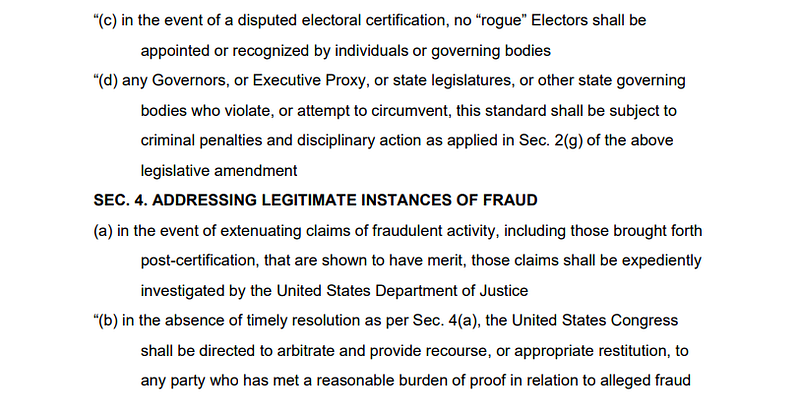
With this in mind, wouldn’t a majority of Americans support a narrowly-defined and concise piece of standalone legislation that would make it federally illegal for members of any political party, across the board, to unliterally overturn election results with which they disagree? Such a basic guarantee should be codified via something similar to my proposed LEVITY Act, which I will revisit a little later in this article.
David St. Vincent recently authored a fantastic and informative piece on the Georgia GOP’s not-so-subtle efforts to disenfranchise voters, particularly Black voters, in The Peach State through the passage of S.B.202. He also cautions us to be vigilant against allowing similar attempts to spread to other metropolitan areas, such as Detroit, Philadelphia, or Milwaukee. The author ends this op-ed by encouraging fiscal pressure from Atlantans (and allies in neighboring suburban counties) to drag such electoral racism even more squarely into the national spotlight.
Stacey Abrams, of course, has already led an unprecedented effort to combat voter suppression. Unwilling to back down, Abrams recently teamed up with Michelle Obama to urge citizens and members of Congress alike to demand common sense electoral reform ahead of 2022.
The Greater Risks
The Brennan Center For Justice keeps a running “watchdog”-style inventory of restrictive voting laws passed by individual state legislatures. Its most current update was published in July of 2021. Furthermore, the Atlanta Journal-Constitution has reported on Georgia’s Republican legislators gearing up to directly monitor future elections in — you guessed it! — Fulton County, based in and around Atlanta.
But the threat isn’t limited to Georgia. Many other states — Arizona, Nevada, Missouri, Kansas, and Texas most prominent amongst them — have also been passing laws that restrict voters’ access. This patchwork quilt of voter suppression can include everything ranging from the purging of voter rolls to imposing stricter identification requirements to limiting early voting or vote-by-mail accommodations to illegalizing pre-election outreach designed for boosting turnout.
S.B.202’s open-ended leeway for state officials to come in and take over any county’s elections (e.g. Fulton County) has prompted panic about exactly how many state legislatures could subjectively overturn election results in 2022 and beyond…simply based on the pretense that they suspect those elections may have been “fraudulent” — and so they’d empower themselves to install either a placeholder or the runner-up candidate (or leave the seat vacant) indefinitely.
I have yet to see the specific wording that would hypothetically give state legislatures this explicit power. Even a comprehensive report by the States United Democracy Center focuses on increased probability and heightened risk…rather than legislative language that would blatantly provide legislators with a clear-cut power to overturn election results. But, however realistic it may or may not be, shouldn’t Americans demand that such a scenario become prohibited, preemptively, from the onset?
What’s Already Been Proposed
As chronicled by The Huffington Post’s Paul Blumenthal, voting rights CEO Nsé Ufot (of The New Georgia Project) has expressed skepticism toward the Biden Administration’s sentiments that activists can merely “out-organize” suppressive laws. Ufot contends that legislative intervention at the federal level is necessary so that human capital and financial resources don’t end up getting stretched too thin.
In response, Democratic lawmakers in Washington D.C. have crafted the Preventing Election Subversion Act (H.R.4064 / S.2155) designed to criminalize the following: removal of election officials without due process, restrictions on poll watchers, or intimidation tactics against election workers. The intent behind these House and Senate bills is to prevent a scenario acknowledged even by suppression-skeptic Nate Cohn of The New York Times — that election officials could use the removal of election boards and other draconian measures to ultimately overturn the results of an election outright by disqualifying ballots at their own whims. UC-Irvine law professor Rick Hasen agrees with this assessment.
The For The People Act (H.R.1 / S.1) has been hailed as the gold standard for election integrity. It seeks to expand same-day voter registration, strengthen access for voters with disabilities, mandate verifiable paper trails for ballots, set up a more generous matching program for voluntary campaign-financing, recommend D.C. statehood, require independent commissions to curb partisan gerrymandering, and eliminate corruption from election officials and precinct workers alike.
Although the U.S. House of Representatives passed H.R.1, it got filibustered by Republicans in the U.S. Senate. Predictably, due to the unwillingness of Democratic U.S. Senators Joe Manchin and Kyrsten Sinema to make any immediate changes (or carved-out exceptions) to the filibuster, the Senate version (S.1) of H.R.1 has stalled. It is also believed that some Senate Democrats are hiding behind Manchin and Sinema, as a result of being too intimidated to publicly declare their opposition to filibuster reform.
Even after Manchin publicly supported some modest changes and compromises to H.R.1/S.1, the Republican-led filibuster still happened. The question is how long Manchin, Sinema, and their ilk will refuse to entertain any type of filibuster-related compromise before they realize how their own future reelection campaigns could be in jeopardy if laws such as Georgia’s S.B.202 remain unchallenged?
There is also the John Lewis Voting Rights Act (H.R.4), intended to be a scaled-down version of H.R.1. It seeks to restore some provisions of the Voting Rights Act previously overturned by the U.S. Supreme Court, under the premise that the High Court placed the onus on Congress to regulate (or refrain from regulating) federal election laws. H.R.4 is narrower in scope than H.R.1, although it still faces the same procedural hurdles in the U.S. Senate due to the Manchin/Sinema-style glorification of the filibuster.
Sensing the tough road for either H.R.1 and H.R.4 to clear the U.S. Senate (as well as the Right to Vote Act, which would establish a universal statutory right to vote), conservative commentator Mona Charen has offered up an even more focused proposal. Charen advocates for amending the Electoral Count Act of 1887 so that state legislatures may no longer appoint electors in presidential races (via the Electoral College) in the event of a “failed election” (i.e., an election riddled with technicalities, aberrations, or dubious claims of fraud).
A Different Approach
Given certain Democrats’ irrational codependency on filibuster preservation, I’m inclined to agree with Charen. But she’s thinking too small. I must go further than she is willing to.
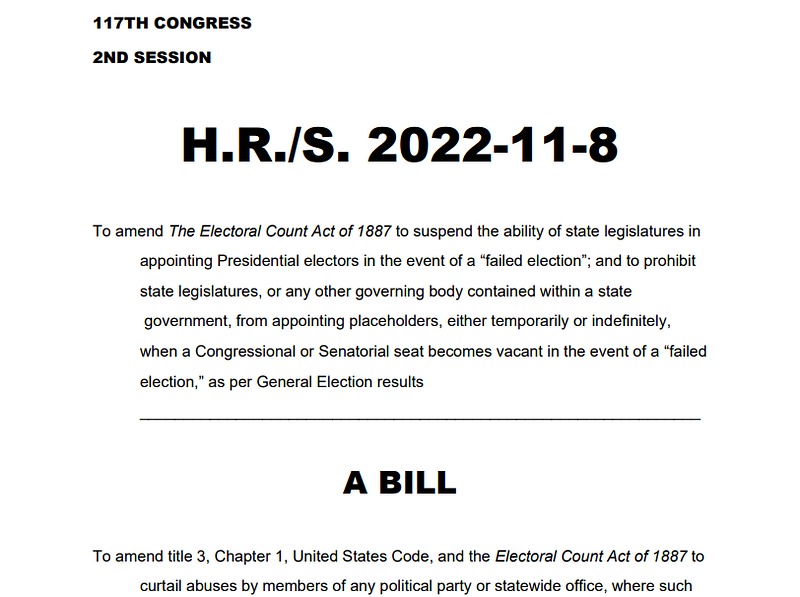
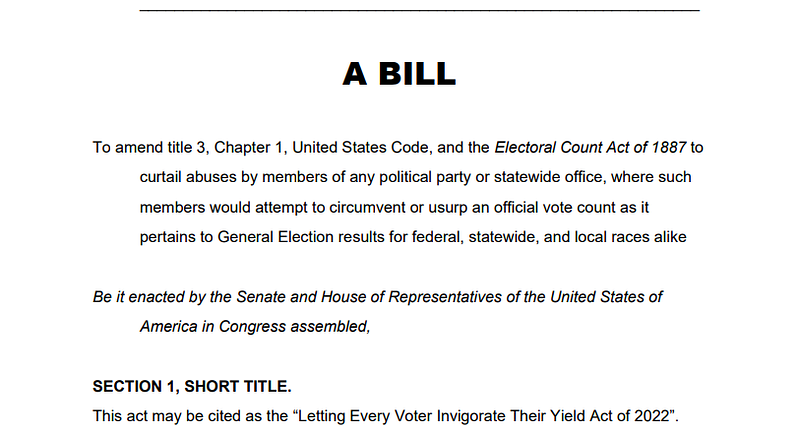
May I suggest what I dub as the LEVITY Act…
The “Letting Every Voter Invigorate Their Yield” Act
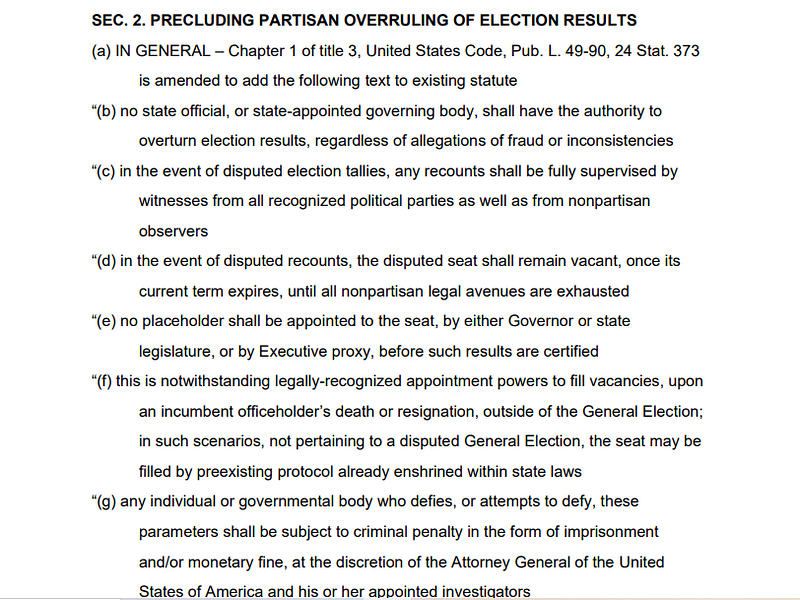
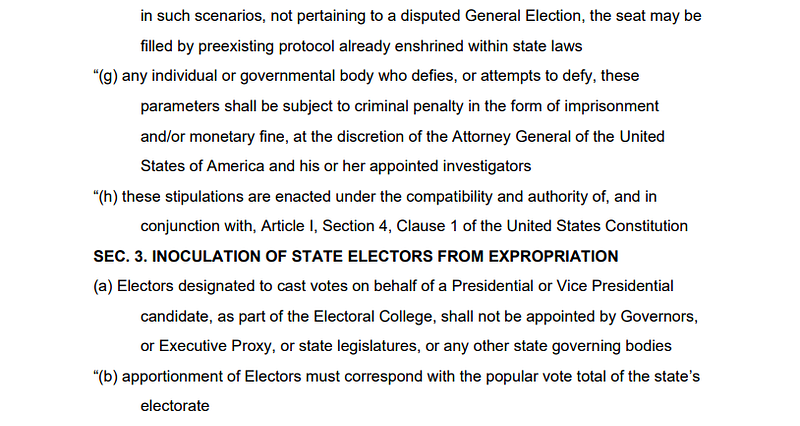
I’m proposing that the House and the Senate do something that they normally don’t do. Put forth a “clean bill” (identical versions in each chamber), explicitly making it a federal crime for state legislatures to overturn results of local or statewide elections.
No amendments, no riders, no attached pork. Written in two or three sentences — using simple, straightforward, purposeful, definitive language.
The impact and intent of this legislation would resonate amongst a vast majority of Americans of all political stripes. One person, one vote. No interference from partisans abusing power. No bureaucrats installing their own puppets against the will of the people.
If Nancy Pelosi fast-tracked this, it would easily pass the U.S. House (possibly even with the support of a limited number of Trump-averse Republicans who are up for reelection in competitive districts). When it reaches the Senate, Mitch McConnell would be forced with an unenviable task, from his perspective: let it go up for a floor vote (and likely advance to President Biden’s desk for signature), or filibuster something that’s an undisputable bulwark of democracy.
Force Senate Republicans to filibuster it, if they’re really going to go there. Then, demand that they explain their opposition to the American people. Harass them on every talk show, at every public rally, across all social media venues.
Basically, make them *ADMIT* that they *WANT* all Republican-controlled state legislatures to have the discretionary power to overturn election results simply because they’d disagree with the outcome of that election.
Such admission would NOT be a winning message for the Republican Party, going into the 2022 midterms — let alone as the 2024 presidential election cycle begins.
Is It All Just Pointless?
Would the U.S. Supreme Court overturn The LEVITY Act, if it did get passed and signed into law? Who knows? But we won’t find out unless we force their hand. Create a circumstance where John Roberts, Clarence Thomas, Samuel Alito, Neil Gorsuch, Brett Kavanaugh, and Amy Coney Barrett would have to decide whether they were going to openly side with authoritarians and fascists who blatantly desire a one-party state in America.
Of course, if they overturned it, the six of them would probably have to go into hiding within their homes, for the remainder of their careers…
And for those of you who question whether my LEVITY Act could withstand constitutional muster…
Article I, Section 4, Clause 1 of the U.S. Constitution stipulates that the U.S. Congress may step in and determine any standards for elections by which all state legislatures must abide, if Congress chooses to do so. Medium’s ScottCDunn seems to agree with this assessment.
Won’t It Just Fall on Deaf Ears?
Some might accuse me of fearmongering or creating an unfounded frenzy for anxiety. Writing for the Savannah Morning News, Will Peebles contends that overturning election results would be a long-shot under the narrow pathway provided by S.B.202.
Other critics would tell me I’m thinking too small with the LEVITY Act. While I personally agree with a bulk of the necessary reforms contained within H.R.1, I’m trying to hone in on a looming crisis over which fifty Senate Democrats (and possibly some Republicans) could finally put their collective foot down. The idea of one political party’s state-level legislators handpicking the makeup of our U.S. Congress is antithetical to every single congressperson’s continued maintenance of their own power or legacy-based survival.
In fact, the LEVITY Act wouldn’t necessarily even need to pass. Just the threat of malevolent consequences (that it seeks to curtail) should be enough to generate a widespread public backlash. It’s one thing when you struggle to try to explain to voters how this grab bag of convoluted and incremental suppression efforts work. It’s a whole other matter for politicians to be forced to admit to their constituents, “I literally won’t allow your votes to count!”
Don’t believe me that people would actually care?
When imminent disaster scenarios are spelled out, people will go into panic mode to prevent even the most outlandish consequences from coming to pass. Their actions, no matter how extreme or surreal the fear itself seems to be, aim to protect themselves against a worst-case scenario.
Consider the millions of Americans who hoarded nonperishable food and paper products when the COVID-19 lockdowns first began in early-2020. Irrational? Perhaps…but they still went overboard.
How did America react to H1N1 (“swine flu”)? A decade before COVID-19, we witnessed our first historical spike (albeit a tiny bump compared to what coronavirus spawned) in rigorous hand-washing, hand-sanitizer shortages, and avoidance of public events.
For a period of time during and following the Great Recession, Americans delayed their plans for homeownership, starting families, labor negotiations, or luxury purchases. We were literally afraid to spend money (or lose even more of our already limited income).
How about all of the security theatre we had to deal with (and still do!), in the years following the 9/11 terrorist attacks? Because it really makes sense that terrorists could take down pilots and flight crews using a small bottle of sanitary liquid.
Remember all of the tech-dependent citizens who backed up their files and updated their personal technology ahead of the Y2K virus-that-wasn’t?
Hindsight suggests that the perceived threats, in these cases, were outsized compared to the actual realistic threats. Ultimately, however, I assert that it is better to be safe than to be sorry. It is preferable to overprepare than to underprepare. Shining a gigantic spotlight on any maneuvering for a fascist takeover will have a greater chance of preventing such an outcome than would whistling past the graveyard.
The Bottom Line
One thing is for certain. Doomsday rhetoric and hopeless resignation won’t bring about the result that a majority of us (who belong to all sectarian stripes) desire.
To stave off an irreversible descent into fascism, every activist and conscientious citizen must loudly and aggressively call out local and statewide election officials who appear to be positioning themselves to subvert or overturn election results according to their own whims.
The more we blatantly accuse them of preparing to do it…the less likely it will be that they actually go through with it, or succeed at it. And the likelier it will be that more voters than anticipated actually turn out to participate in the midterms — bucking the historical trend of apathy — in order to prevent fascists from seizing such power in plain sight.