
Amy Ray Made Me Gay
And other musings on music and queerness
“If I had known about agender and other identities, maybe I wouldn’t have wasted everyone’s time trying to be the perfect girl.”
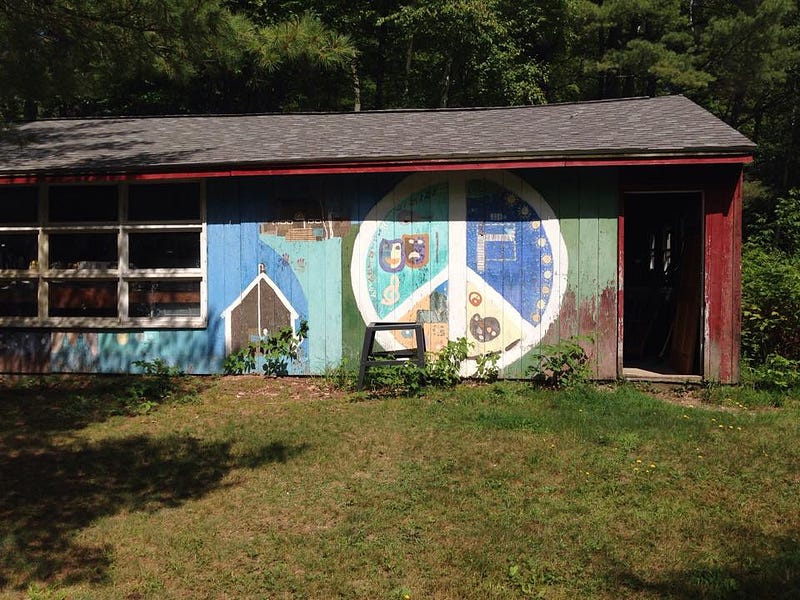
It’s August of 1989, the second day of camp.
I’m a new kid, but I’m feeling lucky because my cabin is virtually filled with new kids; out of 15 between lower cabin and the UDZ, there are only four returning campers. I’m sitting at lunch, still unsure about both the food and the other kids at my table, when two girls stand up at the front of the room. One strums her guitar while the other raises her hand and waits while the room collectively raises its hand and all talking stops. They play John Jacob Jingleheimer Schmidt, which I kind of know, and some song about a guy on a train, which I don’t (Charlie on the MTA, which I would come to know very well.)
The room sings along, from the littlest kids to the owner.
I do not. I feel like everyone is in on something and I’m not a part of it. So, pretty much the standard for me.
But then. Oh, then.
I never knew . . .
How I ever got to be 12 without knowing that music had the power to break your heart and change your life, I don’t know. But I was about to learn just how deeply songs can touch you.
The girl with the guitar just started singing, along with the first chord:
Secure yourself to heaven. Hold on tight, the night has come. Fasten up your earthly burdens, You have just begun.
Something happened. Everything from the minor chords to the harmonies reached in and grabbed my heart and squeezed. I had never heard anything like it before.
Quite simply, it blew my little 12-year-old tween mind.
Three weeks later, I made my mother drive me to Ann & Hope (a New England store that was like Wal-Mart before Wal-Mart came to town and drove them out of business) on the way home from camp so I could buy the Indigo Girls’ self-titled cassette tape.
A love affair is born
From the start, I loved the songs that featured Amy Ray’s discordant melodies and rich, deep voice. Emily Saliers wrote pretty, poetic songs, but they were nothing compared to Amy’s angst-filled lyrics. They spoke to me. They filled the hours after school, taking my mind off the unfamiliar rhythms of bells and teacher escorts and class with boys.
I didn’t know how to dress because I had worn a uniform for six years.
I didn’t understand the social hierarchy that came from where you went to elementary school, because I hadn’t gone to school in the district.
My entire life was full of things I didn’t understand.
Trying to make sense
I didn’t know I was queer at 12. Or 13. Not even at 14.
I didn’t know, but my soul did. I didn't know, but my music did.
Kid Fears, Blood and Fire, Secure Yourself. Welcome Me, Keeper of my Heart, Hand Me Downs. Three Hits and Nashville. Fugitive, Reunion, Touch Me Fall, Dead Man’s Hill. The anthems of my misunderstood soul that I could listen to and feel not-so-alone. Of course, we all bring a bit of ourselves to music, make it mean what we want (or need?) it to mean. They weren’t songs about gender then, to me.
But now? Now, they are about nothing but gender.
Revisiting music in adulthood
Did you know that expressive aphasia (external wikipedia link) kind of temporarily goes away when you listen to familiar songs? Well, mine does, anyway. So I’ve been listening to music recently, mostly because of that, but also because I can drive with the windows down, singing along, feeling everything I now have a name for. It makes me partly sad, partly regretful. Would I have been happier and better adjusted if I had understood my queerness and what non-binary meant in 1989? Or 1991? Or would I have felt even more stifled for a lack of anyone to tell and talk to?
Were my attempts to mimic what the other girls wore and how they acted nothing more than a hopeful performance? Like, if I just had shiny hair and perfect makeup and a delicate necklace and a pretty sweater, then I would be the kind of girl everybody expected me to be.
“If I just had shiny hair and perfect makeup and a delicate necklace and a pretty sweater, then I would be the kind of girl everybody expected me to be.”
I would try, on and off, through to college. Even in adulthood, every two or three years, I gave in and made an effort. But they were half-hearted attempts at best and left me, forever and always, feeling like a little kid caught playing dress-up in his mother’s clothes. If I had known about agender and other identities, maybe I wouldn’t have wasted everyone’s time trying to be the perfect girl. But then again, parental pressure and peer pressure, even if they’re unspoken, is a pretty powerful thing.
Finding your tribe
I think it says something that my two closest friends in junior high and high school also turned out to be queer. Like speaks to like even when you’re so deep in the closet that you don’t even know you’re stuck there.
My friends didn’t save me, mostly because I didn’t show anyone that I needed saving.
But music? Music did save me, and continues to. Melissa Etheridge, Pink, Cary Brothers, Adam Lambert. They all speak to that same part of me that woke up on an August day in New Hampshire when two girls I didn’t yet know strummed a guitar and sang.
So thank you, D and Z, and Amy Ray and Emily Saliers.
You didn’t make me gay, but your music has been the soundtrack to my life, and that *is* pretty queer.