
Amy Coney Barrett Made Me Cry
Anger, courage, determination, and love
“Stay angry, little Meg,” Mrs Whatsit whispered. “You will need all your anger now.” — Madeleine L’Engle
I knew it had to happen
I went out to distract myself from the pain with a craft beer and a steak — rare, rationed pleasures. I read from a book about 2000-year-old Greek politics, to fly away anywhen else.
My heart beat too fast the whole time, seared ribeye tasting like cardboard. The condemned man’s last meal cooled and congealed on his plate.
I hoped it would be over before I got home, so I wouldn’t have to feel it happen.
Driving through an almost-freezing drizzle, I couldn’t bear to turn NPR up on the radio. As I pulled into my driveway, my kitten exploded out of a pile of leaves and met me at the door.
She blurted her need to warm up with me on the sofa, so I turned the TV on, stroked her fur, and started to cry. I didn’t expect to, but I couldn’t stop the sobs from choking me and the tears from blurring my vision as the Senate confirmed Amy Coney Barrett to a seat on the Supreme Court.
When hope flickers
As a child, learning I was gay, I swallowed a tremendous amount of shame and guilt. By the time I was 13 years old, I had learned to despise myself. I knew the sexual feelings I had for other boys made me less and other and low and shameful.
I felt like a monster hiding inside my own family and church, wearing a mask of decency and humanity.
I struggled for years with no help and no information. I had no idea how to accommodate my innate feelings of love and goodness with belief systems that weaponized them against me.
I had to lie to join the Air Force. I had to lie to get a security clearance. I had to lie every day of my life for years just to survive.
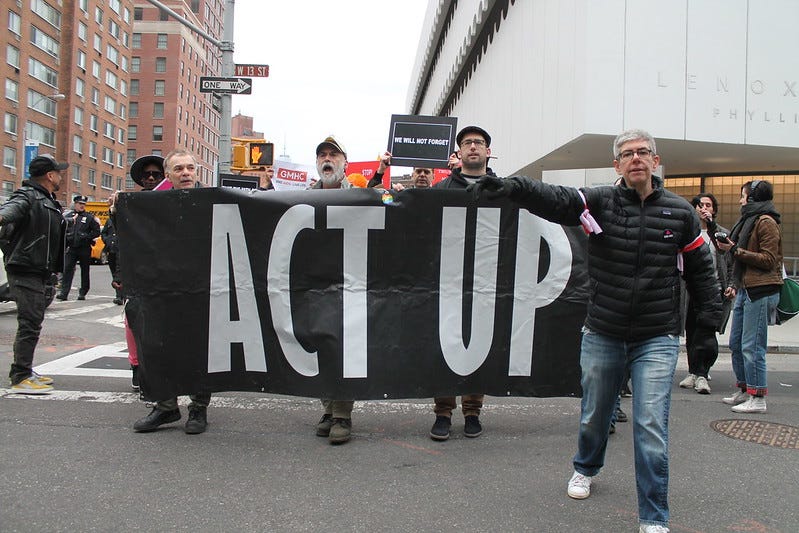
I took a giant leap from lying to activism after I left the Air Force. Instead of hiding myself away to keep from getting discharged, I was out marching in the streets, screaming outraged joy with Act Up and Queer Nation.
“Outraged joy?” you ask. “Not an oxymoron?”
No, the depths of the human condition allow for far more complex contradictions than that.
LGBTQ progress exploded
In the midst of the AIDS crisis, members of gender and sexual minorities like me came out in massive numbers. We refused to hide, cower, or be shamed. We refused to be one bit LESS than any other human being on earth.
As our friends, families, and allies joined us, we started to dream a future most of us could never have imagined. And the victories rolled in one by one. It took a long time, most of my adult life, but we gained real freedoms. Courts struck down laws that persecuted us, legislatures passed new laws to protect us, hearts and minds shifted, and even progressive institutions of faith tempered their demonizing.
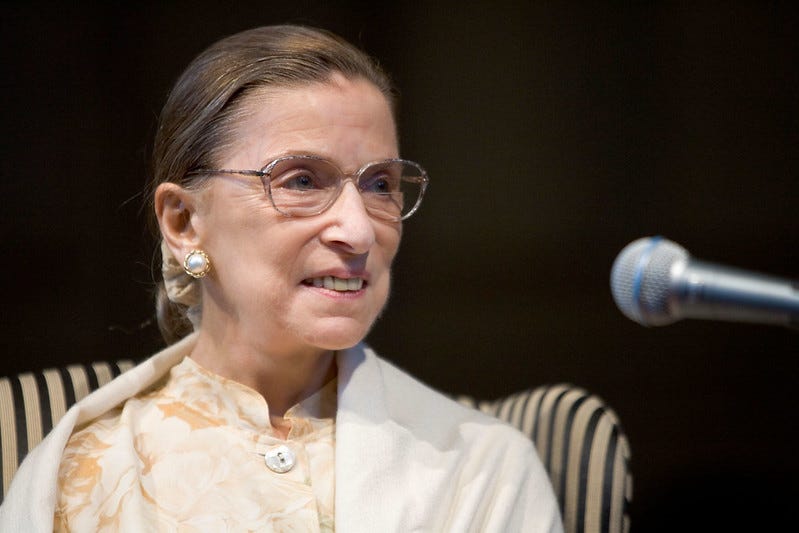
On the U.S. national level, our most significant protections have come from the Supreme Court — with the help of that tiny giant of progressive justice, Ruth Bader Ginsburg.
Lawrence v. Texas
In 2003 (only 17 years ago!) in Lawrence v. Texas, Justice Ginsburg joined a majority to strike down a Texas sodomy law and similar laws in 13 other states. For the first time, same-sex sexual activity became legal in every state and territory of the United States.
Obergefell v. Hodges
The right of LGBTQ people to marry and enjoy the full benefit of its civil advantages might not exist in the United States without Justice Ginsburg.
She joined three contested 5–4 majorities advancing same-sex marriage, the most critical being the landmark Obergefell v. Hodges in 2015. Only five years ago, the court struck down all state bans on same-sex marriage, extending equal marriage throughout the nation.
Bostock v. Clayton County
Ginsburg also joined the majority in last June’s landmark Bostock v. Clayton County, ruling that anti-LGBTQ discrimination is a form of sex discrimination. For the first time in history, US employers are barred from firing people merely for being transgender or gay. The ruling should eventually extend to discrimination in housing, health care and education, but with Ginsburg’s death, that outcome is far from certain.
Pushback threatens liberty and humanity
Our LGBTQ legal champion died just a little more than a month ago amidst a conservative pushback against LGBTQ equality, women’s rights, and racial justice. The Republican Party has allied with the worst elements of hardcore right-wing Christianity to install a misogynist racist as president.
He and his team have fought tooth and nail from the very day he took office to roll back LGBTQ equality in federal regulations and at law . The campaign has been relentless and largely successful.
Last night, Trump pushed shame onto the court
When the Senate confirmed Amy Coney Barrett last night, they didn’t just install a hyper-conservative originalist to the bench. They didn’t just install a woman who opposes genuine legal equality for other women. They didn’t just install a woman likely to strike down affordable health care. They didn’t just install a woman whose judicial philosophy doesn’t allow for the full constitutional equality of LGBTQ people.
They installed an agent of shame.
Amy Coney Barrett is a smart lawyer and distinguished law professor who just happens to hold outrageous personal views about her fellow human beings. What she believes about LGBTQ people is shameful and genuinely horrifying. She served as a leader in a religious organization that expels people for being gay or transgender. She served for three years as the trustee of a private school that explicitly excludes LGBTQ staff and students, and even the students of gay or transgender parents.
Despite all that, she testified to the Senate Judiciary Committee that she has never discriminated against an LGBTQ person.
The shame I ate as a little boy, the anti-LGBTQ poison that made my life hell for years is central to Barrett’s existence. She has so internalized the hate, she can’t see discrimination even when she’s the one enforcing it.
So I cried last night
I cried out of frustration because our hero has been replaced by a toxic judge in a process that shattered American political norms. I cried because I’m scared of how much progress we stand to lose.
I cried also because of how little most people care about the LGBTQ issues involved. I cried because not one single Democratic senator called Judge Barrett on her plainly false statement about never discriminating against LGBTQ people.
Mostly I cried because the mean-spirited religious ideas that tormented me as a child have gained great prominence in the United States, and one of their strongest proponents has just been elevated to a position of the highest power.
So, I stroked my cat and tried to push trauma aside. I thought back to the childhood books that had been my refuge. I remembered how Madeleine L’Engle’s beautiful voice spoke with power and purpose to girls and to me as a frightened gay boy.
I remembered how, on September 27, 2018 Christine Blasey Ford was set to testify against Brett Kavanaugh, another mean-spirited hyper-conservative Supreme Court nominee. To encourage Ford, Madeleine L’Engle tweeted a simple quote from her book “A Wrinkle in Time.”
“Stay angry, little Meg,” Mrs Whatsit whispered. “You will need all your anger now.”
I remembered how, in the face of impossible evil and fear, little Meg did stay angry, and against all odds, she did prevail — with courage, determination, and love. The road forward for LGBTQ people demands all that and more.
Last night was a time for tears. Now is the time for courage, determination, and love. We have battles to win!
James Finn is a former Air Force intelligence analyst, long-time LGBTQ activist, an alumnus of Queer Nation and Act Up NY, an essayist occasionally published in queer news outlets, and an “agented” novelist. Send questions, comments, and story ideas to [email protected].


