
Ampulex Wasps Enslave the Cockroach in the Same Way That the Mind Ensnares Us
A Philosophical Perspective for Better Understanding the Mind
The unusual genesis of an article
The onset of this article is rather peculiar. While stemming from the philosophical investigative premise I have been mining for several weeks, seeking to elucidate Vedanta Philosophy through juxtaposition with microbiology, a genuine short circuit sparked from music this time. I was surveying the musical frontiers of “Neurohop,” lending an ear to the album “Marble Hunting” by the artist Tipper, whilst perusing parasitoid insects. Then, in hearkening to the track “Rancid Shuff,” almost suddenly, its equally disquieting sounds akin to buzzing made me ponder how our minds often mimic parasitoid insects taking charge of us, rendering us mere puppets. It is not microbiology in this case, but I think entomology is equally interesting.
Thank you for reading, and enjoy listening to the aforementioned track embedded below.
The Zombifying Sting
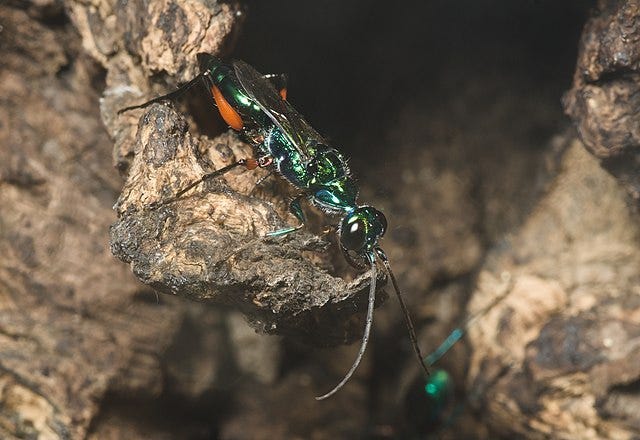
The faint clicking betrays their presence — a battalion of Ampulex wasps patrolling the rainforest understory. Skimming along leaves, these parasitic predators search for their target host — the cockroach. Spotting one lumbering across the forest floor, an Ampulex breaks from the swarm and sets pursuit, guided by some ancient compass towards its prey.
Alighting on the cockroach’s back, the wasp enacts a graceful dance, bobbing and weaving to identify a suitable spot before curling its ovipositor to deliver a sting. The cockroach slows, immobilized by venom and the beginnings of zombification. Its antennae stroke the empty air as the wasp delivers a second surgical sting to its brain, initiating a deeper mental takeover.
Enslaved
The stung cockroach is now fully enslaved, incapable of initiating movement yet able to walk when guided. Clasping its mandibles, the wasp leads its docile hostage to a burrow, where it lays an egg on the cockroach and entombs it inside. Here the wasp larva will hatch and methodically devour the cockroach, steering it as needed to optimize feeding. The cockroach becomes an empty vessel, no longer an agent of its own free will.
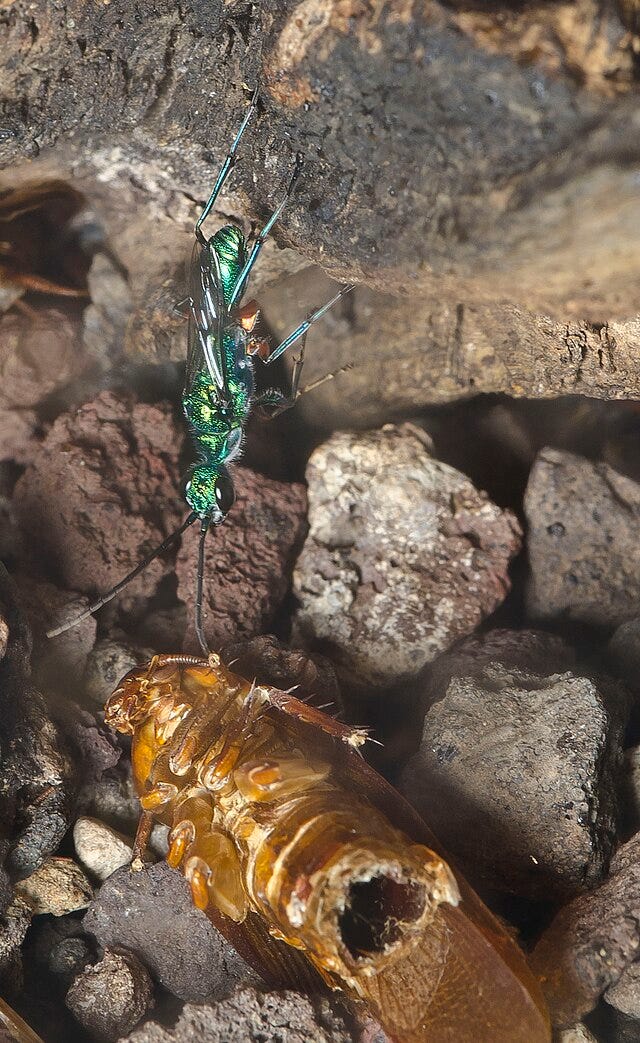
This haunting behaviour seems lifted from science fiction, but numerous species of wasp parasitoids enact this precise mind control, from the tiny Emerald Jewel Wasp that enslaves cockroaches to the Tarantula Hawk Wasp, which zombifies tarantulas. Once stung, the host serves only to nourish the larva that has claimed dominance inside it.
To the Vedantic sages of ancient India, such parasitism evokes how the mistaken identification with the ego-mind allows base instincts to seize control of consciousness itself. The Katha Upanishad condemns this as the
“mind deceiving, always unstable, flickering, difficult to detect, and alights like a bird wherever it wishes.”
It further exalts the Atman, the True Self, declaring:
“When all desires that surge in the heart are renounced, the mortal becomes immortal. Herein he reaches Brahman.”
Thus consciousness entangles with phenomena arising within it, analogously to how the will of the cockroach becomes ensnared by the Ampulex wasp. The mind with its tendencies toward self-protection and sensory gratification comes to dominate behavior. Consciousness is steered toward temporal pursuits, dragged through experiences that satiate biological drives but only briefly.
The cockroach and the wasp may seem to be independent creatures interacting, yet there is only one unitary field animating both. Their terrible entanglement springs from that unitary field losing sight of itself. Likewise, we sentient beings may feel ourselves to be separate individuals, seeking validation and control over circumstance, yet in truth, there is only the ebb and flow of consciousness interacting with its ripples.
Conclusions and Takeaways
The goal of Vedantic practice is to cut through this illusion of otherness and recognize oneself as consciousness only. When identification with mind and phenomena ceases, the Upanishads proclaim, then “evil is slain” as duality collapses back into pure subjectivity. Past and future dissolve into the prior unity from which they emerged. One rests in the silent wakefulness termed Turiya, where no separateness between the thinker, the object of thought, and the act of thinking appears.
Turiya is considered the true self. Unlike the three normal states of consciousness (waking, dreaming, deep sleep), Turiya refers to pure, undifferentiated awareness untouched by the mind or senses. It represents consciousness in its purest, transcendent form.
From this liberated state, conscious phenomena play out against the backcloth of aware Brahman much as actors cavorting on a stage. Yet the misapprehension of division between witness and witnessed falls away. One can engage fully in each role while recognizing the contextual wholeness holding all. No longer then can baser instincts hijack attention and dominate behaviours. One leads an integrated existence, aligned with a higher purpose yet unperturbed by changing fortunes.
As Shankara proclaimed:
“I am other than name, form and action. My nature is consciousness itself. I am the witness of all these.”
From Turiya emerges Tat Tvam Asi, “You Are That,” apprehending the identity of subject and object as Brahman. Integrating this knowledge loosens the fetters of worldly identification so consciousness may once again flow freely through myriad forms, no longer snared by the dazzling jewel wasp of a reductive sense of self.
A primal survival impulse
Yet a primal survival impulse kindles inside the cockroach. As the lobotomizing toxin seeps through its nervous system, numbing its ability to control its limbs, an intense determination ignites, surpassing even the self-preservation instinct that originally dominated its simple consciousness.
Insectoid rage begins to burn through the fog of paralysis. The cockroach rallies every last neuron still under its command. As the wasp grasps to steer its victim into the burial grounds, the cockroach summons a final paroxysm of resistance. Fighting against the neural cage of venom, it turns on the wasp and releases a violent kick, knocking the tiny overlord away.
Its strength rallied, and the half-zombie cockroach regained enough motor control to set upon the disoriented wasp. Forelegs flailing in primal fury, the cockroach pummels the Ampulex wasp under a barrage of boneless blows, bashing in its metallic blue exoskeleton. Now splayed and crushed impotently beneath the revived cockroach, the mangled wasp draws its last, leaving its would-be host victorious.
Having overcome the chemical spells that enthralled it, the cockroach emerges reborn from its brush with annihilation. Shedding the last clinging veils of ensorcelment, it scuttles away once again unfettered, liberated ruler of its domain.


