
Amerigo Vespucci
How America Got Her Name
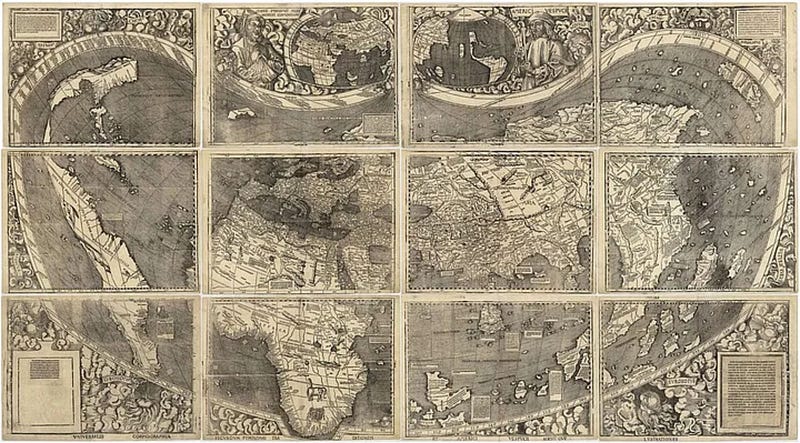
If you’re easily triggered by Western expansion, you may not want to read this. It is not my intent; it’s just a matter of history and curiosity, because for the longest time I simply wondered how America got her name since the history books said (tho’ they were wrong) that Columbus discovered America. So, if you too are curious about this origin, here is the tragic and twisting story.
In the Age of Discovery, Amerigo Vespucci (what a great Italian name) was an explorer in the years soon after Columbus. His first voyage was in 1501, with a few other Atlantic crossings that followed.
At that time, England, Spain, and Portugal had the arrogance to divide the unknown worlds among themselves along particular lines of latitude, parallel to the equator. England claimed everything North of 23.5 degrees (the Tropic of Cancer), which is why Americans speak English. Spain claimed everything South of 23.5 degrees, but North of the equator, which is why Mexicans speak Spanish. And Portugal claimed everything South of the equator and that’s why Brazilians speak Portuguese.
When Amerigo Vespucci first sailed, he was sponsored by Portugal, so after sailing across the Atlantic Ocean, he turned left, sailing South to follow almost the entire coastline of the 4th continent, still not yet named. Only a decade prior, the known continents (at least in the minds of the men who were able to explore outside their on world) were Europe, Asia, Africa, and Australia.
Failing to find a Westward path to the Far East, as most explorures were trying to do, Amerigo returned to Europe. For his next voyage Amerigo gained the sponsorship of Spain so that he could sail in closer proximity to the equator where he was still hoping to find a Western path to India, but of course, this attempt also failed.
On his last voyage Amerigo contracted malaria and died in 1512 at 58 years old, and just like that, there were no more discoveries for Amerigo Vespucci.
This sudden tragedy still leaves us to wonder, how did America get her name? After all, Amerigo himself, was a humble man who had never suggested that the 4th continent be named after himself, let alone the 5th continent. Furthermore, Amerigo Vespucci never even set foot on either continent. He likely would have passed without fame or glory or even a mention in history had it not been for the power of the press.
Among the ranks of a wealthy gentleman’s club in Germany there was a man named Martin Waldseemuller who got a hold of a French letter that described Amerigo’s first voyage in 1501.
After researching the voyage and the maps that Vespucci had catalogued, Waldseemuller borrowed the printing services of another club member to share the new discoveries with Europe, including the first — the very first world map to include the 4th and 5th continents of the new world.
On this first-edition printing he not only placed Amerigo’s portrait facing West, but also the name of the 4th continent as “Amerige,” where the “ge” is Greek for “land of.” So, this was understood to be “The land of Amerigo” or “America” when it’s translated to English.
Later, Waldseemuller regretted naming the new world as he did because it inferred that Amerigo discovered the new world, which he didn’t. Amerigo was a few years too late for that. So Waldseemuller later printed his maps without the new title. But as the saying goes, “A lie travels half way around the world before the truth has a chance to tie its shoes.”
Before Waldseemuller could correct the error in the second printing of his world map, and because the name was so catchy, very quickly every map printer in Europe not only included the name “South America,” the land who’s coastline Amerigo explored, but also named “North America.” And so it remains.
A couple hundred years later, colonists in North America simply took on the truncated name for the new-world country they were trying to build, so the continent “North America” simply became the country “America.”
Ironically, Amerigo’s writings of the New World were 3 times more popular than even Columbus, as they were more descriptive and adventurous. But as the decades rolled by, it became old news while Columbus continued to be credited with making the first daring voyage across an unknown ocean. Today, thousands of statues are erected in honor of Columbus, (tho’ many have been torn down) but not one statue, not even in South America, is honoring the man who explored more and discovered more than Columbus ever did, yet who’s name has now been on every world map for 516 years.
And that’s the story of how America got her name from a man who never set foot on the shores of America, but the power of the press influenced history and geography, even if it wasn’t completely accurate.
So, impress your friends and remember the name Amerigo Vespucci. Maybe you can win a drink at the bar.
Can Banks Keep Your Money in a Financial Crisis? | by Jim West | Politically Speaking | Medium