
America’s Fastest-Growing Metropolitan Area You’ve Never Heard Of
Welcome to The Villages, Florida


I’d never heard of The Villages until one of my besties in Southern California said she and her husband were moving there. We agree on almost nothing, but we love the hell out of each other.
Not yet having any knowledge of the place, I asked her why they were moving there. I felt it odd that a lifelong Californian would pick up and move to Florida, a state with the same mild winter weather but is nowhere as scenic as California. And so far away.
She responded they were tired of California politics, policies, and taxes. The worsening mega-drought in the West was another reason she cited. (They lived in Ventura, which saw a major wildfire burn through part of the city in December 2017.)
They wanted to be in a place where the people were more like them. Ventura County voted 57% for Clinton back in 2016 and 59% for Biden in 2020. So they clearly were not amidst kindred spirits. The Villages voted 70% for Trump. If you can’t beat ’em, leave.
Being the geography geek I am, I immediately had to research this so-called city with a strange name. I came across some census data stating that it was one of the fastest-growing metropolitan areas in the U.S. How could I not know about this? It was confirmed on August 13, when the official census data was revealed. The fastest-growing metropolitan area in the U.S. is The Villages, Florida.
Another metropolitan area you wouldn’t think to be in this league is St. George, Utah. It was barely a town in 1950, and it is now the third fastest-growing metropolitan area in the country. Most of the newcomers are from California. They, too, are looking for a more homogeneous place to live and raise their children. In the 2020 election, St. George voted 78% for Trump. Oh, but they’re running out of water. Nice move.
Besides good weather, what do these two cities have in common?
Politics.
I’ve never cared for Florida. I think it's ugly besides the beautiful beaches (which are now dirtied with red tide and dead fish). It’s flat as a pancake, unbelievably humid, contrived, bug-ridden, and there are sinkholes—lots of them. I refused to take my kids on vacation to Walt Disney World. (I allowed one trip to Disneyland before it became Disneyland Park California Adventure.) Instead, we went to national parks out west or to Hawaii.
On top of all that, there’s another reason I’m not too fond of the thought of Florida: Politics.
So what is The Villages? The Villages is more a company than it is a city. It is a master-planned community with unlimited new development opportunities that extends into three counties 45 miles northwest of Orlando. Think of the Del Webb Sun City developments.
Billed as the world’s largest retirement community, it is targeted to retirees ages 55 and up. It offers many well-maintained amenities (clubhouses, over 100 recreation centers, and swimming pools). Upon completion, it will sport 27 total golf courses, 12 of them being country club-type championship courses.
It is known as “Florida’s Friendliest Hometown.” That’s probably true if you’re a Republican and over the age of 55. Less bickering, more living!
If you’re thinking of a town that lives under a bubble (like “The Truman Show” or even “Pleasantville”), you’re on the right track. Author Ryan Erisman wrote a book called “Inside the Bubble,” which is a guide to the community. Read it before you take the plunge — it includes some downsides.
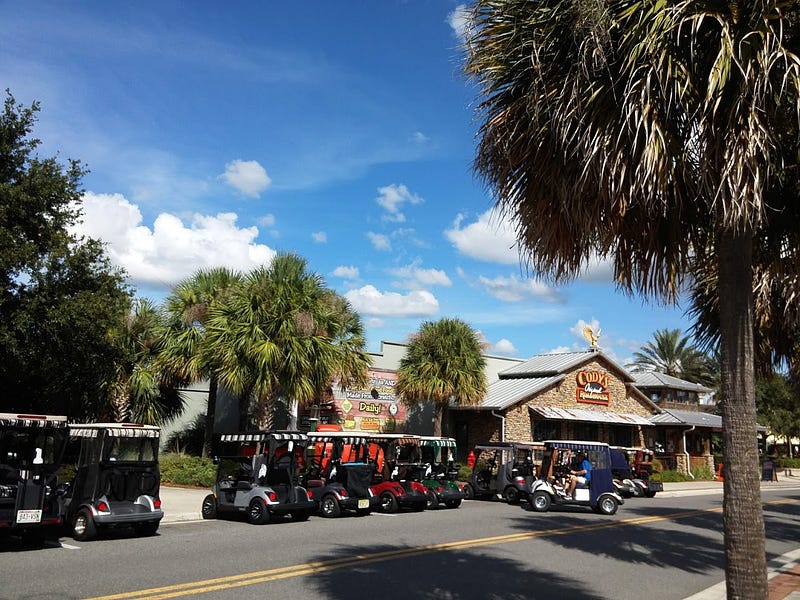

Demographics: There is not much to talk about here. The Villages is 98% White. Latinos or Hispanics of any race total 1.2%. So that leaves just .08% to all other races, including Blacks. Next.
Community: There are 78 different communities in The Villages. Each community is called a village. (How original.) People often identify themselves to other villagers by naming the individual village in which they live.
Each village is clustered around one of the golf courses or close to one. Thou must love golf. You can play it for free for life! I’m not a golfer, so I don’t get the mystique. I’d rather get my rocks off in other ways, like getting out of The Villages.
Crime: In his book, Erisman states, “most of the crime seems to be alcohol-related, including DUIs and sometimes domestic disputes and battery.” He says that “back in 2014, there were eight burglaries in about 60 days….” Good lord, what’s the world coming to? I shudder to think. I’m no advocate of crime, but these residents are pretty safe and secure compared to the rest of us.
Stolen (golf) carts and golf clubs happen fairly regularly as well. ~Ryan Erisman
In the latest U.S. Census, sandwiched between The Villages and St. George lies Austin, Texas, the second-fastest-growing metropolitan area in the country. This comes as no surprise, as this astounding growth has been going on for years. However, in the last decade, it has absorbed over 567,000 new residents, equal to a city the size of Albuquerque.
But back to The Villages.
Thousands of Republicans from California and other states are pulling up ranks, choosing to live in homogenized enclaves such as The Villages, St. George, Utah, and Bend, Oregon.
A California Diaspora is going on. It grew at its slowest rate between 2010 and 2020 than in any other decade in history. If it weren’t for births, in-migration from other states, and international migration, the state would have lost citizens. Florida grew at a clip of 16% and is now the third most populous state. California grew by only 6%.
In the end…
But who am I to judge? It’s a free country, and folks can live wherever they want to live. If you want to live with your socio-economic equals with no diversity and far removed from the world’s problems, The Villages might be right for you if you’re Caucasian. And Republican.
I can’t wait to write about “The Gay Villages”. It will come because gays love Florida! We could have our own zip code and everything! If you like Florida.
Sources for this story include Wikipedia, U.S. Census Bureau/CNN, insidethebubble.net, TheVillages.com, florida-backroads-travel.com, and BusinessInsider.com.