avatarJ. Andrew Shelley

Free AI web copilot to create summaries, insights and extended knowledge, download it at here

5023

Abstract

: a nearly logarithmic accumulation of inequality.</p><p id="4bf2"><i>An exponentially-growing petri dish of bacteria would be proud of us!</i></p><figure id="31b8"><img src="https://cdn-images-1.readmedium.com/v2/resize:fit:800/1*6Gsqr_f5vYSy-Ury07AqJA.jpeg"><figcaption>Chart by author. Based upon <a href="https://dqydj.com/average-median-top-net-worth-percentiles/">PK</a> Analysis and <a href="https://www.federalreserve.gov/econres/scfindex.htm">Federal Reserve SCF Data</a>.</figcaption></figure><p id="129a">On the one hand, this data is compelling. On the other hand, it doesn’t mean so much. Since no one can eat, sleep in, or drive a dollar, another example might be helpful.</p><p id="aa67">Earlier this year, <i>Car and Driver</i> reported that the <a href="https://www.caranddriver.com/news/a38748092/new-car-average-sale-prices-47100/">average sale price</a> of a new car in December 2021 was 47,017. A big number. But again, it is meaningful only in the context of its implications for the American family:</p><p id="2552" type="7">One-third of American households could liquidate all their worldly possessions and still not be able to buy the “average” new 47,000 car.</p><p id="9d56">Even this statement doesn’t mean so much. We need context and comparison.</p><p id="0076" type="7">Some time ago, a product manager at Land Rover shared with me that the typical “Land Rover” family owned between three and four Land Rovers. The Range Rover today is commonly priced over 100,000.</p><p id="f6c8">Given all the above, it’s no surprise that the conclusion many reach is that financial inequality in America is a real problem. Urgent change is a must, they say.</p><p id="7358">Some, however, continue to sagely argue that financial inequality is NO PROBLEM. It is a virtue, even.</p><p id="93ad">Like the government experts in Hawkins (again a reference to <i>Stranger Things</i>), they insist that everything is under control, the way it is meant to be.</p><p id="bd9c">The “everything is under control” camp looks at the above information and insists that America still boasts the world’s most dynamic society:</p><ol><li>A competitive, market-based, highly-incented economy is inevitably going to toss people to the top and kick them to the bottom. Americans are allowed to roll the dice of success. Right? Twenty years ago, half of Americans believed failure (poverty) was primarily the result of <a href="https://www.prb.org/resources/american-attitudes-about-poverty-and-the-poor/">lack of individual effort</a>. More recent surveys shift only a little and blame <a href="https://www.cato.org/blog/poll-what-americans-think-cause-wealth-poverty">poor life choices</a> as the top reason.</li><li>They observe that it’s only when we try to keep everyone “level” that we encounter real problems: See the <a href="https://history.state.gov/milestones/1989-1992/collapse-soviet-union">collapse of the Soviet Union</a>.</li></ol><figure id="48ca"><img src="https://cdn-images-1.readmedium.com/v2/resize:fit:800/1*g2zq6CXWdfoH89po1XnjPQ.jpeg"><figcaption>A flea market in 1992: Russians liquidating their worldly possessions…largely to buy food. Brian Kelley, CC BY-SA 2.0 &lt;<a href="https://creativecommons.org/licenses/by-sa/2.0">https://creativecommons.org/licenses/by-sa/2.0</a>&gt;, via Wikimedia Commons</figcaption></figure><p id="b016">3. Americans, they say, are positively engaged and doing great things.</p><p id="7b1e">Gallup polling a year ago showed that Americans felt their lives were suddenly “thriving” more than ever. A few surveys, especially as Covid lockdowns were ending, showed that a majority thought America’s <a href="https://www.mckinsey.com/industries/public-and-social-sector/our-insights/for-many-americans-economic-opportunity-seems-increasingly-out-of-reach">long-term prospects</a> remained more positive than negative.</p><figure id="003b"><img src="https://cdn-images-1.readmedium.com/v2/resize:fit:800/1*2fxhHP00goly-MtBlaTw4w.jpeg"><figcaption>Panelists are rated as thriving, struggling, or suffering. Thriving was winning in <a href="https://news.gallup.com/poll/351932/americans-life-ratings-reach-record-high.aspx">Gallup</a> polling through June 2021.</figcaption></figure><p id="4bf4">The “things are getting much worse” camp disagrees:</p><ol><li>They are deeply disturbed that the bottom third of American households — often the <a href="https://www.forbes.com/advisor/investing/average-net-worth/">young without</a> education but also the newly-educated with an average of <a href="https://www.valuepenguin.com/average-student-loan-debt">32,000</a> in college loans — will be anchored to the bottom rungs of society.</li><li>Poor Americans particularly don’t feel that they have a <a href="https://www.prb.org/resources/american-attitudes-about-poverty-and-the-poor/">legitimate opportunity</a> to roll the dice of success.</li><li>In recent surveys, more Americans than ever (even in the latest <a href="https://www.mckinsey.com/industries/public-and-socia

Options

l-sector/our-insights/for-many-americans-economic-opportunity-seems-increasingly-out-of-reach">McKinsey Opportunity Study</a>) do not believe that America is the <a href="https://www.nytimes.com/2021/11/04/opinion/american-politics-optimism.html">land of economic opportunity</a>.</li></ol><p id="05b3">The answers to the questions — <i>Does America offer as much real opportunity as it should? Does America care sufficiently for its citizens?</i>— are exceedingly hard to answer objectively. They will always be somewhat subjective.</p><p id="4a1c">In school we were taught that competitive, free markets won the Cold War. Capitalism is better than communism!</p><p id="54ed">But now we are stuck debating about when oligopoly and birthright advantages become insurmountable.</p><p id="5d67">Many researchers now worry that American markets are <a href="https://academic.oup.com/rof/article/23/4/697/5477414">dangerously uncompetitive</a>. They fear that a very few companies in the <a href="https://readmedium.com/heres-how-we-can-break-up-big-tech-9ad9e0da324c">technology</a>, <a href="https://www.theguardian.com/environment/ng-interactive/2021/jul/14/food-monopoly-meals-profits-data-investigation">food</a>, and other industries have gained too much power. Whatever the exact truth, it feels that prices are being pushed higher and job creation rates lower.</p><p id="1cd3">Just like we fear the unbridled power of Apple, Google, and Facebook, many have similar worries about the persistence of family wealth. Wealth is <a href="https://www.federalreserve.gov/econres/notes/feds-notes/how-does-intergenerational-wealth-transmission-affect-wealth-concentration-20180601.htm">being concentrated</a> among the few and across the generations. It’s not too different than in the bad old days of kings, queens, and ruling dynasties.</p><p id="cbe9">The OECD, Organization for Economic Coordination and Development, suggests that America’s level of income equality is on the more concentrated side of the spectrum. It’s about the same as that found in Turkey, Mexico, Bulgaria, <a href="https://www.indexmundi.com/facts/indicators/SI.POV.GINI/rankings">Iran</a>, and <a href="https://www.indexmundi.com/facts/indicators/SI.POV.GINI/rankings">Haiti</a>.</p><p id="d43e">Yes, Haiti. It is disturbing to realize that most Americans are in the same boat as a nation our previous President described as a “<a href="https://www.nbcnews.com/politics/white-house/trump-referred-haiti-african-countries-shithole-nations-n836946">shithole</a>.”</p><figure id="fc4b"><img src="https://cdn-images-1.readmedium.com/v2/resize:fit:800/1*oSeBgqXP4z-mbv8wFndjrQ.jpeg"><figcaption>Annotations by author. Organization for Economic Cooperation and Development <a href="https://data.oecd.org/inequality/income-inequality.htm">chart and data</a>.</figcaption></figure><p id="cc6a">This concentration of wealth is much higher than among many of our peer countries, including Belgium, Denmark, Sweden, and Germany. Strikingly, America’s concentration of income returned to the levels of the Gilded Age <b><i>almost a decade ago</i></b>.</p><figure id="739e"><img src="https://cdn-images-1.readmedium.com/v2/resize:fit:800/1*TxXs8fr2MF-lIK_xx_KqOQ.jpeg"><figcaption>Annotations by author. Our World in Data <a href="https://ourworldindata.org/uploads/2018/07/Top-Incomes.png">charting and data</a> through 2014.</figcaption></figure><p id="4376">Half of the economic regulations that we are taught about in high school — the creation of the FDIC, the separation of investment banking and commercial banking by the Glass-Steagall Act, and so on — came about because of the perceived failures that led to the Great Depression, the worst economic decade America has ever known.</p><p id="459f">We all know that feelings and perceptions matter.</p><p id="f8ed">Lots and lots of Americans now believe that the classic <a href="https://en.wikipedia.org/wiki/Horatio_Alger">Horatio Alger “success” story</a> is malarky made up by old dudes to keep folks going to work and following the rules. Horatio Alger himself was a graduate of Harvard Divinity School and a minister until he suffered his own little indiscretions.</p><p id="2c38">That’s why today’s Young Adult success stories are more often about standing up to the oppressive regimes described in the <i>Hunger Games</i> or surviving the environment-destroying corporations found in the <i>Maze Runner</i>.</p><p id="bffe">Pesonally, I don’t believe America is facing an economic invasion by The Upside Down of <i>Stranger Things. </i>I have no doubt, however, that</p><p id="4867" type="7">America is a little bit upside down right now.</p><p id="88a8">We should be doing what we can to turn the place back around.</p><p id="111d">Above all else, let’s keep talking.</p><p id="0a20"><i>Please <a href="https://americanbutterfly.medium.com/about">follow J. Andrew Shelley</a> to read more. Let’s experiment with better ways to help our world.</i></p><p id="1f79"><i>Be well</i></p></article></body>

Americans Live In An Upside Down World

The world of economic inequality is its own stranger thing

Over the last few days I’ve participated in a conversation about making the American economic system work better for more Americans.

It’s been a good talk. A lot of folks have joined in, and the discussion has remained civil.

Out in the real world, the discussions have continued to be less civil. Whether on Twitter, MSNBC, or Fox News, we dive into the extremes about gun control or the January 6th Capitol Riot: extreme agreement and disagreement. Extremely right and extremely wrong. And we call people out for their every opinion.

Last weekend my family tuned into Stranger Things Season 4. It’s a rare show that two generations in our household have watched together. After the first two episodes, we were all — even our teenagers — disappointed that the writers behind Stranger Things felt that [Spoiler Alert!] they had to get to gruesome so fast.

What happened to suspense?

Six years ago Stranger Things Season 1 survived and thrived on suspense. The audience didn’t get a good understanding of the bad guy until late in the season.

Netflix, Public domain, via Wikimedia Commons

I fear this is more than just a problem of questionable scripting. The writers are deeply tuned into the America of 2022. They know the audience’s attention span is shorter than ever.

Ok…since it’s a must, let’s get to the gore! Now.

The discussion about a better America started with two observations based upon analysis of data from the Federal Reserve Survey of Consumer Finance:

  • The top American households are doing great! $11M+ in assets
  • While so many American households are doing not so good.

Close your eyes! It’s bad!
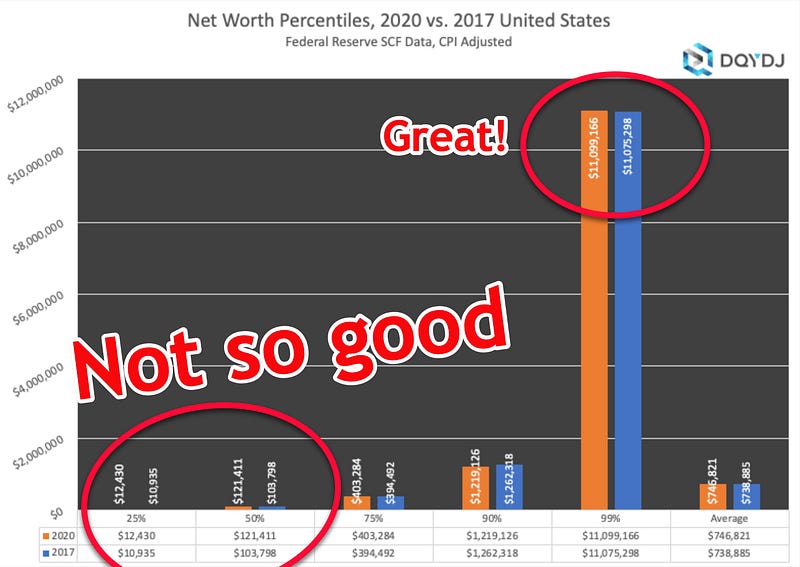
Annotations by author. Analysis by PK based upon Federal Reserve SCF Data.

46% of households have a net worth of less than $100k.

30% have a net worth of less than $29k.

The bottom 10% owe more than they own.

Another way to look at American wealth is to think of everyone relative to the 25th-percentile of American earners. I pick the 25th-percentile somewhat arbitrarily. There will always be a number of Americans towards the bottom of the asset ladder. It is just math.

The 25th-percentile, however, is also interesting in that it marks the moment where — as we walk up the asset ladder — the total number of people with positive assets tops the number of people with negative assets. It also marks the moment where the average family has accrued two months of income as a buffer against a small misfortune.

The St. Louis Fed estimates almost 129 million households in the US. The 25th-percentile represents around 1,290,000 American households.

This 25th-percentile of American households — almost 1.29 million families — can claim an average of only $12,430 in net assets. A two-month buffer against misfortune.

Another perspective is that $12,430 could almost pay for one semester at a typical public college…as long as the student didn’t need food or housing.

Fortunately for the rest of Americans, asset accumulation is more generous. The 50th percentile of Americans has 10-times more wealth than the 25th. The 90th percentile approaches 100-times more wealth. And the 99th percentile possesses almost 900-times more wealth.
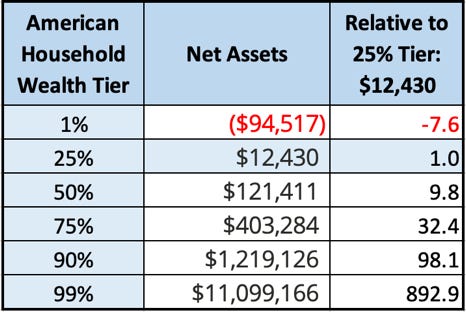
Table by author. Based upon PK Analysis and Federal Reserve SCF Data.

This reveals a startling spiral of poverty and wealth: a nearly logarithmic accumulation of inequality.

An exponentially-growing petri dish of bacteria would be proud of us!
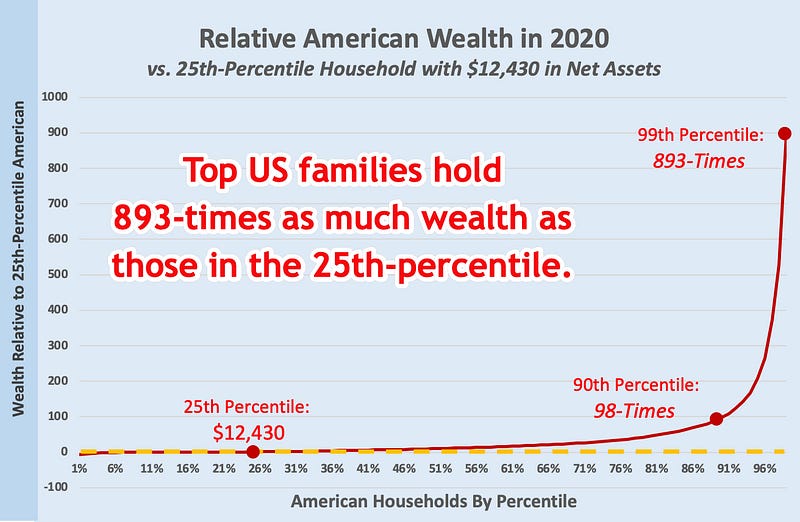
Chart by author. Based upon PK Analysis and Federal Reserve SCF Data.

On the one hand, this data is compelling. On the other hand, it doesn’t mean so much. Since no one can eat, sleep in, or drive a dollar, another example might be helpful.

Earlier this year, Car and Driver reported that the average sale price of a new car in December 2021 was $47,017. A big number. But again, it is meaningful only in the context of its implications for the American family:

One-third of American households could liquidate all their worldly possessions and still not be able to buy the “average” new $47,000 car.

Even this statement doesn’t mean so much. We need context and comparison.

Some time ago, a product manager at Land Rover shared with me that the typical “Land Rover” family owned between three and four Land Rovers. The Range Rover today is commonly priced over $100,000.

Given all the above, it’s no surprise that the conclusion many reach is that financial inequality in America is a real problem. Urgent change is a must, they say.

Some, however, continue to sagely argue that financial inequality is NO PROBLEM. It is a virtue, even.

Like the government experts in Hawkins (again a reference to Stranger Things), they insist that everything is under control, the way it is meant to be.

The “everything is under control” camp looks at the above information and insists that America still boasts the world’s most dynamic society:

  1. A competitive, market-based, highly-incented economy is inevitably going to toss people to the top and kick them to the bottom. Americans are allowed to roll the dice of success. Right? Twenty years ago, half of Americans believed failure (poverty) was primarily the result of lack of individual effort. More recent surveys shift only a little and blame poor life choices as the top reason.
  2. They observe that it’s only when we try to keep everyone “level” that we encounter real problems: See the collapse of the Soviet Union.
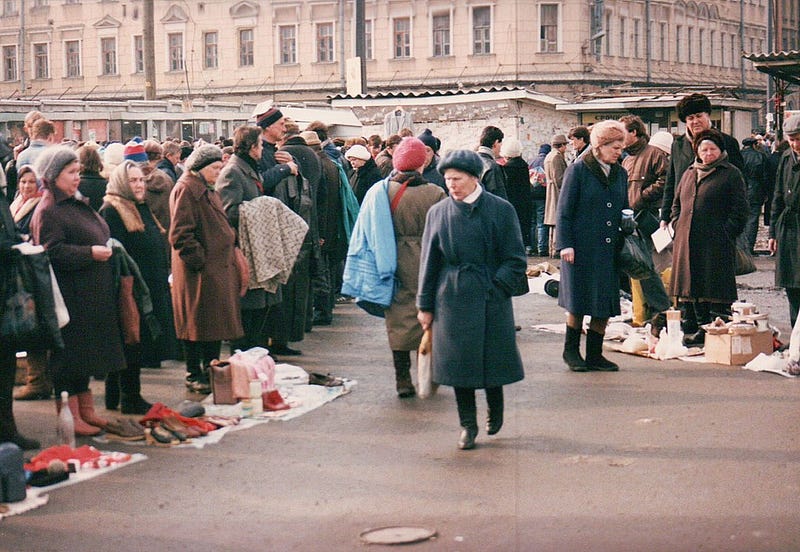
A flea market in 1992: Russians liquidating their worldly possessions…largely to buy food. Brian Kelley, CC BY-SA 2.0 <https://creativecommons.org/licenses/by-sa/2.0>, via Wikimedia Commons

3. Americans, they say, are positively engaged and doing great things.

Gallup polling a year ago showed that Americans felt their lives were suddenly “thriving” more than ever. A few surveys, especially as Covid lockdowns were ending, showed that a majority thought America’s long-term prospects remained more positive than negative.
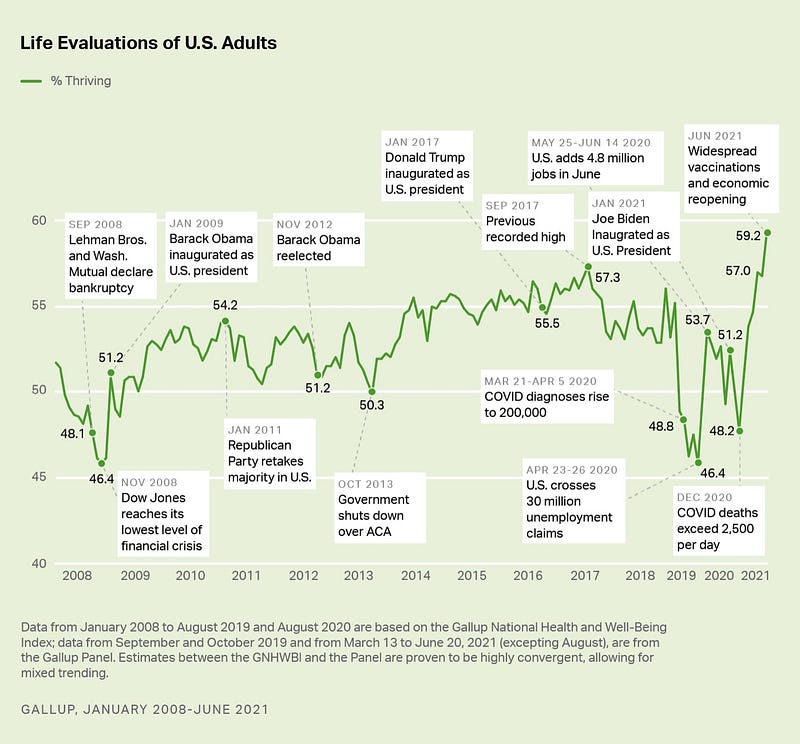
Panelists are rated as thriving, struggling, or suffering. Thriving was winning in Gallup polling through June 2021.

The “things are getting much worse” camp disagrees:

  1. They are deeply disturbed that the bottom third of American households — often the young without education but also the newly-educated with an average of $32,000 in college loans — will be anchored to the bottom rungs of society.
  2. Poor Americans particularly don’t feel that they have a legitimate opportunity to roll the dice of success.
  3. In recent surveys, more Americans than ever (even in the latest McKinsey Opportunity Study) do not believe that America is the land of economic opportunity.

The answers to the questions — Does America offer as much real opportunity as it should? Does America care sufficiently for its citizens?— are exceedingly hard to answer objectively. They will always be somewhat subjective.

In school we were taught that competitive, free markets won the Cold War. Capitalism is better than communism!

But now we are stuck debating about when oligopoly and birthright advantages become insurmountable.

Many researchers now worry that American markets are dangerously uncompetitive. They fear that a very few companies in the technology, food, and other industries have gained too much power. Whatever the exact truth, it feels that prices are being pushed higher and job creation rates lower.

Just like we fear the unbridled power of Apple, Google, and Facebook, many have similar worries about the persistence of family wealth. Wealth is being concentrated among the few and across the generations. It’s not too different than in the bad old days of kings, queens, and ruling dynasties.

The OECD, Organization for Economic Coordination and Development, suggests that America’s level of income equality is on the more concentrated side of the spectrum. It’s about the same as that found in Turkey, Mexico, Bulgaria, Iran, and Haiti.

Yes, Haiti. It is disturbing to realize that most Americans are in the same boat as a nation our previous President described as a “shithole.”
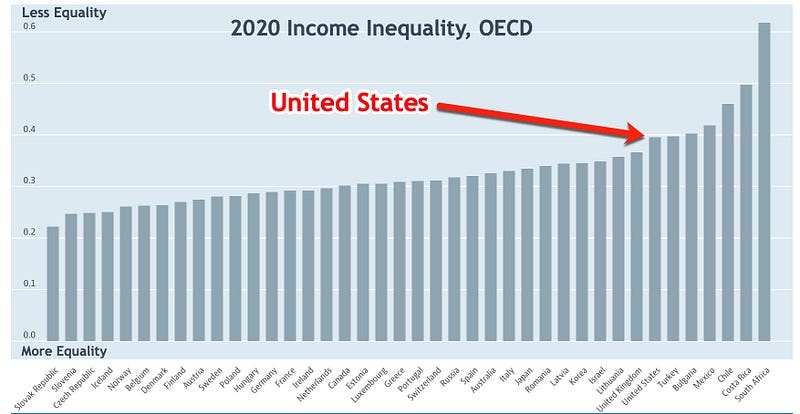
Annotations by author. Organization for Economic Cooperation and Development chart and data.

This concentration of wealth is much higher than among many of our peer countries, including Belgium, Denmark, Sweden, and Germany. Strikingly, America’s concentration of income returned to the levels of the Gilded Age almost a decade ago.
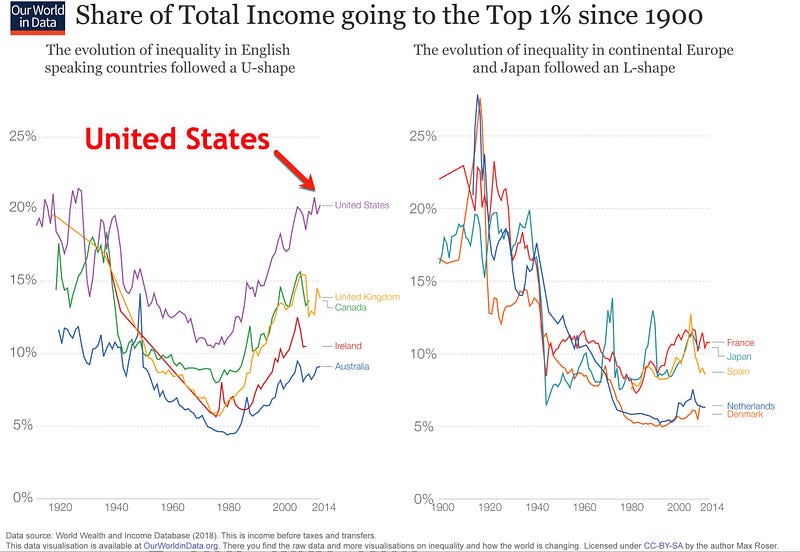
Annotations by author. Our World in Data charting and data through 2014.

Half of the economic regulations that we are taught about in high school — the creation of the FDIC, the separation of investment banking and commercial banking by the Glass-Steagall Act, and so on — came about because of the perceived failures that led to the Great Depression, the worst economic decade America has ever known.

We all know that feelings and perceptions matter.

Lots and lots of Americans now believe that the classic Horatio Alger “success” story is malarky made up by old dudes to keep folks going to work and following the rules. Horatio Alger himself was a graduate of Harvard Divinity School and a minister until he suffered his own little indiscretions.

That’s why today’s Young Adult success stories are more often about standing up to the oppressive regimes described in the Hunger Games or surviving the environment-destroying corporations found in the Maze Runner.

Pesonally, I don’t believe America is facing an economic invasion by The Upside Down of Stranger Things. I have no doubt, however, that

America is a little bit upside down right now.

We should be doing what we can to turn the place back around.

Above all else, let’s keep talking.

Please follow J. Andrew Shelley to read more. Let’s experiment with better ways to help our world.

Be well

Culture
Economics
Politics
Wealth Inequality
Recommended from ReadMedium