
Americans keep misdiagnosing China and America
Why does America keep getting this so wrong?
I just finished the book Destined for War: Can America and China Escape Thucydides’s Trap? It’s the most balanced book by an American on the growth of China toward being the world’s largest economy and how America could deal with this that I’ve found yet. It appears to be strongly aligned with the Washington Consensus on China, something internalized by Republicans and Democrats alike.
Which is why it’s so frustrating that it makes so many fundamental mistakes and gets so much wrong.
Let’s start with provenance. The author, Graham Allison, is an America Harvard prof, somewhat aligned with Democratic administrations in the past, but with a decades-long history of moving in and out of the Pentagon and Rand Corp. He’s a US military-industrial complex insider, in other words. He’s a hard-power guy, which is to say someone who is out of touch with how the rest of the world operates in the 2020s but well aligned with American foreign and domestic policy. The book was published in 2017, so it’s not like it has the excuse of being simply obsolete.
The book gets a lot of things right, which is why its failures and theme are so frustrating. The first section on the rise of China overlaps with many of my observations, albeit with less of a focus on clean technology, my primary strategic focus. He apparently teaches a course at Harvard with this content, and regularly blows students minds as they are confronted, perhaps for the first time, with how China has already surpassed the USA on so many fronts. His point about purchasing power parity having been matched in the first half of last decade is crucial to understand, especially in the USA where 80% of the populace has seen declining real income since 1980.
That decline and its period is important in many ways. China has taken 850 million people out of poverty during the same period that American inequity has soared, American wages have stagnated or declined, American life expectancy has decreased and the American literacy rate has dropped to 88% while China is at 96.8%. One of these countries is making its citizens affluent, healthy and well-educated, and it isn’t America.
The rapid change in economic fortunes is what Allison considers to be the relevant trigger to Thucydides’s Trap, a term he pulled from works of a Greek man dead for 2,500 years and then applied almost entirely to Western conflicts between adjacent nations with long histories of wars with one another. He asserts that when an economic and military power (he downplays the military side) arises that threatens the currently dominant power, war is almost inevitable. Yet he bases this on 16 cases where there was a lot more going on, from a mostly geographically constrained sample and from periods when war was a regular resort of countries. Even then, only 12 of the 16 resulted in war, yet his book about China and America is titled Destined for War.
Allison explicitly rejects the thesis that war isn’t a primary modern response, ignoring the evidence of others’ research that Pinker relayed so eloquently in The Better Angels of Our Nature about the massive decline in violence at all scales in the past decades. (Pro tip: Pinker is only as good as the research and perspective of the people he channels, which means Better Angels is great, and everything else is much weaker sauce.)
Even there Allison flip flops. He first says that nothing is different with the massive web of treaties and trade agreements that ties the world in webs of mutual benefit vs centuries past when militarized empires colonized the world, then admits that the decades after WWII have been remarkably peaceful, but only attributing it to a hard-power Pax Americana.
It’s probable that Allison rejects the global movement away from war because he is an insider in the military-industrial complex of the USA, the primary military adventurer on the planet. Allison ignores this history of the USA’s, just as he ignores drawing parallels with China’s military actions.
Since WWII, America has fought and mostly lost five major wars: Korea, Vietnam, the Gulf War, Iraq and Afghanistan. It’s been militarily engaged in dozens of other efforts. It maintains and has expanded illegal assassination of foreign nationals on foreign soil with drone strikes.
Notably, two of those wars are this century, where America entered two Middle Eastern countries on slight or false pretenses with no clear definition of what winning constituted or any exit strategy. These wars cost the USA close to ten trillion dollars.
Meanwhile, China hasn’t invaded and occupied a country since it annexed Tibet in 1950, 72 years ago. Its other military efforts that crossed borders have been quick, sharp and short duration efforts to assert territorial borders, followed by immediate withdrawal behind its borders. Kissinger was clear and descriptive of this, understanding why China took these actions and why they had clear strategic goals and exit strategies. All of China’s military efforts since 1960 have been focused, quick, small and short. China is a master of saber rattling to avoid larger conflicts.
This history of military comparisons barely shows up in Allison’s book. However, many, many European wars do, as does the Cold War Allison spent so much time on early in his career. It’s as if the comparative military histories of the two nations under question for the past 70 years are irrelevant.
Similarly, there’s the question of destabilizing foreign regimes and supporting regime change. China stopped supporting communist insurgencies in countries in the 1970s. Meanwhile the USA has been directly involved in regime change efforts around the world 27 times from 1970 onward. Once again, Allison gives the comparative actions of the USA vs China no attention vs his over riding thesis that a long dead Greek historian’s insight was completely relevant today.
The section on understanding China begins with a quote by a long-dead Greek historian, which is typical for the book. In attempting to understand how America and China, never directly at war, separated by 10,000 km of Pacific Ocean and with massive mutual trade, Allison spends virtually all of his time assessing European conflict. His premise of emerging powers threatening existing ones is heavily biased by virtually every example being European where there were a thousand or more years of hot war between the states in question in their history, and being from eras when war seemed like a reasonable option.
For his first example, he had to go back 80 years, and the rest were hundreds or thousands of years earlier. No tv. Few global institutions and with limited influence. Mostly pre-tv, never mind internet or satellites.
Allison participated in and writes about multiple China<>USA intellectual war gaming exercises with Americans in part 3, entitled A Gathering Storm. The sessions saw almost every instance of sparks leading to conflagrations and this surprised him, but they weren’t peace-gaming or trade-gaming or pandemic-gaming exercises. The entire intent was armed conflict, so finding paths that led to armed conflict was inevitable. In most of the cases he outlines, he sees the Chinese as ready to commit to hard power as America is, or more so, the opposite of historical evidence of the past decades.
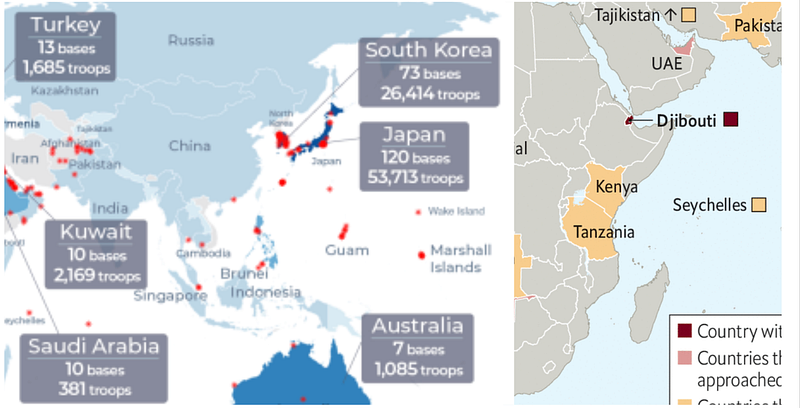
The graphic which leads this piece was assembled from an Al Jazeera map of 750 US military bases globally, with multiple individual bases not aggregated in callouts in neighboring countries, and a 2022 Economist graphic of the sole Chinese military base in Djibouti with a list of a tiny handful of places China had thought of putting a base. Allison references weiqi, the game most westerners know as Go, but fails to contextualize that the USA has surrounded China with massive military power, a clear encirclement strategy that is highly threatening to the country. He claims that Obama’s intent to pivot to China was never followed through on, but ignores that the Middle East is close to China, and that the USA maintains hundreds of military bases in a dozen Asia Pacific countries with easy force projection into China.
Most analysis in recent years has been about China’s build up of its military, but let’s contextualize that. America spends 3.8% of its GDP on its military, and as noted maintains 750 foreign military bases along with 450 to 500 on domestic soil. China spends about 1.8% of its GDP on its military, about the same as Europe, meaning it is well aligned with modern military expenditures, and the USA it a significant outlier. It’s clear from outside of the Washington Beltway, or at least from outside of the borders of the USA, that China’s military build up is defensive, and forced on it by being surrounded by the biggest military in the world.
China has been absurdly clear that its focus is economic growth, building infrastructure, making its citizens affluent, investing in health care, participating in and creating international governance and investment bodies, and growing ties of trade with countries around the world. It has been clear that it does not consider its military a priority. It has been clear that its military is a necessary requirement to prevent encroachment on Chinese soil and waters.
Yet the USA, and Allison, keep interpreting everything China does through the lens of their hard power perspective.
One of the jarring elements of the book was Allison’s regular comparisons of Donald Trump to Xi Jinping (that’s the current President of China to assist American readers). He regularly equated the positions of an incompetent, bragging, populist, con artist born into extravagant luxury who has led an entire life of deep privilege and attempted to mount an insurrection of rabble, to that of a highly intelligent, disciplined career politician with a degree in chemical engineering who at ten was sent to the country side of China as his father was denounced during the Cultural Revolution. Allison says more than once that Xi wants to Make China Great Again, as if that hadn’t been a Chinese national obsession for 150 years. He makes these comparisons as if the two men are comparable, or that Xi’s disciplined strategy is akin to Trump’s populist rhetoric.
To be clear, I had hoped that Biden’s election would lead to a more balanced perspective on China, but that just isn’t so. This is not the place for an extended discussion of it, but when the Carbon Border Adjustment is sold domestically as an anti-China bill, when hundreds of millions of anti-Chinese propaganda funding is approved by Congress, when Pelosi and coterie visit Taiwan in a period of significantly heightened global tension due to the Russian invasion of Ukraine — note: a limited war that the aggressor is losing badly between neighboring countries with a long history of wars triggered not by anything Allison writes about — then my hopes are dashed. The Washington Consensus includes Democrats.
Allison’s failures to even begin to understand how America is viewed by the rest of the world is typical of the Washington Consensus, and apparently the US business consensus on China right now as well. His failure to understand China’s limited and defensive military build in context of massive US forces surrounding China and regular intrusions into Chinese waters is remarkable for a hard power strategist. His lamentations that American naval forces were actually forced by Chinese defensive military increases to stay out of range of direct attacks on the Chinese mainland is remarkable.
The Washington Consensus is that America can do no wrong, America is great, America is exceptional, and China is a communist totalitarian militaristic state and can do no right. America doesn’t understand itself, and doesn’t understand China. As all China watchers must (and I, of course, do), Allison quotes Sun Tzu:
“If you know the enemy and know yourself, you need not fear the result of a hundred battles. If you know yourself but not the enemy, for every victory gained you will also suffer a defeat. If you know neither the enemy nor yourself, you will succumb in every battle.”
America keeps mistaking China’s economic growth as a military conflict and its defensive growth in response to America’s overwhelming dominance in the South China Sea as military expansionism. America keeps thinking that its system is the only right one, and that it is doing good globally. China’s view of itself and America is much more accurate. And China has zero desire for military battles or war. Its history since 1950 is border strikes to assert its borders as per the strategic imperatives of weiqi.
Allison closes weakly. After a book length exhortation on the inevitability of war, the things China is doing or could do wrong, and the lack of attention to the USA, his conclusion is a bunch of soft guidance mostly to the USA, as is fitting. From the outside of both countries looking in, it’s clear that the USA is the problem, not China. It’s clear that the USA is provoking China, and China is doing precious little except growing its own strength and security. It’s clear that the USA’s hard power fixation and massive military expenditures lead it to view every other country and conflict through that lens.
The USA deserves a senior American insider who will slap them in the face with the reality that they are the problem, so that perhaps they can become part of the solution again. This book isn’t it, and Kissinger’s better 2011 book On China is a history, not a strategic prescription or an upbraiding of America’s leadership for their failure to understand what is going on.
For those interested in a much better, more insightful book on the challenges of the rise of China and the multi-polar world that is emerging with China as the largest economy, I strongly recommend Kishore Mahbubani’s Has China Won? The Chinese Challenge to American Primacy. A Singaporean senior diplomat who has dealt at the highest levels with China, the USA and the UN for decades, he is more kind to the USA than I am, but clearly lays the lion’s share of strategic failures at their feet, and outlines clear solutions of merit.


