
‘American Horror Story: 1984’ is an Uneven Meditation on the Nature of Good and Evil
The ninth instalment of AHS might be a campy tribute to ‘80s slasher horror, but it also boasts some interesting reflections on heroism

Warning: Full spoilers ahead for American Horror Story: 1984
American Horror Story is not typically a show that dives very deep into social issues. Don’t get me wrong, they have a presence here and there, but the series is less interested in fleshing out coherent and thought-provoking themes than it is in indulging its camp and theatrical elements. In some respects, 1984 is no different, with the show’s ninth season paying homage to slasher films like Halloween, Friday the 13th and Sleepaway Camp, particularly the former two movies. With Billy Idol fanatics, pornstar ‘staches, half-naked teens and voyeuristic point-of-view shots from the killer’s perspective, the season is dedicated to feeling like an ’80s killer-thriller throwback.
But for as much as the show’s camp elements are just as present here as in other seasons, it also does a very good job of dissecting what it means to be a good person. On the surface, the season is about a young woman, Brooke, who decides to travel to Camp Redwood to be a camp counsellor with some new friends she’s just met. Unbeknownst to the youngsters, years before this a vicious killing spree took place, committed by a killer known as Mr. Jingles.
Beneath the basic outline of its plot, the season has some interesting layers that explore the boundaries and grey areas of morality. Much of 1984’s thematic content comes from trying to figure out whether evil is innate to some people, or a learned behaviour. Mr. Jingles starts off as the season’s killer, and is more noticeable for the sound of keys jingling by his hip than he is for his personality. Like Jason Voorhees, Michael Myers and other classic slasher villains, he rarely ever speaks. He might as well be faceless and nameless, since he reveals so little in the way of his motives that it’s impossible to interpret why he is the way he is.
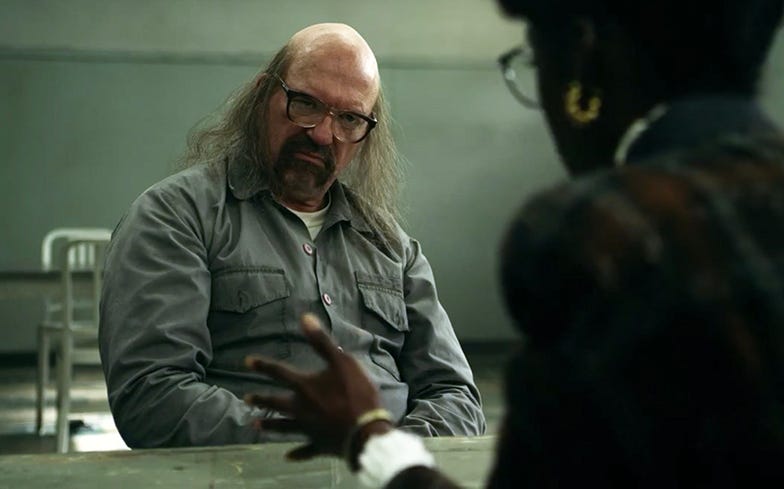
We learn that he actually wasn’t the killer he’s been made to think he was, after he was locked up and tortured in a mental health facility for crimes he never committed. By having this idea constantly reinforced into his psyche, his old memories and personality are transformed, altering his reality forever. In this case, evil is passed on through trauma. But as we discover later in the season, Mr Jingles has a rather traumatic background of his own that could explain why he ends up forgetting his recent past. At the same camp where he was accused of killing a large number of people, he neglected to look after his brother Bobby by a creek when the two were young boys, and feels responsible for Bobby’s death in a freak accident.
Camp nurse Donna, who is only at Camp Redwood to allow Mr. Jingles to repeat his massacre so she can study the mindset of someone truly evil, thinks that a traumatic past might have caused him to kill. That idea seems null and void once we learn that he was framed for the murders, but I think it still holds weight, if only in ways that Donna couldn’t have anticipated. Mr. Jingles has used the guilt of his brother’s death to allow himself to think he was the Camp Redwood killer, since Bobby died in an earlier version of the camp years before the massacre. Donna thinks that evil can be understood if she sets up controlled environments, but as the season continually demonstrates, the duality of good and evil is far more complex than she could anticipate.
Not only was she unaware that Mr. Jingles was innocent of his crimes, she wouldn’t have even been able to comprehend that he could be haunted by an event from his past, which would cause him to take responsibility for the murders as a way of confirming his own worthlessness. The delusion is so strong that he isn’t even aware that he’s buying into a narrative that he and others have reinforced. What complicates this even further is the fact that he is able to finally confirm reality after learning that the only victim to survive the attack, Margaret, was the real killer all along. Mr. Jingles is able to let go of his murderous past, but also abandons any notion of getting revenge on the woman who had him punished for her crimes.
He is the personification of good, yet that doesn’t change the fact that during the period in which he believed he was a killer, he murdered numerous innocent people, including one of the young adults set to work as a camp counsellor at the re-opening of Camp Redwood. Despite literally committing murder, it’s difficult to see him as a killer by the end of 1984 when he has constantly redeemed himself for these actions.
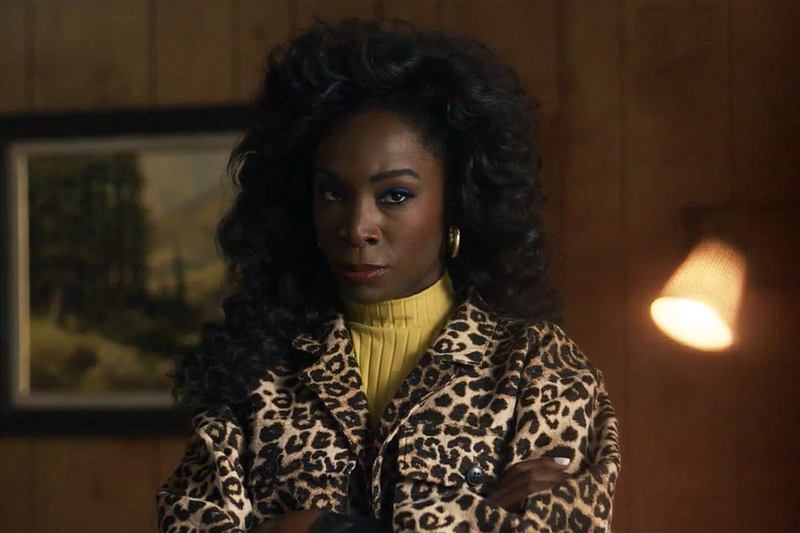
As for Donna, she claims to be a nurse, yet that isn’t her real identity. But even when she discusses her motives, she doesn’t disclose a crucial piece of information that explains her fascination with studying evil. After finding a bloodied and tied up woman in her father’s bedroom, she realises that he was about to kill her. As she struggles to piece together how the man who raised her could commit such atrocities, she uses his role as a father to placate him. She isn’t the only one conflicted about how these two aspects of a person’s character could be valid — that of a caring father and remorseless killer — since her father uses the knife he wielded to commit suicide, ending the years of bloodlust he insists was an innate part of him.
After all this time, Donna has still not received an ounce of closure, and the only way she thinks this can be achieved is through testing out whether or not her father was telling the truth. Orchestrating Mr. Jingle’s escape from the mental health facility, she drugs protagonist Brooke and uses her as bait for the near-silent killer. In trying to understand evil, she loses her empathy and views an innocent person as collateral damage.
Both Donna and Mr. Jingles are looking for salvation from guilt and pain they should never have had to feel responsible for. Just as Mr. Jingles deeply regrets not watching over his younger brother, Donna feels guilt for her father’s victims, and his own self-induced demise. Both of them, in seeking to atone, become far more evil than they ever could have thought possible. They refuse to value their lives, squandering them in aid of revenge or discovery.
For as interesting as these ideas are, they are still a part of American Horror Story, a series that isn’t exactly subtle when it comes to conveying its themes. Richard Ramirez directly addresses Donna’s guilt and what her attempts to understand evil signify, in a scene purely for people who weren’t able to piece together that information on their own. Moments like these hamper 1984’s deep dive into morality, and unfortunately, they’re a consistent presence in the season, particularly in its latter half.
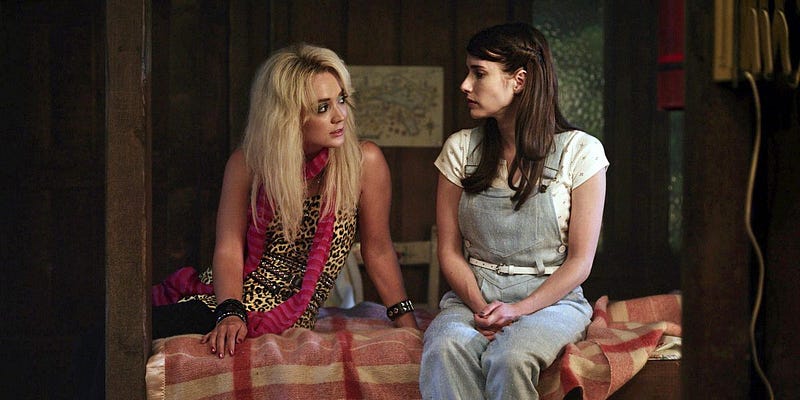
The season also explores good and evil through Montana’s interpretation of Brooke. Unbeknownst to the other young adults, Brooke is still trying to overcome her tragic wedding day, where her husband-to-be killed his best man and then himself, believing that Brooke had an affair with his friend shortly before their wedding. It turns out that the best man was Montana’s brother, so when the two meet by chance, Montana seeks out her revenge. Brooke winds up being the season’s perpetual victim in its first half, after being drugged by Donna and hunted by Montana and her new boyfriend, Richard Ramirez.
Despite Brooke never identifying as a victim, Montana despises her for this, as Montana equates vulnerability with victimhood. While Brooke is able to be open and honest about her feelings, Montana masks her suffering with her brash personality. Montana is obsessed with her single-minded pursuit to have Brooke killed, refusing to accept the possibility of Brooke’s innocence. Just like with Donna, if Montana looks for evil and doesn’t seek out other avenues, she will find it time and time again. Also like Donna, she isn’t even pursuing the real killer, since her brother’s killer is long dead.
Xavier and Ray are also struggling with their flawed senses of right and wrong, with the two of them entering a state of crisis after their callousness leads to the deaths of innocent people. Xavier aspires to be a better person and struggles with his intense desire for revenge against Mr. Jingles, while Ray consistently gives in to his cowardice even when he’s well aware that he should do the right thing, locking him in a state of never-ending self-hatred when he inevitably abandons his friends. Both characters are deeply unsympathetic at times, but that’s also what makes them so compelling to watch, since they both clearly have a conscience.
Unfortunately, we largely come to the end of 1984’s thematic significance here. The season’s fifth episode ends just as the nightmare of the characters’ night at Camp Redwood does, with Margaret killing a number of the main characters and allowing Brooke to be framed for the murders. From here, the rest of the season follows these characters years after that fateful and climactic night. This is the exact point in which the season nosedives in quality, largely abandoning its themes and amping up its stupidity to an absurd extent.
For long-time fans of the series, this shouldn’t be much of a surprise, since virtually every American Horror Story fan has at least one season that they think experienced a serious dip in quality as it progressed. Such is the case in 1984, where, despite its attempts to continue its exploration of good and evil, the characters and their dynamics become so convoluted that nothing feels thematically or tonally satisfying. Certain plot events are simply inexplicable, like Margaret and Trevor’s marriage of convenience. Trevor seems to have forgotten about former lover Montana, just as Brooke doesn’t seem to ever think about her one-time lover Ray.
For whatever reason, Richard Ramirez is still present in the season. It’s a bizarre choice to have a recreation of such an awful person play a prominent role in a season of television, especially when the show seems to be trying to make the character seem edgy in an appealing way, but it’s a total misfire on all fronts for him to still have a presence this late in its runtime.
Xavier undergoes one of the worst transformations in 1984, where he completely abandons his attempt to turn a new leaf and become a better person after being killed. The season makes some attempt to justify his change of heart, and while it does bear logical consistency with regards to his gruesome death and the fact that his attempt to be good didn’t stop the brutal fate that awaited him and his friends, it completely destroys the care with which this season handled its meditation on good and evil. He just abruptly changes forever, with nothing more in the way of depth or characterisation for him and many of the other young adult characters.
The idea of a group of undead people being incredibly bored with the limbo of their existence, where they are neither alive nor dead, sounds like a compelling idea. Unfortunately, it’s a storyline that has taken up the bulk of the plot in numerous seasons of the show already, most notably in Murder House and Hotel. It’s one thing to recycle a stale idea from other works of art, but to copy your own storylines is especially egregious, since it’s most frustrating for fans of the series who have watched its other seasons. As for how it’s represented here, it turns somewhat compelling characters into one-note nihilists.
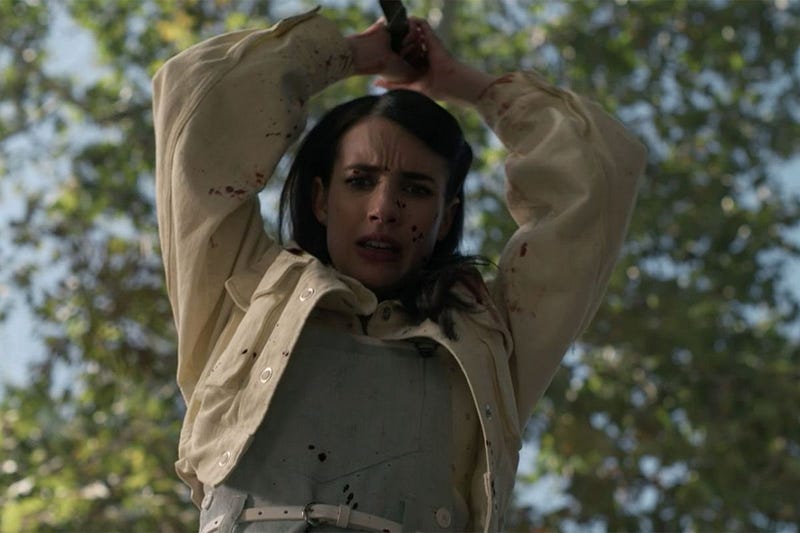
Brooke is treated the most bizarrely in the season’s latter half, where it’s clear that her creators had absolutely no idea how to envision her. On the one hand, she’s a victim of the spooky killer, but this season is all about subverting those staple horror tropes, whether that’s an overreliance on half-naked women, a silent, masked killer, or the idea that there can’t be a ‘final girl’, a concept mentioned a number of times throughout 1984. Without any obvious path forward for the character, she gets turned into an inconsistent mess.
In the span of literally two minutes, Brooke goes from wishing she was dead, to finding renewed purpose in hunting down and killing Margaret, to embracing living in the moment as her and Donna have fun at a roller skate rink. For all its intentional cheesiness, 1984 does genuinely care about its characters. Unfortunately, like many other seasons of American Horror Story, it views them more and more frivolously with each episode, turning them into pulp in moments like this to justify the season’s runtime.

Clearly, Brooke has lost her vulnerability, since she chops off the fingers of a man who tried to kill her and Donna, and then attempts to execute a journalist, all because the woman is a die-hard true crime fan. Well, that’s not exactly the reason why, but at this point I’m not even sure if the season is aware of what it’s depicting, or why. These new characters are nothing more than cheap diversions, appearing at the tail end of a season that somehow needs their presence in an already large cast.
Maybe these additions are for the better, since 1984 clearly has no idea what to do with its main characters. Montana’s change of heart is nonsensical, where she miraculously shifts her way of thinking in just a few contrived scenes. There are some compelling moments, like her relative lack of self awareness when she rants to Trevor about how male serial killers are idolised, relating this to the subjugation of women. Taking aside the fact that people who look up to serial killers make up an insanely small percentage of people in any society, Montana is indirectly telling Trevor that she is drawn to people like this.
Her critiques of society are almost entirely a case of projection, reflecting her self-loathing since she despises the people she most looks up to. Ultimately, her speech is about how she doesn’t think she’s good enough for him. It’s an interesting idea in that it relates to how Donna and Mr. Jingles view themselves, where their self-loathing leads to them committing far more harm than they otherwise would. Montana does end up being with Trevor, after Brooke moves him as he’s dying to Camp Redwood’s grounds so he can be with Montana forever. When Montana asks why Brooke would be so charitable to the person who tried to have her killed, Brooke says it’s because they are not alike.
Perhaps the season’s writers developed amnesia, because I’m pretty sure Brooke tried to kill an innocent journalist not long before this. Montana’s change of heart regarding her former boyfriend is equally stupid, where she is told in just a few lines that Richard Ramirez is not the sensitive and brilliant killer she thought he was. No, it turns out he’s more sociopathic than that. How that could come as a surprise to someone who watched him carve up someone’s stomach for criticising Billie Idol’s music, I’ll never know. Maybe Montana has amnesia too. That’s about as much justification as I can come up with for this plot development, since it’s utterly absurd.
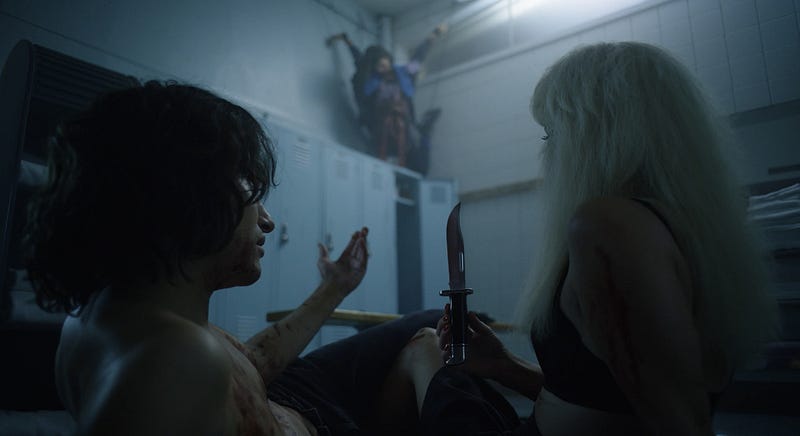
It’s clear that Montana has something resembling a conscience, ensuring she isn’t as explicitly evil as Richard Ramirez. Instead, she’s about as evil as an accomplice of someone like Ramirez, which is still a little too cut-throat to justify such a simplistic redemption arc. As a ghost / immortal entity, her and her fellow campmates engage in sadism to pass the time, since they are so tired of their existence that they see no harm in killing innocent people. If this is supposed to be a commentary on how we all have the capacity to become deranged, remorseless killers, the season has well and truly lost me by this point.
It would be less frustrating if 1984 had focused solely on being a campy homage to ’80s slashers, but for much of the season it genuinely succeeds at having thematic depth. Yet in its latter half, none of the characters engage in any of the important conversations they need to. Chet becomes about as one-note as someone could be, relegated to the background so often that he’s almost forgotten about. Ray and Brooke’s relationship peters out to nothingness, with one brief scene towards the end of the season not being nearly enough to make up for their dynamic being forgotten about.
Speaking of forgetting about important character dynamics, Brooke herself seems to have left the writers’ minds for 1984’s last few episodes. Two new characters have to be introduced just to give Brooke something to do, which is ludicrous considering that the season is clearly setting up a showdown between Margaret and Brooke. As for why this didn’t end up happening, I can’t honestly say whether that was a blind spot on the part of the writers or an attempt to be subversive and challenge our perceptions about what would occur. Whatever the case, neither justification works.
Brooke, as the innocent and vulnerable virgin who is perceived to be crazy or evil by others for no reason whatsoever, makes for a quintessential horror protagonist. The season is clearly aware of this, constantly referring to the idea of a ‘final girl’ and trying to subvert tropes related to ’80s horror films and their treatment of women.
Unfortunately, these ideas are delivered in such a heavy-handed way that their execution isn’t nearly as compelling as the first half of 1984. But even if it was, by this point the season has already ensured it can’t be redeemed, sidelining important characters and abandoning its exploration of how complex morality is for a shallow and ludicrous plot.