
MOVIES
America Will Eat Itself Alive: The Future of Horror in the 2020's
Horror media has always sparked and reflected our larger societal fears. What comes next?
You open your door tentatively, hearing fireworks going off somewhere nearby. You step outside as a helicopter whizzes overhead, chopping the air into savage chunks. In the street, people are staying far apart, masks covering most of their faces. Sirens blare in the distance.
Nope, you’re not in a nightmare and you’re not watching The Purge — you’re in Los Angeles in the year 2020.
Needless to say, the new decade has started off with a bang — murder hornets, a brutal pandemic, an economic recession, protests against police brutality and racial injustice…and it’s only June. We’re seeing a level of worldwide upheaval that is (apologies for this massively overused word) unprecedented.
We’re being plucked out of our normal lives, our familiar routines, and being faced with a new reality that is so Other and very much a threat — which makes it perfect fodder for a new decade of horror movies.
Chances are you (like most people) tend to think of a horror movie as something to be watched on a date, at a sleepover, or during Halloween. These films are campy, creepy, horrifying, maybe even a bit funny at times, and that’s all. Right?
Wrong.
“If movies are the dreams of the mass culture… horror movies are the nightmares.” — Stephen King, Danse Macabre
According to Karina Wilson, writer, story consultant, and horror expert, “Horror offers us a fictional space in which we can share and evaluate our collective fears–whatever they may be at the time.”
We’ve certainly got a huge witches’ cauldron of collective fears to choose from, assuming Americans have an appetite for horror after living through this year. But, to understand and predict where horror could go in the coming decade, we need to take a quick hop back in time to look at where we’ve been.
A short history of horror, decade by decade
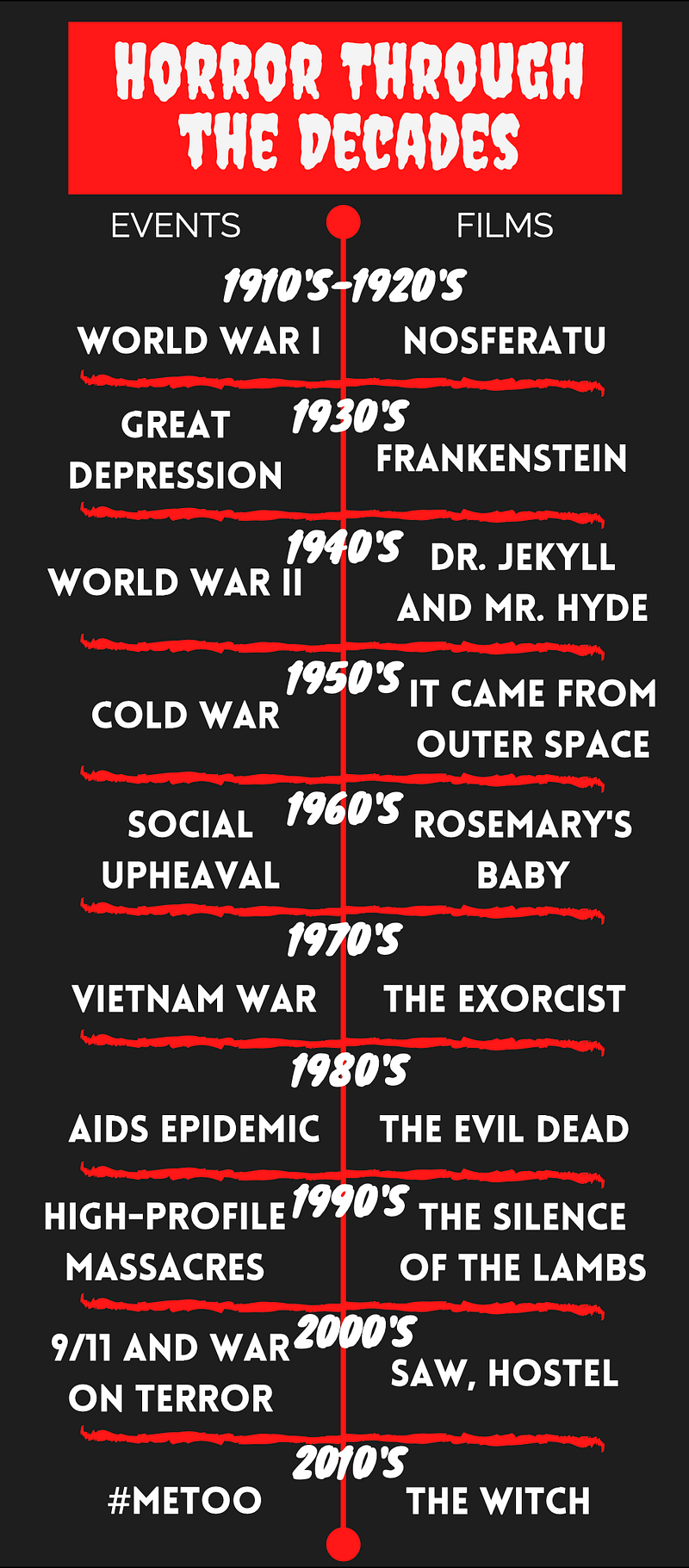
The history of American horror films is a rollercoaster of terror, comedy, gore, surprises, and originality, depending on the overarching culture and current events. Here’s a mini-look at the major horror films of each decade (not even close to being exhaustive!) and the major events happening during each time period.
The 1910's–1920’s: The era of the Great War
The carnage of World War I (1914–1918) was absolutely unprecedented, with over 20 million lives lost (not including the tens of millions of fatalities due to the 1918 Spanish Flu pandemic). New battle tactics, such as trench warfare, combined with horrifying advances in technology like mustard gas to make WWI not only deadly, but torturous. Returning soldiers suffered from shell shock, facial disfigurements, blindness, and other injuries. This real-life horror stoked fears of bodily harm, corpses, and the foreign “Other”, which spawned films like Nosferatu (1922).
The 1930’s: Depression
The 1930’s started off on a desperate foot after the stock market crash of 1929 plunged America into the Great Depression. Americans were looking for a distraction; horror delivered. The 1930’s saw the birth of the great Universal monsters: Frankenstein (1931), Dracula (1931), the Mummy (1932), the Invisible Man (1933), and the Bride of Frankenstein (1935), among others. These films were often centered around a foreign “Other” acting as a threat; plus, they also had the new advantage of sound, which allowed them to terrorize viewers even more.
The 1940’s: Another war and a new code
Another war ushered in the 1940’s, this one even deadlier than WWI. To protect the eyes and ears of innocent Americans amidst such a bloody time, the Hays Code, which had been simmering throughout the 1920’s and boiling in the 1930’s, restricted the types of images, language, and subject matter that could be present in a film. The code pushed horror away from gore and toward more psychological realms, with the mad scientist at the forefront. Dr. Jekyll and Mr. Hyde (1941) encapsulated these fears; it was accompanied by a spate of horror comedy (think movies such as Abbott and Costello Meet Frankenstein (1948)) meant to keep the horror genre alive while also adhering to the extremely constricting Hays Code.
The 1950’s: The Cold War
Fears of communism provided the engine for horror films in the 1950’s. Alien invasions, mutant monsters, and body snatchers ruled the decade in films such as The Blob (1958), Invasion of the Body Snatchers (1956), and It Came From Outer Space (1953). As Karina Wilson says, “Horror comes home” in the 1950’s. The mad scientist was also still alive and well in films such as The Fly (1958).
The 1960’s: Social upheaval
The 1960’s was all about rebellion. The Civil Rights Movement and the sexual revolution were touchstones of this era of rapid change. Horror films of this time often vilified women, whether that be by portraying witches or demonic possession. Seminal films include Psycho (1960), Rosemary’s Baby (1968), and Night of the Living Dead (1968). According to Karina Wilson, 60’s horror films often “served as cautionary tales about the dangers of abandoning traditional values.”
The 1970’s: Nihilism reigns
Horror exploded in a big way in the 1970’s, thanks to the collapse of optimism at the beginning of the decade and the end of the Vietnam War. Conservatism rose to combat the straggling hippie culture, leading to an upswing in religious horror. The Exorcist (1973) and The Omen (1976) are prime examples. The 1970’s also saw some new players in horror: Steven Spielberg with Jaws (1977) and Stephen King with his first film adaptation, Carrie (1976).
The 1980’s: Greed is good
Horror turned inward in the 1980’s. Fears of consumerism and greed spawned movies such as The Stuff (1985), and the AIDS epidemic correlated with a new rise in body horror, showcased in films such as The Thing (1982) and The Evil Dead (1981). Advances in technology and special effects helped bring horror to vivid, terrifying life.
The 1990’s: Reality strikes back
In the 1990’s, the Other “was the classic serial killer — usually a white man, hyperintelligent, narcissistic, who likes to play with the cops,” says Karina Wilson. A rash of high-profile murders and massacres fed the horror movie machine, which spat out classics like The Silence of the Lambs (1991) and Se7en (1995). These monsters are scary because they’re just people — there aren’t any horns, tails, or hoofs to mark them as Other.
The 2000’s: Rise of torture porn
September 11th, 2001 was a horrifying, cruel, and devastating attack that, for awhile, quelled any appetite for horror in America — for a few years, anyway. Once horror got back on its feet, it showed the world something that could reflect the cruelty of the terror attacks, the War on Terror itself, and reports of torture at the hands of US soldiers: torture porn. Movies such as Saw (2004), Martyrs (2008), and Hostel (2005) pushed body horror to its absolute extreme.
The 2010’s: #MeToo
The theme of 2010’s horror is still a bit up in the air, but Karina Wilson thinks that the resurgence of religious horror (The Conjuring (2013), The Witch (2016), Hereditary (2018)) “comes from a very pervasive current of misogyny.” This current flows at odds with the #MeToo movement, which put abusive men in the crosshairs, finally making powerful figures such as Harvey Weinstein pay for their crimes.
The 2020’s: What comes next?
The chaos of 2020 is a rich soil from which the next decade of horror can grow. Karina Wilson believes there are a few key horror elements that will start popping up in the next few years:
- Rampages: Whether it be an ordinary person throwing caution (and sanity) to the wind and going on a destructive spree, body snatchers wearing us like human suits, or aliens coming down to end it all, expect horror movies to reflect a country tearing itself apart in a big way.
- Politics: It’s no secret that we’re living in a polarizing political atmosphere, which can shut down dialogue, fast. Expect politically-charged horror movies to have a moment, because these types of films can be used to get a point “across partisan boundaries in a way that a documentary won’t” (according to Wilson). In other words, horror might shift into propaganda, which is a pretty scary thought in itself.
From monsters originating on another planet to invaders living inside our own bodies, the history of horror films has cycled from a far-away Other to a much closer, more invasive Other. As we enter a new decade, we can clearly see that the Other is here, and it is very much a threat. What shape that threat takes will vary from film to film, but, in my opinion, horror will enter a new golden age in the 2020's.
Our journey in time from the Great War to the sexual revolution all the way through the pandemic offers just a tiny taste of the vast, exciting, terrifying abyss that is horror film. I really wanted to show you that horror is far more than gore for gore’s sake or jump scares or cheesy Halloween masks. Horror is cathartic, cautionary, explorative, innovative, and, in my opinion, a necessary evil.
Where do you think horror is headed?


