
How Oaxaca Makes An Amazing Food Culture
How Oaxaca, Mexico weighs in on the obesity epidemic and what America can learn from them
Introduction
America has a problem. In fact, this problem has been affecting the country for decades. No, I’m not talking about the country’s political polarization (although that is a topic worth plenty of discussion). I’m talking about the obesity epidemic. Since the 1980s, America has struggled with an increasingly obese population.
Over time, the government tried to implement different strategies to curtail this national issue. A recent example is the “Let’s Move!” campaign headed by Former First Lady Michelle Obama. This program aimed to get Americans, particularly children, to be more physically active. However, this campaign did not work as expected. By the end of the 2010s, the obesity problem got even worse: today, 73% of Americans are either overweight or obese.
The United States’ obesity epidemic has multiple factors, so it is reductionist to attribute this issue to one central cause. Our increasingly sedentary lifestyles certainly do not help with the matter. But I believe one of the biggest contributing factors to this epidemic is our food. Generally, American food contains ridiculous amounts of additives and processing, not to mention (believe it or not) microplastics. In many cases, food in this country is perfectly prepared to be as tasty as possible, using sugar and other ingredients to make a meal people literally can’t stop eating.
The good part about this is that it allows for tastier, sweeter, richer meals. The bad part is that before we know it, we’ve eaten too much food. As a result, we are sicker and slower than ever before. This phenomenon is particularly embarrassing when looking at other countries, which typically have better and healthier food options than we do. The amount of dietary restraint other countries can show makes us look childish in comparison.
Now, I am of two minds about the obesity epidemic: On one hand, I would rather our country have too much food rather than too little, as famine is no joke. In fact, I think we as Americans ought to be grateful for the food options we have. But is it really in the best interest of the American food industry to sicken its citizens? Do we really benefit from having food that we are ashamed of eating sometimes? Do we really need another McDonald’s to open down the street?
On some level, this is a problem of progress, a result of the greater material wealth this country has accumulated over the past many decades. Regardless, I eventually decided I needed to find another explanation. I demanded an alternative.
I wanted to explore the food in a country that is not as wealthy as the United States. I had heard that other countries generally have healthier food options, even in their respective versions of McDonald’s. With that in mind, I recently traveled to Mexico, partly to have a taste of that country’s food culture. I hoped that I could find a cuisine was not as “optimized” as in America. If Mexico was indeed healthier, I needed to know how.
However, Mexico also faces an obesity problem.
Not only does Mexico face an obesity problem, but this epidemic has been going on since the 1980s, just like in the United States. Today, obesity is the number 1 cause of death in Mexico. How could this be? How could Mexico have the same obesity epidemic as in America? It may be because to a lesser extent, Mexico has slowly become a wealthier country in the past few decades. In other words, Mexico may be suffering from the same problem of progress as in the United States.
For example, around the 1990s, Mexico got introduced to the ultra-processed food other countries like America have. What makes this food particularly alluring is that it is often cheaper than many traditional foods. Many Mexican families struggle with poverty, so processed food can be cheaper than the alternative. This would be fine if it didn’t come with a troubling side effect: health issues. Additionally, Mexico has a dangerous love affair with Coca-Cola, a drink that has taken the country by storm.
Part of Coke’s rise might be because of the danger of drinking the towns’ municipal drinking water. Regardless of the reason, however, Coca-Cola’s sugar still affects the Mexican population in a negative way. Some may suggest that Mexico’s sugar-cane Coke is healthier than America’s Coke, with its high-fructose corn syrup.
However, this is a myth. According to this Mashed article, Mexican Coke has the same deleterious effects as in America, despite the different ingredients. Even with more natural sugar, drinking too much Coke in Mexico will produce the same results as in America. I suppose America and Mexico have more in common than we think.
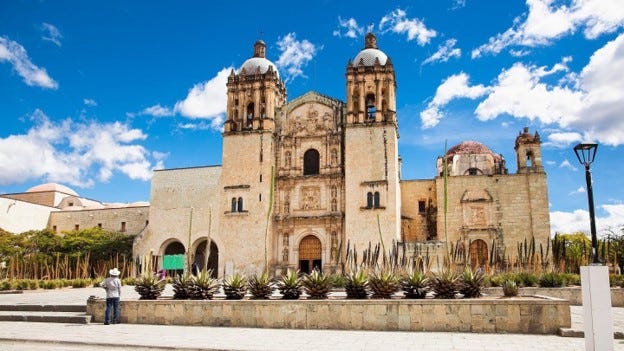
Knowing that Mexico inherited some of our food problems, I became quite discouraged. However, I found hope in one state of Mexico: Oaxaca. This state is somewhat peculiar, being geographically isolated from the rest of the country via a mountain range. Not even Mexico’s infamous drug cartel visits this location often. Oaxaca has become more popular in recent years due to its rich food culture. In fact, many consider this state to be the food capital of Mexico.
A Deep Dive into Oaxaca
Oaxaca is a state that contains a mixture of valleys and mountains. The flora of this area is very diverse, ranging from colorful flowers to tree-like cacti. It is the origin point of many popular international foods enjoyed today, such as squash, corn, and pasta. Indeed, Oaxaca contains an interesting variety of food native to the state. More importantly, Oaxaca seems to have retained some of its original food practices. This means that even though the state has the same obesity problem as Mexico at large, Oaxaca manages to have a good amount of fresh, healthy food.
First, Oaxaca is home to many local, sometimes organic markets. In these markets, people can often be seen preparing food or ingredients on-site. Sometimes this extends to smoky meat markets, where chefs or butchers will prepare the meat near market shoppers. The fire to cook the meat is fueled by wood, creating a strong sensation of smoke and heat. Some of the meats featured are Oaxaca’s signature chorizo, a ground pork sausage. It’s also worth noting that this meat often tastes very good, even if flies will land on it every now and then.
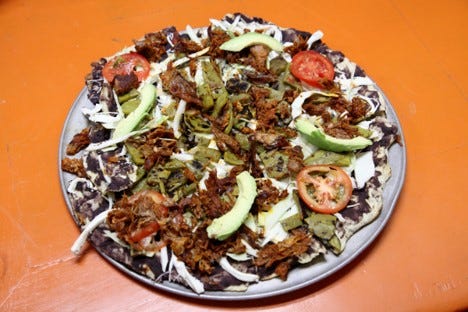
There are other examples of traditional Oaxacan food: for example, moles are a sort of sauce made from ingredients like cilantro, guacamole, and chili peppers. Depending on the different types of ingredients used, one can prepare different types of moles. There are also Americans’ worst enemy when it comes to food: insects.
Edible insects include los chapulines (grasshoppers) and ants. Though many readers may have an aversion to eating bugs, I thoroughly enjoyed them. I was eager to try the bugs when I visited Oaxaca. They have quite a strong taste, but the chapulines are a tasty source of protein. However, even I must admit that appreciating Oaxacan cuisine from an American perspective requires some trial and error. I quickly grew to love eating grasshoppers, but mole negro, a sauce containing chocolate, made my stomach sick. A shame, considering how much I like to eat chocolate.
What strikes me the most about Oaxacan food is how fresh it is generally prepared. It is not uncommon to find food prepared by street vendors. Even in restaurants, especially the Americanized ones, the food has a remarkably different taste than in the United States. Part of this is because of the unique nature of some foods. It is difficult to imagine grasshoppers being processed and filled with microplastics. The microbiome difference plays a role as well. But ultimately, I believe the unique way Oaxaca prepares food may be due to its culture.
Oaxacan Culture
It’s often said that culture and cuisine are intertwined, and Oaxaca is no exception to this rule. Because Oaxaca has 16 different ethnic groups, some of which were not conquered, the state was able to have a sort of cultural resistance due to self-governing. This cultural resilience seems to carry into other aspects of Oaxacan life.
For example, many of the old sites from the indigenous eras have been preserved, such as the ancient Zapotec city Monte Alban. The aforementioned wood burning is a conscious choice to preserve the traditional way of cooking meals. Finally, Oaxaca’s biggest event is La Guelaguetza, a two-week festival in July where Oaxaca’s ethnic groups congregate in the central city for an incredible display of fireworks, parades, and symbolic celebrations of this intriguing culture.
With the Oaxacan people’s dedication to fresh, quality ingredients, it’s no surprise that the food in this state is often better — and healthier — than some of America’s foods. The cuisine in Oaxaca may reflect a desire from the indigenous communities to preserve their lifestyle. It just so happens that in this state, that lifestyle and identity is closely related to the food they eat. More power to them — if it means that the food keeps the citizenry healthy, I love it.
So, what lessons can the United States learn from Oaxaca? Some might say that the food industry in America is beyond saving. Perhaps we are simply in too deep within our sickening food culture to make a change. I disagree.
For one thing, I think that we as Americans should take great pains to have pride in our own food again. I understand that America’s bigger geographical size leads to multiple different regional cuisines, but that is besides he point. I believe the food industry should take greater pains to ethically source its food, especially the meat. Now would be a wonderful time for the return of grass-fed beef (looking at you, meat industry).
If possible, we should avoid entering McDonald’s as though it were filled with land mines (which is ironic, considering the first McDonald’s used to contain grass-fed meat). Being able to cook meals at home would be a good alternative to using Uber Eats or Doordash every now or then.
Some may object that healthy food is simply outside of their budget. Sometimes, this is true, and I can sympathize with such arguments. However, I would also urge people to consider the long-term effects of how they handle their diets. I would additionally like to lay out some practical examples. Assuming one has the space and time, a backyard garden would not hurt. A supermarket like Whole Foods is good, but an outdoor, local market is even better.
Finally, we should avoid wasting our food at all costs. Americans waste tons upon tons of food each year, and there is no reason this trend has to continue. The best way to avoid wasting food is to eat it. Eating food before the expiration date is helpful as well, although various foods can stay fresh longer than others. These simple steps can be the beginning of cultivating a healthier food culture in the country.
Conclusion
In laying out this call to action, I am not necessarily saying we should aim to be exactly like Oaxaca. Considering the bug thing, I am not sure we could ever perfectly emulate the cuisine of Oaxaca. Rather, I think that if we embraced the culture of farms and how we locally grow our food, we would see higher-quality meals on our plates. If that means we lose some of the convenience of food being instantly available to us, I think this is a worthy trade-off. We don’t have to be like Oaxaca, but we should work to be healthier nation for the sake of ourselves and our food.


