
America and Procrastination
Of course we know what is coming, we’ve seen it too many times.
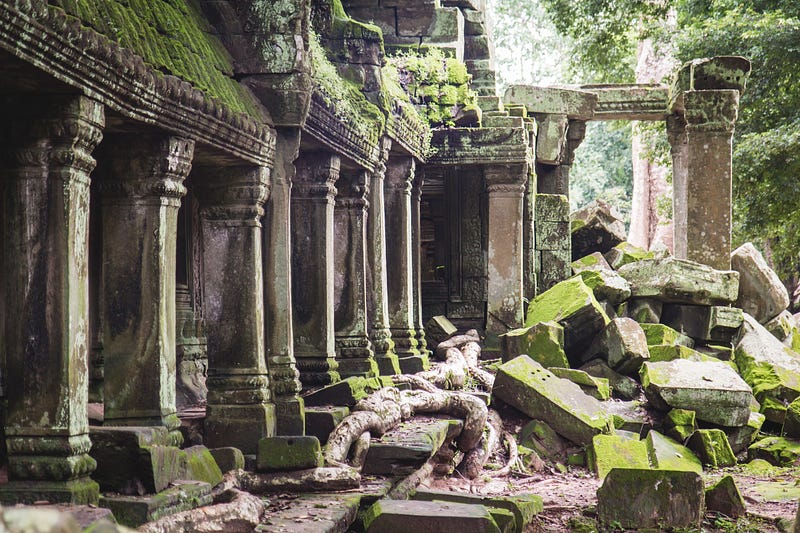
I was a volunteer driver for one of several NGOs (Non-Government Organization) working in Cambodia during the 1970s. The notes from my diary have been used in a story I am presently engaged in writing. Some facts have been forgotten; some never will be.
What follows are extracts from that diary, September 1976. These extracts do not make for comfortable reading, witnessed by me they detail the kind of ferocity and lack of humanity seen in the kind of conflicts brought about by dictators. I believe history is being repeated in Ukraine.
11th Sept. 76
We left Hong Kong on September 1st, driving down through Thailand and crossing across the border into Cambodia near Anlong Veng where we met our UN escort. We are six trucks, five carrying relief supplies, one with spares, and food supplies for the journey. The UN escort consisted of four armored cars and twelve personnel.
Today is our eleventh day, progress is slow due to the monsoon rains, and we are camped seventy miles west of Anlong Veng. My shoulders ache as badly as they did at the end of yesterday.
I tried massaging each of them under the thickness of the bullet-proof vest, but each time I relaxed my grip on the steering wheel it snapped left or right, slugging me with more pain. Already there’s several broken fingers, a dislocated thumb and a sprained wrist as we attempt to steer ten-ton trucks, loaded down with supplies, through tracks that have become all but impassable.
What is happening in Cambodia, the wasting of a culture is shocking and ignored by the West.
Between 1969 and 1974 President Nixon ordered the devastation of the Cambodian countryside, using B-52 bombers to waste it. Such a decision remains one of the worst any president has made, leaving peasants fleeing to join the ranks of the Khmer Rouge, and flattening two thousand years of history. Nixon and Kissinger being responsible for the greatest American foreign policy disaster in history.
I remember being warned about the tension in my shoulders every time the steering wheel tried to climb out of the tracks, increasing the pain level.
The rains have been so heavy, tracks are immediately submerged. Driving, keeping the truck’s wheels in the rain-filled ruts, was guesswork.
The first I realized something was wrong, two U.N. soldiers had leapt from the rear of the first armored car, sinking calf deep in mud, before they struggled toward a clearing in the undergrowth.
They moved like men waiting to be ambushed, machine guns at the ready, and the hum of the armored car turret could be heard swiveling.
Moments later, I heard voices and poked my head up to peer through the mud-splattered windshield. A returning soldier struggled to carry a naked woman over his shoulder. Twenty feet away, two more soldiers reappeared from the undergrowth, both staggered backward, their weapons trained on the undergrowth. The soldier carrying the woman stumbled, dropping her, but her fall was cushioned by mud. “She’s alive,” he called out.
The soldier waved, shouting, “get the nurse.”
The nurse was brought forward. A minute later, still with the woman in his arms, the soldier followed her to the medical truck.
Fifteen minutes later, the convoy was moving again. A soldier stood on each driver’s truck step, a ready response with the Khmer Rouge clearly in the area.
The girl had been captured only minutes before the column came by, disturbing a rape, then knifed many times before her attackers fled.
As the undergrowth became less thick, the convoy entered a village. Mud houses, stray dogs, garbage, even a derelict car sat on the verge, half-buried by undergrowth.
Two young men wearing jeans passed by on a motorcycle, one wearing Oakley wrap-around sunglasses and a backward-facing baseball cap.
The other wore a Hawaiian short-sleeved shirt, and both waved as they passed down the side of the convoy. Every U.N. weapon is trained on their hearts.
We kept moving, though people were emerging from ruined dwellings. They appeared anxious and frightened but curious.
Not starving though frighteningly thin and ill-looking. The women, many carrying children, stood against walls, straining to see. Older children ran holding sticks in their hands.
The reason for the womens’ anxiety was soon apparent, coming across several dead women lying scattered on the verge.
We stopped. Soldiers spanned out, ready with tremendous automatic fire at the ready. Colonel Verdgaard, the relief coordinator, got on the radio while a U.N. officer escorted the nurse into the horrific scene. No sign of life was found.
The murdered women, thirty-three of them, twelve children, bludgeoned with pickaxes.
One officer, fluent in Vietnamese, reported back that Khmer rebels had entered the village last night. The women and children were murdered as revenge for their men and boys fleeing to Vietnam.
The UN commander kept us away from the scene.
Cambodia during this time had separated into a war between Cambodia’s city dwellers and the peasants who lived in the countryside. All schools were shut down, newspapers and Buddhism were outlawed, and intelligent people were slain. These people were considered the worst of Cambodian society. Tens of thousands of Cambodia’s educated were taken away in trucks in haunting reminders of Jewish people being taken to concentration camps. Strict rules for behavior were put into place, money was abolished, clothing, haircuts, vocabulary were implemented.
When we were ready to move off, the UN commander visited every truck.
There was intelligence informing us that the Khmer Rouge were thick in the area. Soldiers would continue to stand on the step of each truck. If anything happened on no account was NGO personal to leave their trucks.
13th September, 76
The push to deliver aid to the victims, most having fled from regions where the roads and infrastructure were in shambles after America’s bombing spree, was critical.
Scandinavian countries were heavily involved in relief work. Most of the vulnerable were women because the different factions were still recruiting boys, nine years old upward, and placing them in ‘educational camps’ where they were trained to kill with hoes, pickaxes, knives, anything at all.
The convoy rested on Sunday, and on Monday set out again. My heart felt ripped and torn and broken. I thought about my wife at home, and the child we are expecting.
It has been raining forty-eight hours straight. We passed through two more villages, not stopping. After the second village, two miles farther, the convoy was brought to a stop.
The soldiers, leaping from the armored cars, split up and entered the undergrowth keeping their A.K.47s ready. The soldiers stood on the trucks remained.
When the area was considered safe, the UN commander waved all clear. I thought that it was a false alarm.
Instinctively, I jumped down and sloshed my way toward the soldiers who waved to go back but it was too late; the sight made my guts heave, vomit surged up my throat, blasting out with such force it bent me double.
I took in the deepest breath that expanded my lungs and tightened my stomach muscles to keep from spewing up more of my innards.
The buttery, cocoa colored face would perfectly have graced an advertising board in London’s West End.
Her once shining black hair, now caked with mud, strands of which licked into her gaping mouth, covered her split open skull. I stared at her tongue hanging between her lips, which in any other circumstance might have seemed erotic, except that her body lay twenty feet away, stomach sliced open, a child’s head and one tiny, but perfect arm, falling from the cut.
I turned away, chucking up more remnants of vomit.
The nurse, mud oozing over her thighs as she knelt. The blood on the body of the dead girl had not yet congealed; something the soldiers were very aware of, perhaps her killers were watching. An uncontrolled warmth trickled down my inside leg and seeped into my boot.
The nurse then walked back to where the girl’s skull lay, stooping to pick it up, and the sight made me wretch. Two soldiers stood over her, their senses tuned with automatic weapons, knees unlocked, eyes strained and ‘buzzed’ with fear. If a twig snapped, the whole area would be cut down with gunfire.
The nurse carried the girl’s severed head the short distance to the body, where she sank once gain in the mud and set it from where it had been severed.
It was then I noticed the merest tremor in a tiny finger. I stared for a few seconds more; it twitched again on the blood-soaked stomach.
The soldiers remained agitated, keen to have me move back toward the truck, but I struggled and refused, shouting to check the baby. I was inhaling great gulps of air. The baby, check the baby.
The soldiers, finally too strong to muscle away marched me back to the truck.
Five minutes later, I saw the nurse carrying a blood-stained bundle in her arms.
The lead truck moved off, spewing water and sludge from the rear wheels. I slammed the gear lever forward, slowly increasing the revs, and thought to myself ‘I’m driving into hell.’
12th March, 2022.
I am passionate about what is going on in Ukraine. Yet again, a dictator holds the world to ransom using the lives of innocent people against democracies of the world. If we aren’t prepared to stop this genocide in its infancy, we may as well turn our backs the way we did with the genocides of Pol Pot and Hitler.
There is NO diplomacy that turns these murderers back, they keep going, keep killing, keep wanting to rule the world.
When the fuck are we going to learn that procrastination helps the enemy. Putin is gambling that our fear is greater than his insanity.
P.S. To anyone interested the child in this article lived and is a miracle.


