
Amazon Final Interview(Interview Loop) Experience
Sharing my Amazon final frontend interview experience for the Frontend Engineer role
You can read the free version by clicking here.
This is the second part of the story where I shared my interview experience from Amazon. It is a fast follow up so I highly recommended to read the first part here if you have not already.
My Final interview was scheduled for the 28th and 29th of October, and Diwali (The biggest Indian Festival) was around, so I had a hard time preparing for the interview and focus. I almost got 2 weeks to prepare.
The problem with the recruiter and proper communication still goes on. I got 4 interviews but do not know which one is which. I googled it and based on my search I considered them as most of the FAANG and other interview experiences are similar to General Tech Interview, Frontend Web JavaScript Tech Interview, System Design, and Hiring Manager round.
This was my 1st mistake thinking and categorized it based on 99% of the interview experience that I have searched and learned from the internet. And it was just last 30 minutes, 1st 30 minutes are again the same 14 Amazon Leadership Principles.
For this interview, I prepared and practiced in the same way, I did it for the 1st and 2nd telephone round.
- JS Core Refresh
- React JS more than intermediate level, deep react understanding and performance
- Web Performance in General
- System Design (Micro frontend, Micro Service, Database, read-write operation, sharding, load balancer, API Gateway, CDN, etc
- Leetcode medium-level problem-solving
- Algorithms performance (Searching, Sorting, Tree, Graph, BigO, Map)
- Practicing 14 leadership principle STAR responses for each and follow-up questions for them.
Final Round 1:
With all this preparation, I was still nervous, It was at 10:00 AM, so I didn’t read or open anything before my interview, I closed my preparation at night. Because if you read even just before the interview, you always feel less and think something is missing and try to read and refresh those as well, by the time you finish, you will be left with the feeling that there are still things there to cover or go throw, personally I feel that negative and sitting in the interview with that mindset just like a minus point to self. ✌️
The first 30 minutes were again on the leadership principle some of the questions were the same as last two interviews, so my response was similar, I would highly recommend creating multiple responses if possible for each leadership principle (maybe 2 for each).
Technical Question:
I requested to create and design like button with multiple states and styles, again in the same shitty code editor using any framework or library. So I used React and created components, props, and included styles.

The main focus was on reusability, extensibility, and encapsulation. The design was in such a way that it is part of any Component Library and anyone can import and use it, bind callback functions, and state.
I was able to do it within the given timeframe, with a defined typescript schema, and interface for states, events, and props.
Once the interview finished, I was like is it an Amazon Interview, I felt like it so simple and I got more confident for the next round which was at 2:00 PM the same day. So I consider myself green 💚 in this interview.
Final Round 2
The first 30 minutes were again on the leadership principle some of the questions were the same. So far (1 Leadership principle Customer Obsession was asked more than once in each round and 1 was different it was almost 2–to 3 in each round).
Technical Question:
I requested to create an optimized, dynamic page for the news website like the Washington Post or any other news site, with the flexibility to push Headline content on top and steer the news articles in a fluid layout.
Almost every time these questions were open-ended on purposely, you were not sure, which part to cover or which part to skip, like API design, Database Design, or Component Design that too in 30 min. So better to ask the question clarify and scope the problem statement and start the coding.
In this round, there was no coding expected, it was mainly on Design (so I considered it a System Design Interview) I used draw.io to create the design of the page based on component composition, and discussed it with the interviewer, there were a couple of follow-up questions.
- How can you handle the load for a breaking news situation
- How can you use server-side rendering to enhance performance for clients on 1st paint?
- How you can inject add in between the articles
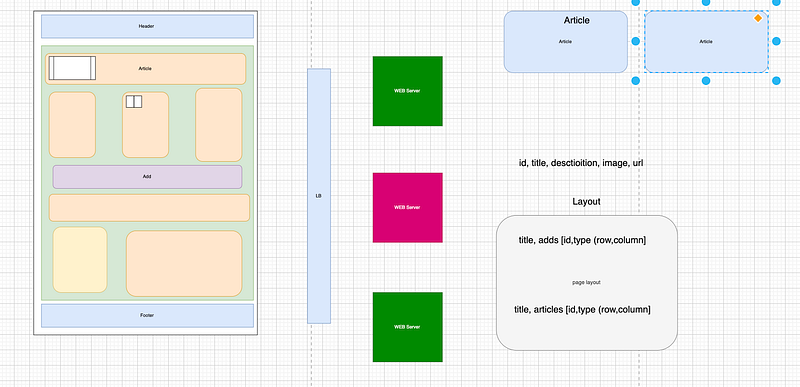
Maybe the diagram doesn’t make sense, but that is what we have discussed in the interview along with the follow-up question.
Once this round finished, I was relieved, my personal feeling was okay It may not be a 100% perfect solution and discussion with the interviewer but it was almost 75% accurate. So I consider myself a green 💚 event in this interview.
Final Round 3
Well, my mind was still confused and started the permutation combination calculation that the last interview would be with the Hiring Manager, I already have System Design and Basic Frontend Interview, so this might be the Core JavaScript or Web Tech interview. I didn’t prepare anything in the night, just let myself free and in a good state of mind as I was confident based on my last two interviews. The interview was scheduled for 11:00 AM the next morning.
The first 30 minutes were again questions from the leadership principle, a few repeated questions, and a few new ones (but still from those 14 so I was able to answer them).
Technical Question:
In this round the question was a bit tricky, it has a UI component, and data structure to maintain in order to show the data in the component.
I was asked to design an Amazon widget that shows on the AWS Console Home Page and displays a frequently visited services list and links.
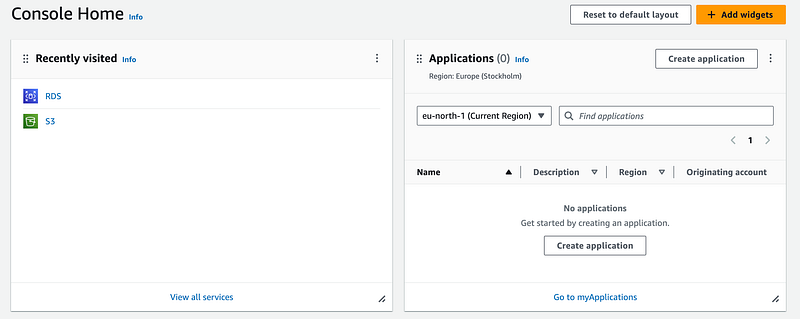
Again the question was open-ended, so I clarified details about how the component would receive the data of last visited services. We agree upon, an event system.
So again I used React and created the component, listed out all the services, created data for those services, and event listener, assuming other services will emit the event when customers visit the service.
Inside the component, I have to keep track of the data and its visited count, so any services visited more should be on top. So I created a structure like this
{
  title: "S3",
  icon: "/some/url/s3.jpg",
  link: "s3/home/url",
  visited: 0
}
I used the map, to keep track of the count of visits, and as I received visits events, I just increased it.
While displaying the list, I sort it in descending order and just show the top 10 widgets.
I received a couple of follow-up questions:
- Time and Space Complexity of sorting technique? I used JS Array.sort method
- How can you optimize it, in a way every time after getting the visit event, we should not do the sorting, as on each input, it increases the list and does a sorting
Time was almost ending, so I just discussed my approach to do in-place sorting, every time input comes, I will place it in the right place so that the order of the visited count is maintained and does not require sorting of the whole list again on each input. The interviewer seemed convinced, at least I didn’t get any negative vibe at the time. Within 30 minutes that is the best I did.
After the interview, I was quite happy and confident about how each round went so far, I also consider myself 💚 here. I did 80% of what was asked and discussed my approach to follow-up questions.
Final Round 4
It was scheduled on the same day in the evening, and after my 3rd round, I was confident, and considering this was a Hiring Manager Round, I started preparing a bit for behavioral questions.
The interviewer was the manager, who was hiring for the position. Again the first 30 minutes were Leadership principles and follow-up questions on those. This time I mentioned some examples from my past work experience in 2019 and answered follow-up questions about my learning and take away from that work.
Technical Question
I was asked to create a cart system, where customers can add products, apply offers on that product, and apply multiple coupons on the final cart amount. The interviewer was very clear and asked, He is expecting production-ready with option to extend it in the future code. I was almost scared how could I do that in 30 minutes (25 minutes because every interview stops 5 minutes for any question from your side)
I started with schema, and defined type script interface and attributes for Product entity and Cart entity, and Offer and Coupan as well. There was also a requirement to display prices in the currency of customer choice.
Based on the interface, I created a react component and displayed the products and buttons to add coupons and offers. There was also one requirement that if the customer apply multiple coupons, the best n coupon should be applied and n can be configurable depending on the offer.
And Imagine you are doing this in the shitty editor, where code formatting, lining, and coloring was broken, you can not run the code as well. This is the most challenging part of all the interviews.
Somehow I managed to create the component and implement the business logic as asked, although it was not up to the mark, because some business logic like currency change requires a backend API call and complete integration, and meanwhile, he reminded only 5 minutes left, so I just finish business logic of applying multiple coupons.
This question really tricked me or just my mind and I was feeling like it wasn’t well, I could do this better if I had more time. This time I didn’t think it was green, It turned amber 💛
This time Amazon surprised me, they got back to me immediately the next day with feedback. Unfortunately, I didn’t make it. I felt a bit shattered for a moment but in the next hour, I quickly inspected things “What went wrong?” That is something that I always do after a bad interview result.
So here is what I learned from the Amazon interview.
- Consider each interview “Do or Die”
- Do not presume what kind of interview will be the next. I still feel the moment I started rhyming “Okay only last one left that too with Hiring Manager would be Managerial Round, which normally has behavior questions” I lost my grip and somehow took it lightly.
- Give equal time and importance to the “Amazon Leadership Principles” as you do it Tech, Algo, Data Structure and Problem Solving
- Prepare at least two examples for each leadership, I did only one. Sometimes same question is asked by different interviewers, I give the same answer. Keep in mind that all interviewers write “Interview Memos” and write feedback and conversation and respond to what you give them. After 5–6 rounds it should be like the same STAR response repeated 3–4 times because they all asked the same question. That is what happened to me and this is a big negative point. Do not forget to prepare follow-up questions for each leadership principle. Remember that 50% of the interview is about answering leadership questions in STAR format and discussing your work experience and follow-up questions on them.
- Prepare and practice a different set of questions for each interview, based on the conversation flow, to give yourself an extra edge. Don’t just say, “No, I don’t have any questions.” This is a valuable chance to ask about the team, company, culture, or tech stack. The more interesting and relevant your questions are, the more engaged they’ll be with your profile. Thoughtful questions not only help you learn more about the role but also show your genuine interest in being a strong team fit.
- Prepare your introduction and practice it, when you have a back-to-back interview, I felt each interview my introduction was getting shorter somehow, because physiologically when you repeat a thing, your brain starts to skip. For example, in the first round, I clearly mentioned My current role, past work experience, Tech stack, and my interest in the area, and hobby. By the last round, I introduce myself with just my current role and tech stack. This happened to me so smoothly that I didn’t realize it through the interviews. When I inspect it after the final round. I feel this is one of the mistakes, that happens naturally.
- Do not just refresh DS-Algo. Practice problem solving from leet code or component design, or try creating data tables, tabs most UI elements that we use today via some library, just try to create them with plain JavaScript
Wrapping it up with my last thought, I never thought that one day I would get a chance to interview at Amazon 😊. Although I failed, It boosted my confidence, and the good thing is I know where and how I failed. I hope this article will help someone to prepare for the interview. Feel free to reach out to me if you want to discuss it more in detail.
In Plain English 🚀
Thank you for being a part of the In Plain English community! Before you go:
- Be sure to clap and follow the writer ️👏️️
- Follow us: X | LinkedIn | YouTube | Discord | Newsletter | Podcast
- Create a free AI-powered blog on Differ.
- More content at PlainEnglish.io


