Amana Rag Balls & Technology
When writing merges the past with the present, with a little help from technology
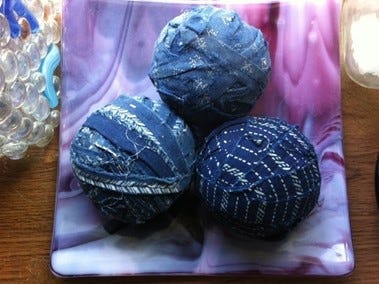
As enamored as I am with the past and the ‘good ole days’, technology has invaded our lives and I have to accept it. For the most part, I’m glad about it. Now, I could easily regress to the days when cell phones were not permanent attachments to everyone, and we could meet friends for dinner without half of the table constantly texting or checking their Facebook page. But, overall, I do appreciate the electricity, the air conditioning, the refrigerators…and the indoor restrooms, to name just a few.
Sometimes moments arise that showcase how much technology has changed our lives.
One night I was musing over a blog idea while I headed for bed. No — not that. No — don’t feel about writing about that. Nope — too much research is needed for that subject.
And then my three Amana rag balls leaped into my mind. I’d brought them back from an antique store in Iowa. Now….where in the world had I stashed them?
I dashed back to my office and pulled out my ‘Iowa Quilt Squares’ folder. When I’d taken the quilt squares to Iowa in 2014, I’d stopped in an antique store in Bedford where I’d discovered these fabric delights. The owner had a note explaining the basketful of rag balls & I jotted some of the snippets down.
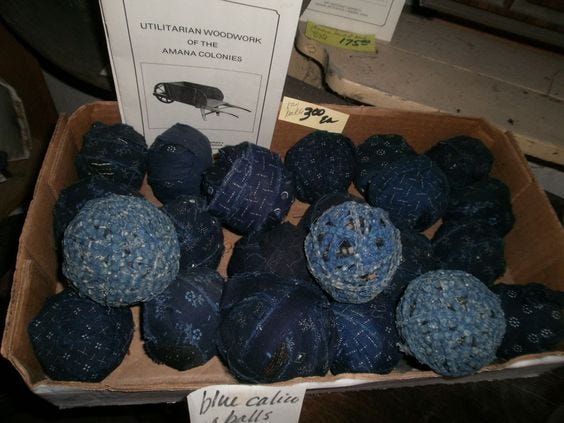
Amana Blue Calico…
Produced up until the start of WWI…
No longer able to purchase dyes from Germany…
Factory located in main Amana…
Perfect! Now I just needed to research Amana. But, ugh! I’d already put the computer to bed for the night. I didn’t want to pull the laptop out and turn it all back on. Such a hassle. I mean, after all, it would take all of two or three minutes for this whole process.
But I didn’t have to!
The phone!
You know that good ole cell phone I was complaining about a few paragraphs back? A little slide here, a quick tap here, a few words typed into a search engine and instantly I had more information than I needed.
My mind leaped back to how it would have been, not that many years back. A great idea would have popped into my head at eleven o’clock at night. No libraries open at that time of night. The idea would have had to wait until the next day. After work I would have stopped at the library. And then….spent how much time searching through the card catalog? If there was anything available. If the library even had a book on the subject. If it wasn’t checked out by anyone else. If it wasn’t Missing in Action as library books are apt to be occasional. May a few days — or a few weeks — later I would have had the information I needed.
It appears I won’t be tossing my cell phone away. Not today. Maybe I will embrace this new technology, since it makes my trips back in time easier and more productive than ever before.
I found myself diving into one of those infamous rabbit holes that often trap us. I headed for the past and didn’t return to the present time until well past midnight.
I found that the Amana Colonies had its roots in Germany. Seeking freedom from religious persecution, the community came to America in a843–1844. They purchased 5,000 acres near Buffalo, New York and called themselves the Ebenezer Society.
Requiring ore farmland for their growing community, they moved to Iowa in 1855. Choosing the name Amana, which means to ‘remain true’, six villages were established, with a seventh village added in 1861.
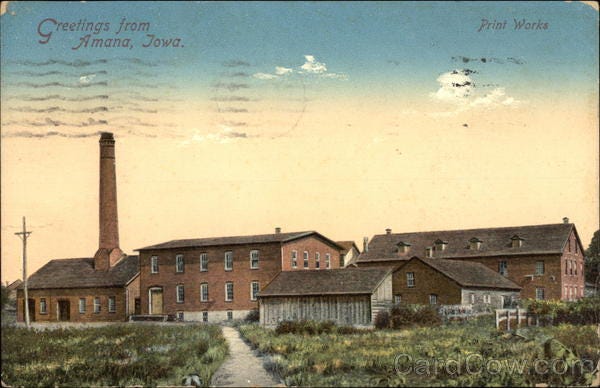
Also in 1861, they built the Amana Calico Mill and a wool mill which supported the community. At its peak the calico mill produced up to 4,500 yards of dyed calico per day. The print factory obtained white cotton fabric from the south. The white muslin was acid-proofed and dyed in indigo vats that were one-story high. The factory expanded to eight buildings, each one housing a different department: washing, drying, dyeing, printing, trimming, inspecting, packing, and shipping.
Calico fabrics sold for about six cents a yard at the turn of the century. Goods were sold in the Amana General Stores. Salesman also traveled around, carrying sample books with a variety of designs and colors, getting orders from outlaying retail establishments.
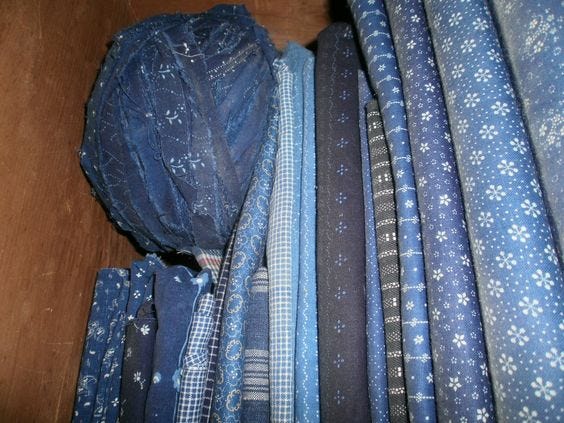
These fabrics were most often used for clothing. Small scraps found themselves stitched into quilt pieces. Larger remnants and work out clothing were ripped into strips and wound into rag balls to be used in woven rag rugs.
The Amana colonists obtained their indigo dyes from I.G. Farer Company in Germany. With the advent of World War I and the British naval blockade, the mill was unable to obtain the dyes necessary for their specialized prints. The factory closed down, never to create its blue dyed calicos again.
Two buildings from the old calico mill still remain. They now house the Amana Furniture Shop. Meanwhile in attics, small stashes of indigo rag balls are discovered, many making their way to antique stores. Three of these now reside in a new home in Texas — a remnant of the past — although it was technology that shared the history that lay behind these three fabric spheres.