
Am I Too Old For A Coming-of-Age Ceremony?
How can we re-engineer ritual and ceremony back into secular western society?
I’ve been thinking a lot about Jordan Peterson lately — and the astonishing way in which young men (and yes, let’s be honest, young white men) from across the Anglophone western world seem to be latching onto him. In the past I’ve written some fairly disparaging things about the man — less about his inflammatory political incorrectness and more about his frustratingly fuzzy logic — but I nonetheless agree with the many pundits who have argued that, fuzzy or not, the man is clearly tapping into something.
Here’s my take. I think Peterson is correct when he argues that we in the secular west have lost something very important. I can only speak for myself, of course, but as a white North American male raised in a secular home with a notable absence of extended family in my entourage (both my parents moved far away from their birthplaces), I am precisely the demographic that has flocked to Professor Pete: those who feel culturally rudderless and denuded of true community. People like me don’t have a culture — unless you count middle-class North American consumer culture.
Of course when you dive deep into the waters that the Peterson Party Boat stands afloat in, there’s more than a modicum of privileged white male whining and entitlement in the mix. There’s really never been a bad time in modern history to be a white man, and the early 21st century is absolutely no exception to this. But if salary and economic prosperity alone ensured happiness and vitality, then Bubble Economy-era Tokyo in the late 1980s would have been the happiest place on earth (it wasn’t), and my oil-rich home province of Alberta would be a deliriously happy place — at least until the 2014 oil crash (it isn’t now and it never was).
Everywhere you turn you hear stories about how men in the western world are psychologically falling apart. In Canada, the suicide rate is three times higher for men than it is for women, a situation many experts now describe as “epidemic”. At age 41 I am now smack-dab in the single most at-risk demographic in the country for suicide, namely men aged 40 to 59, not to mention living in Canada’s western prairie region, home to the country’s highest suicide rates south of the 60th parallel. On an individual level, I feel it. My late thirties brought about the absolute worst clinical depression I have ever faced, and while I’ve had more tools to deal with it as an adult living in the 2010s than I did as a teenager in the 1990s, it still feels like a mere containment strategy.
That said, I’m not going to chime in on the increasingly tired cliché of “masculinity in crisis”. Yes, we guys are a disaster, but it’s not “masculinity” that’s in crisis. If anything, masculinity, or rather our outdated ideas of what that term represents, is aggravating the problem, causing men to opt for suicide rather than therapy, hard liquor and Fentanyl instead of mindfulness meditation, and President Trump instead of any of the more reasonable presidential candidates on offer in 2016. Google the term “crisis of masculinity” and you’ll get a tsunami of panicked, usually right-leaning polemics about how men are being feminized and so on, how feminism has gone too far, and other frankensteined formulas for a return to true masculinity based on Freud, Jung, the Bible, and other questionable sources.
But there is a real crisis affecting both men and women in our society (I’m focusing on men here because I happen to be one), and it’s a problem that Jordan Peterson is one of the few public figures is actually talking about. Ours is a cultural crisis, namely that we inhabit a cultural landscape that is increasingly stripped of meaningful life markers. Of course many rites of passage endure to this day in the modern world — Bar/Bat Mitzvahs, Quinceañeras, Seijin-no-hi to name but a few, and some might argue that we just need to re-embrace the ones we have.
But that’s not going to work, because our world bears very little resemblance to the world that gave rise to these traditional rites. For one, so many of us, especially in the western world, are culturally heterogeneous and increasingly so far removed from the cultural traditions of our ancestors that to re-incorporate such rituals would seem tantamount to cultural appropriation — fake tradition. Secondly, we live on average much longer than we did when these traditions were established, hence why few if any ancient cultures would have developed rituals for people older than 30. Thirdly, our families are much smaller than they once were, and a growing number of adults (this author included) do not have children of their own. And lastly, statistically fewer and fewer of us are religious, making much of our cultural arcana feel unsuited or even distasteful or dishonest in our modern-day context.
This is where I differ from the likes of Peterson. There are no easy answers to be found in our ancient myths. Sure, they may give us some good models for behaviour here and there (as well as a lot of really terrible ones) but it seems to me that we need new cultural artefacts that are capable of inspiring us in the here and now. Much has been said and written about “cultural appropriation” in recent years, but in a sense any insertion of an old tradition like a Bar Mitzvah or a Quinceañera is cultural appropriation of a sort — or perhaps “epochal” appropriation inasmuch as it’s a separation in historical epoch rather than of cultural lineage that is being overstepped. We’re not the same people as we were when we developed these rites. It only makes sense that we develop new ones.
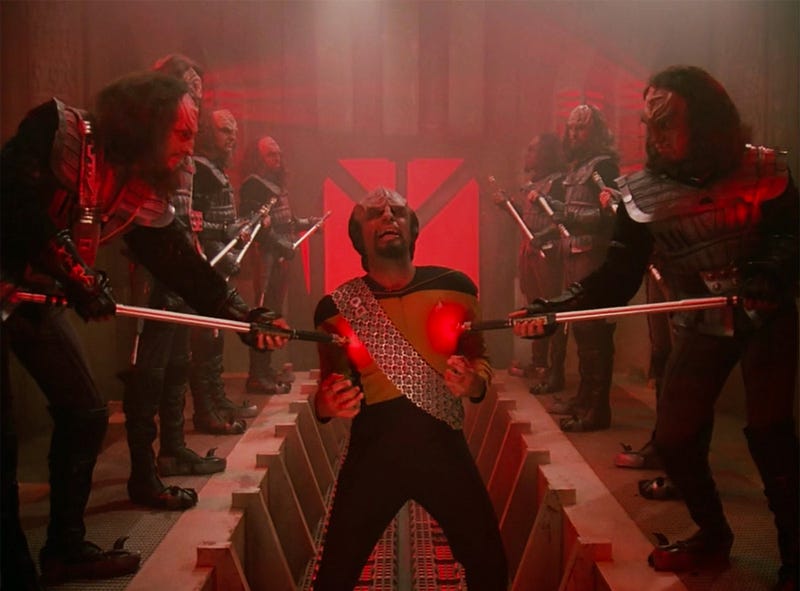
This is where my essay starts to run dry. I don’t know how to do that. Does one crowdsourse a ceremony? Does one outsource it to an unusually creative event planning firm — possibly with the help of a philosopher, a folklorist, and a science fiction author? What would Neil Gaiman or Ursula K. LeGuin dream up for a 21st century rite of passage? Would it look like the Klingon Second Rite of Ascension (as depicted in the Star Trek TNG episode “The Icarus Factor”) in which Lieutenant Worf channels his inner warrior while being tormented by a gauntlet of pain stick-wielding fellow Klingons? In a sense I do the same thing to myself every time I subject myself to a long distance run — embracing pain as a form of passage. But being but one runner in a massive marathon crowd, it doesn’t feel quite the same.
In a fascinating and inspiring 2017 TEDx lecture, tech CEO and father of three Ron Fritz tells the story of how he and his family created entirely new “coming of age” rituals for their own children, involving all the traditional components: involvement of extended family and friends, a physical endurance component, a learning-from-an-elder component, and solitary contemplation. I felt immediately jealous, as I’ve neither had anything like that in my own life, nor have I had the opportunity to create it for anybody else. To my mind, this is one of the great blind spots in our modern world. If we’re lucky we get some memorable birthday parties, a fun high school graduation, and a wedding that doesn’t completely suck — all of which tend to adhere to societally (and commercially) sanctioned cultural norms. And after that we’re on our own.
This year I turn 42. According to Douglas Adams, author of the Hitchhiker’s Guide to the Galaxy and the other books in that series, the number 42 is the answer to life, the universe, and everything. Why not make that our culture’s new age threshold for a middle-aged rite of passage? Suffice it to say I’m not going to plan one for myself — that would be ridiculous — but I would be more than happy to help somebody else plan theirs.
We have every reason to be happy and celebratory moving into our forties and fifties. We live longer and healthier lives than any of our ancestors could have dreamed of, and have access to opportunities and information previously unimaginable. Is there some unspoken rule to the universe that we have to jettison life-anchoring spiritually energized traditions in exchange for humdrum suburban drudgery as part of that bargain? I can’t imagine why that would be. Let’s not go back to the past à la Peterson and his beloved ancient myths. Sure, we can look to them as potential templates for new traditions, but surely we can be creative in how we live and celebrate our lives.
P.S. If any readers have experimented with “new traditions” of this sort, I would love to hear about it.


