
Am I Too Competitive Because I’m Asian?
I’ve always wondered whether it was because of my genetics or cultural upbringing
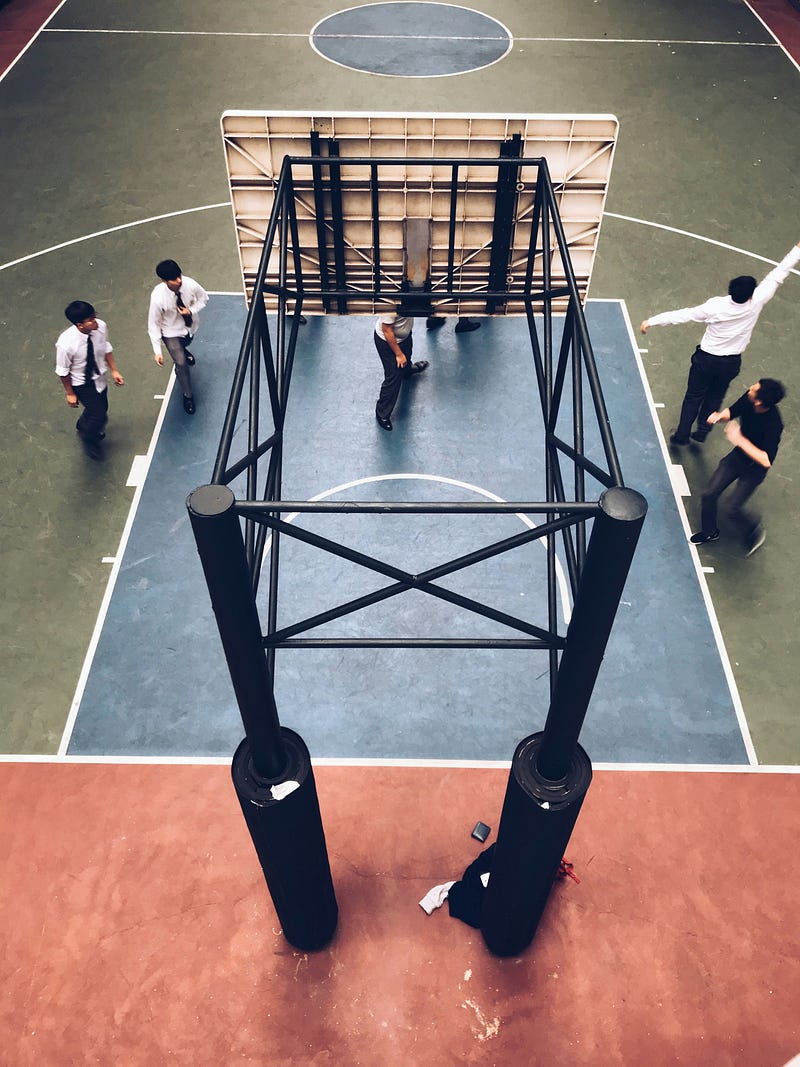
In BEEF, a show that illuminates Asian American repressed anger and rage, a group of Korean church members play a pickup basketball game. There is one team of church members who are new and outcasts in the Asian community, per se. Their ulterior motive is to swindle the church to profit the protagonist’s ailing construction business.
But there is also the super devout, holier-than-thou group, some of whom see themselves as better and superior to the new group at the church. This group has members and leaders of the worship team and are seen as the “stars” of the church. When the new group challenges them to a pickup basketball game in conversation, the leader says their team is “really good” and suggests that they shouldn’t challenge them because there’s no chance they will win.
The game finally happens, and the new group dominates the holier-than-thou group. The sanctimonious leader starts to show his true colors, kicking a trash can, yelling “fuck!” incessantly in frustration. But it’s not just this church leader — everyone involved (in this predominantly Asian group) seems to take something so trivial so seriously.
On watching, however, I found this scene incredibly relatable.
I am extremely competitive, and so are many of my friends, particularly my Asian male friends. Two weeks ago, I was running a local 5k. I wasn’t having the best race. I went out somewhat fast in windy conditions, and I was hurting and struggling. Other people were speeding up or maintaining the same speed. I was slowing down.
Fortunately, going out too fast and dying in the 5k isn’t nearly as bad as dying in the marathon. I only got passed by three people in the last mile, which was three more than I wanted. At that point, I was just trying to finish the race and get through the finish line.
At around mile 2.8 or 4.5 kilometers, I got passed by someone who, to some degree, I internally saw as a rival. We are very friendly and supportive of each other because we both have busy lives and jobs and try to maintain running with a busy schedule. We like all of each other’s runs on Strava, which is social media for runners and bikers. At the shorter distances like the 5k, 10k, and 5 miler, we match somewhat closely, although he has beaten me the two times we have gone head to head. He has paced those races better and gone out slower, and has just run smarter overall. He was a better runner on those particular days.
There is only one reason I internally think of this guy as a rival: he is the only other Asian guy at local races who runs as fast as I do, and, on some occasions, runs faster than I do.
I often finish small, local races, even ones where I do horribly, as the top Asian finisher. That doesn’t mean anything to me, as I would rather be the top finisher as a whole and run a personal best. If I had a terrible race and was still the top Asian finisher, I still feel terrible. However, I do notice when I’m not the top Asian finisher, and although I will give slightly more encouragement and support to my fellow Asian finishers, I simultaneously do see these runners as more rivals than other runners as well.
This is not to say I don’t try to beat the predominantly White runners I run against too — that’s just part of the game. I do try to beat myself the most, as a big part of running is running your own race and not letting what other people do lead you astray and dictate your tactics. I wanted to be the best to maximize my own potential and success at something I cared deeply about.
That being said, I did smirk and feel a particular sense of pride when I won a local 12 mile race, unexpectedly. It was the time for the awards ceremony, and they asked for the top finishers to come up. I went up, and the person I was sitting with said she overheard a spectator say “who won? That short Asian guy?” It was clearly a surprise to the hundreds of people watching, so yes, I did enjoy disproving a lot of people’s expectations, even if I was not trying to.
But growing up, I also did not see any fast Asian runners who dominated the sport. I saw some fast Asian sprinters, but usually not a lot of fast Asian distance runners. Yes, this did feed into the stereotype of Asians as unathletic. And I did wonder whether we had some sort of genetic disadvantage when it came to distance running compared to other races. I was shorter than most of my peers and competitors, so part of that made sense.
The whole genetic disadvantage hypothesis was completely disproven when I visited Japan and started to notice the incredible success of Japanese marathoners. In Japan, running culture and tradition is different, particularly in the marathon. No, the best Japanese runners have not met the same success as the best Kenyans and Ethiopians, but they are a close third.
There are ingredients for the success of Japanese runners. First, people care a lot about running in Japan. Road running is the second most popular sport in Japan outside of baseball. It is often said in the running community that America is not more dominant in track and field because its best athletes flock to more popular sports. The obvious ones include football and basketball, but I saw this on a micro level in high school, where distance running was just a refuge and second chance for many who didn’t make or were cut from the soccer team.
As it went beyond just doing seventh-grade cross country, running manifested itself into something more serious. I wanted to run a personal best in every race. I have, at times, particularly in high school and college, tied an unhealthy amount of my self-worth to this competitiveness of wanting to be the absolute best every time I stepped on the line, being better than every time I ran last time. This would often make me run worse. I wouldn’t account for a very hot or very windy day where I needed to revise my tactics to account for the conditions on the ground. I wouldn’t be responsive to my body and how it felt when I went too fast, too soon, and overexerted myself in a long race.
I have embraced a healthier approach of taking running less seriously, but also using smarter and more balanced tactics that thread the needle between being very responsive to how I feel on a given day but also hitting target times and paces. I back off on days I’m not feeling the best. I stop workouts when they’re really not going well instead of gutting them out. I stop making big surges in the middle of races. These trends have been a very big deal for me as someone who spent a huge part of my early running career going all out, balls to the wall, and maxing myself out on every run.
But there’s a part of me that wonders whether I’ve only embraced this healthier and more balanced approach to running because it’s gotten me what I want: running faster. Running is a very interesting sport where the harder you work does not always correspond to the better you perform, unlike it might in other sports. You cannot run for three hours a day like you can practice soccer, basketball, and football three hours a day.
There are times when my new attitude towards running doesn’t lead to personal records and fast times, and I still run poorly, and I do doubt whether I’m doing this right. I know, logically and intellectually, that I should run because I enjoy doing it and discard the need to run fast times every single time, but the emotional, innate part of me struggles with that, and it always will struggle — not just with running, but everything I do.
This competitiveness and hyperfocus on results don’t only manifest itself in running, but in everything I do. It comes in my current job in special education, where I want to be the best. Yes, I compare myself to others in the same position, even though I know it is wrong. It comes as a law student, where I am not satisfied with an A-. It comes in playing video games with family and friends and in simple pickup basketball games. There’s just a part of me that feels like everything is a competition, and that has contributed to massive accomplishments, but also major disappointments when I fall short.
There is often a belief in Asian culture that if you’re not the best at something, it’s not worth doing. Happiness and enjoyment are paired with success, a notion documented in Amy Chua’s popular book, Battle Hymn of the Tiger Mother. In the book and a corresponding Wall Street Journal article of an excerpt from the book, Why Chinese Mothers Are Superior, Chua documents a story of forcing her seven-year-old daughter to master a complicated piano piece.
The daughter said she couldn’t do it after multiple attempts, ripped up the music score, and then Chua taped it back together, took away her daughter’s dollhouse and threatened to take it to the Salvation Army. She threatened her daughter with no lunch, dinner, and Christmas presents. She accused her daughter of being cowardly and just being afraid she couldn’t do it. Her husband pulled her aside and hinted that she was really overdoing it, but they worked well into the night trying to get her daughter to master the score. She wouldn’t let her daughter eat or use the bathroom.
Eventually, however, the daughter succeeded and did it. She performed it very well at a recital several weeks later. The daughter came to her mother that night and hugged her in gratitude.
This anecdote seems, to many, like child abuse. I heard about the article from my middle school history teacher when it came out in 2011. I was not surprised at all, as I had heard similar stories from friends to a lesser extent. My parents often had similar expectations, but they worked too much to really have the time or energy to spend all day trying to teach me piano, nor could we afford a real piano.
So there’s a reasonable assumption that much of this competitiveness is cultural. Educationally, entrance exams in China, Japan, and South Korea all have an end-all-be-all college admissions exam where the only metric for a student to be admitted is their score on one test. There has often been a lot of demand for a finite amount of resources. This results in fierce competition and hierarchy for jobs, and spots in college.
On a personal level, my parents always compared people — me and my brother, their friends’ kids and myself. They often compared academic achievements the most — whether it was who got the highest score on the SAT or who went to the most prestigious college. I used to find this more suffocating than I do now, and now I just realize almost every Asian parent does it.
But I was not raised in China, nor were my also hypercompetitive Asian friends. I do struggle, personally, with attributing my extreme competitiveness simply to my upbringing. Yes, not accepting anything less than 100%, and the best from myself is maybe 20 to 30% of why I am the way I am.
However, I have always been this way, even from a very young age. For me, this competitiveness has, it seemed, always been innate. For the most part, it’s just who I was, and there was a part of me that always felt a bit inadequate when I wasn’t one of the best performers in my academics, athletics, career, or other endeavors.
Of course, it’s easy to see where this becomes healthy. You can’t be the best in everything. For me, at least, it’s such a hard mindset to shake, even at 27 years old. I might outwardly exude humility and try to talk myself out of this hypercompetitiveness. And it’s not that the hypercompetitiveness isn’t there, but I’ve found the values that are more important and mean a lot more: friendship, integrity, relationships. These values override my hypercompetitiveness, and even professional athletes, at the end of the day, say kind words and show great sportsmanship when the game is over. However, I would be lying if I said I still did not feel that innate pressure to want to be the best sometimes.
I always wondered why I and a lot of my Asian peers are so competitive. We have a lot of fun in this competitiveness, and as long as we can remind ourselves that we’re still friends at the end of the day and love each other, it’s okay. Those of us who grew up in America have often learned not to completely discard this competitiveness, but prioritize relationships over winning.
I know some of it is cultural in our upbringings, and some of this competitiveness might be genetic. So yes, a big part of this hypercompetitiveness that I and many of my Asian male friends, in particular, is because we’re Asian. It could also be because we’re men, but it’s likely a totality of the factors rather than just one or two that made us the way we are.
I am working on being happy no matter what, as long as I try and do my best.
But it’s not easy. I want to see the result and I want to win. I want to hit my goals and be better than I was yesterday. It’s not easy for me, but I’m getting closer and closer to focusing more on my effort rather than the results I achieve.
I think that edge will always be a part of me. And it’s not always a bad thing, but I have learned and become well aware that winning is not everything.


