
Am I Striving To Be A Racist?
Making Sense of Racism One Word At A Time
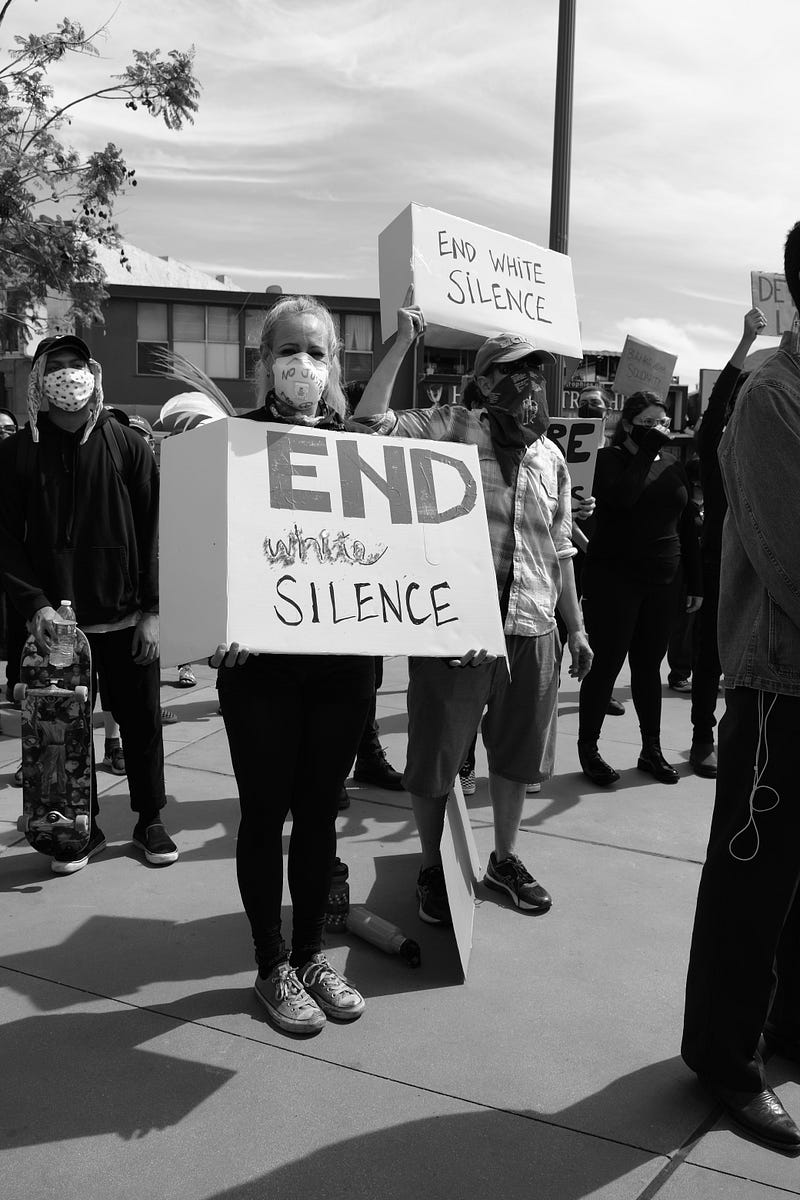
I’m in adrenaline hell after deciding on the title for this article.
It’s like I’ve shot myself with my EpiPen twenty times in the past ten seconds. I honestly feel like I might explode there is so much anxiety coursing through me.
But I won’t change the title, because, at this moment in time, it may be true. I may be striving to be a racist.
Pause. Deep breath. I’m a good person. Kind. Thoughtful. Care about people.
And yet. Striving. Racist. Me.
Is it possible? Is it true?
Defining Terms Anchors Us
“If we don’t do the basic work of defining the kind of people we want to be in language that is stable and consistent, we can’t work toward stable, consistent goals”
— Ibram X. Kendi, HOW TO BE AN ANTI-RACIST
I started reading Kendi’s book to learn about racism and my place in it, but almost immediately, I found something more: a truth that has guided me throughout my life but which I hadn’t considered when trying to understand my role as a white woman in the struggle to change the way our society behaves toward non-white people. That truth is that in order to begin to describe the world that we are in and our place in it, we first need to define the language we use.
It’s so profound and so obvious.
The value in having words to convey our thoughts, beliefs, actions, etc. is to share understanding. It is how we communicate. But if the words we use do not have a stable and consistent meaning, then we end up misunderstanding each other.
The word racist, for example, has not been clearly defined in our greater cultural discourse. If people like Richard Spencer and David Duke, who affiliate with the White Supremacist movement, can say, publicly, that they are not racist and somebody like Kendi can say that sometimes he is or has been a racist (which he states directly in the intro to his book,) then there is a disconnect, which makes for miscommunication. How can we begin to eradicate racism if we can’t agree on what it means to be a racist?
What We Mean When We Talk About Race
Kendi offers up definitions so that the reader can understand what he has to teach about racism in this book, as well as to build a greater understanding, beyond the confines of this book, of what we mean when we talk about racism.
I found it really interesting that he limits what words he believes worthy of the upcoming discussion. He talks about how terms like “institutional racism” and “structural racism” and “systemic racism” are vaguer terms than “racist policy,” which says exactly what the problem is and where the problem lies. “Racism itself is institutional, structural, and systemic,” he says. Therefore, he implies, those adjectival terms that qualify the word racism are redundant.
He also says that the term “‘racist policy’ cuts to the core of racism better than ‘racial discrimination,’ another common phrase.” This is because when somebody discriminates, they are carrying out a policy or taking advantage of a lack of protective policy. Since we all have the power to discriminate and only a few have the power to make policy, focusing on the idea of racial discrimination “takes our eyes off the central agents of racism: racist policy and racist policymakers, or what I (Kendi) call racist power.”
A Few Useful Definitions
Racism: a marriage of racist policies and racist ideas that produces and normalizes racial inequities; a powerful collection of racist policies that lead to racial inequity and are substantiated by racist ideas. (opposite: antiracism)
Racial inequity: when two or more racial groups are not standing on approximately equal footing. (opposite: antiracial inequity)
Racist policy: any measure that produces or sustains racial inequity between racial groups. (opposite: antiracist policy)
(Kendi qualifies that when he speaks of policy, he means written and unwritten laws, rules, procedures, processes, regulations and guidelines that govern people.)
Racist idea: any idea that suggests one racial group is inferior or superior to another racial group in any way. (opposite: antiracist idea)
Racist: someone who supports a racist policy by their actions or inaction or by expressing a racist idea (opposite: antiracist)
Striving to Be a Racist or an Antiracist?
It is that last definition that stings, when I think about it. A racist, according to the definition, is not just somebody who supports a racist policy by their actions or expression of racist ideas; a racist is also somebody who supports a racist policy by their inaction.
Ding, ding, ding, ding.
That is the sound of the bells going off in my mind.
I’m not consciously doing racist things, but by not consciously doing anything substantively antiracist when racist policies are in place, I am still, by definition, behaving in a racist way.
It helps me feel a little less horrified when Kendi says “These are not permanent tattoos. No one becomes a racist or an antiracist. We can only strive to be one or the other. We can unknowingly strive to be a racist. We can knowingly strive to be an antiracist.”
So I may be striving to be a racist through my inaction, but that means there is hope for me if I pay attention and find ways to actively fight against racist policies. Then I will be striving to be an antiracist, which is what I desperately want to do.
Kendi describes this striving to be based on what we do, what we don’t do, what we support, or what we express in each moment. “Like fighting an addiction,” he says, “being an antiracist requires persistent self-awareness, constant self-criticism, and regular self-examination.”
On the Road to Better
I have a lot to learn. I knew that, but it’s been made clearer after only reading the introduction and chapter one of HOW TO BE AN ANTI-RACIST.
There is no question that just being a good person who doesn’t discriminate directly is not enough if I really want to be part of the change, if I really want to strive toward antiracism as a personal and cultural norm.
That is the journey that I am on. This choice to be an antiracist requires, according to Kendi, “a radical reorientation of our consciousness.”
It may take time, but I can feel myself reorienting with every word I read, every idea I process.
Come along with me if you’d like. I would love to be able to discuss these ideas with others who are trying to follow a similar path. And in the meantime, feel your outrage, take care of yourself and take care of others.
(Note to reader: This is the second article in a series about striving to become an antiracist. The first article can be found here.)


