
Infection | Brain
Rethinking the Cause of Alzheimer’s Disease: Are Brain Infections The Culprit?
Will antimicrobials be the future treatment for Alzheimer’s?

Classic AD Etiology: Amyloid Cascade
Alzheimer’s Disease (AD) is the most common type of neurodegenerative disease. Its prevalence can only increase as the aging population continues to increase too, owing to improving healthcare.
For many decades, the infamous etiology for Alzheimer’s disease (AD) is the “amyloid cascade hypothesis” wherein misfolded amyloid-beta peptides accumulate in the brain. This forms amyloid plaque that disrupt the functions of neurons and trigger chronic neuroinflammation — leading to AD.
Today, treatments and interventions based on the “amyloid cascade hypothesis” have been disappointing. None of the drugs targetting amyloid-beta peptides passed clinical trials with optimistic results to date.
This is not because the hypothesis is false, but rather it is unclear what initiated the formation of amyloid-beta peptides in AD, to begin with.
Alzheimer’s Disease (AD) is the most common type of neurodegenerative disease. Its prevalence can only increase as the aging population continues to increase too, owing to improving healthcare.
Novel AD Etiology I: Microbial Infection
In an international symposium held in San Francisco in 2017, renowned speakers conveyed their research supporting the causal roles of microbes in the development of AD:
- Professor Ruth Itzhaki on herpes simplex virus type 1 (HSV-1) and AD
- Dr Judith Miklossy on spirochetes (Treponema pallidum) and AD
- Professor Brian Balin on Chlamydia pneumoniae and AD
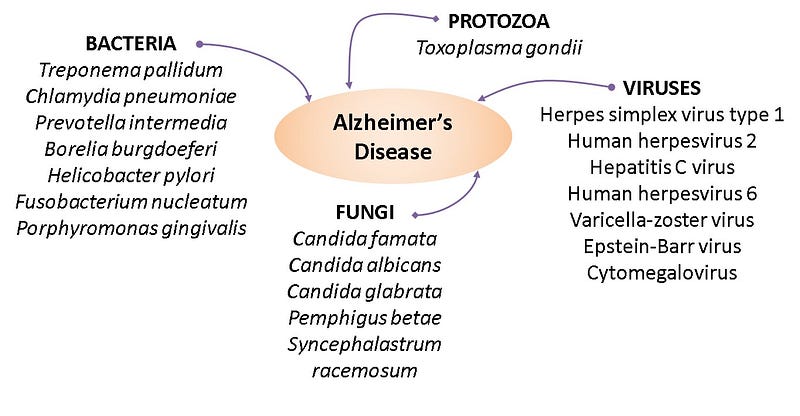
These three microbes have been extensively researched and, thus, are the main highlights being showcased in the symposium. These pathogenic microbes can induce neuropathological hallmarks of AD — such as amyloid plaques and tangles — in animal models via a variety of mechanisms, such as blood-brain barrier penetration and neuroinflammation induction. In observational cohort studies, individuals infected with these microbes faced a higher risk of AD compared to those uninfected.
Many other microbes have also been associated with an increased risk of AD, but with comparably less research being done on them. This list of AD-related microbes is illustrated herein:
Novel AD Etiology II: Antimicrobial Protection
Back to basics: What are the functions of amyloid-beta peptides?
Aside from hindering routine neuronal activities, it also serves as an antimicrobial peptide! That surprised many scholars. It was later discovered that amyloid-beta peptides form and accumulate over the years as a result of persistent or continuous microbial infections in the brain.
Antimicrobial peptides are the first line of defense against microbial infections. Common types include defensins, cathelicidin, and lactoferrin, which are secreted by innate immune cells.
No wonder AD is an age-related disease. With age, our immune system gets weaker and our capacity to defend against microbial infection weakens too. No wonder herpes simplex virus type 1 (HSV-1) has been recognized as a highly likely etiological agent in AD as HSV-1 is included in the antimicrobial spectrum of amyloid-beta peptides.
AD Etiology Refined
By looking at AD from a different biochemical perspective, that is with the involvement of antimicrobial peptides, existing theories are synthesized coherently.
Unbeknownst to us, our immune system deploys antimicrobial peptides in response to the constant, never-ending battle with pathogenic microbes. Alzheimerism may be an unfortunate casualty of this if the antimicrobial peptides — microbes crossfire takes place in the brain.
Now, can antimicrobial treatments prevent the formation of amyloid-beta plaques and, thus, prevent or treat AD? Current data suggests yes.
For instance, a Taiwan nationwide study found that individuals prescribed with anti-herpetic medications had a 90% lower risk of AD development compared to those without this medication. Furthermore, a clinical trial is currently assessing the efficacy of valacyclovir (an antiherpetic drug) in preventing the development of AD (ClinicalTrials.gov ID: NCT03282916).
A pilot study in 2019 administered lactoferrin, an antimicrobial peptide, to AD patients. Treatment outcomes were remarkable with the AD patients showing improved cognitive functioning and decreased blood levels of amyloid-beta peptides and other oxidative and inflammatory biomarkers.
“Research data on a microbial cause of AD have been ignored or dismissed for three decades, very unfortunately for those who developed AD during that period and who therefore had no chance of benefitting from the information,” Ruth Itzhaki, Professor Emeritus of Molecular Neurobiology, lamented back in 2018.
Even though Prof. Itzhaki’s applications for funding to conduct AD clinical trials based on antivirals have been denied many times, this research field is finally moving forward. “Now is the time to rectify the situation by determining and then using the best means of treatment at hand,” Prof. Itzhaki added. Indeed, interventions based on a firmly-grounded etiological basis should work.


